Calcium Carbonate in Paint, Paper and Construction: What to Specify
What calcium carbonate does in paints, paper and construction products, how particle size, whiteness, oil absorption, coating and moisture decide the grade, and what to put in the RFQ.

Calcium carbonate earns its place in paint, paper and construction products by doing three jobs cheaply: it adds white bulk, it extends costlier ingredients such as titanium dioxide, fibre and binder, and it adjusts how a wet mix flows and a dry surface looks. The grade you should buy depends on which job matters most in your product. The lines that decide it are particle size and top cut, whiteness, oil absorption, surface treatment, moisture and packing, not the product name.
This guide covers what the filler contributes in each sector, how to read the main specification lines, when ground (GCC) or precipitated (PCC) material fits, and what to write in an enquiry. It gives no numeric benchmarks, because acceptable values depend on your formulation and process. Your formulator sets the numbers, and the supplier's certificate of analysis and technical data sheet confirm them. For how the two types are made, see our guide to ground versus precipitated calcium carbonate.
What the filler actually contributes
Answer first: in all three sectors the filler is part of the formulation, not an inert diluent. Change the grade and you change the product.
- Bulk and volume. In paper it replaces part of the fibre. In paint and construction mixes it replaces part of the costlier binder or pigment.
- Opacity extension and brightness. In paint and paper the filler helps the white pigment work and lifts overall brightness. It does not hide on its own the way titanium dioxide does.
- Rheology. How a paste, slurry or mortar flows, sags or thickens depends on the particle size, shape and surface area of the filler.
- Filler loading. Raising the loading lowers cost only while the product still meets its performance requirements. Overloading is a false economy.
Paints and coatings
Answer first: in paint, calcium carbonate is mainly an extender. It lowers formulation cost, supports the opacity of the white pigment and sets part of the gloss and flow behaviour.
Opacity. Calcium carbonate has a refractive index close to that of the binder around it, so alone it scatters little light and hides poorly. Its value is indirect. Well-dispersed fine particles can keep titanium dioxide particles apart so they scatter more efficiently, and the filler occupies volume that costlier ingredients would otherwise fill. A well-designed formulation gets acceptable hiding at lower cost. A badly designed one simply loses opacity.
Gloss and matting. Particle size and top cut control the dry film surface. Coarse particles at the surface scatter light and give a matt finish, which suits flat emulsion paint. The same coarse tail in a gloss coating ruins the finish. This is why paint buyers watch the top cut, not just the average size.
Practical guidance for formulators:
- Interior flat emulsions generally tolerate coarser, lower-cost grades. Higher gloss and premium whites usually need finer, tightly controlled grades, and sometimes precipitated material.
- Trial in your own formulation, because dispersion in your resin system cannot be read from a data sheet.
Paper
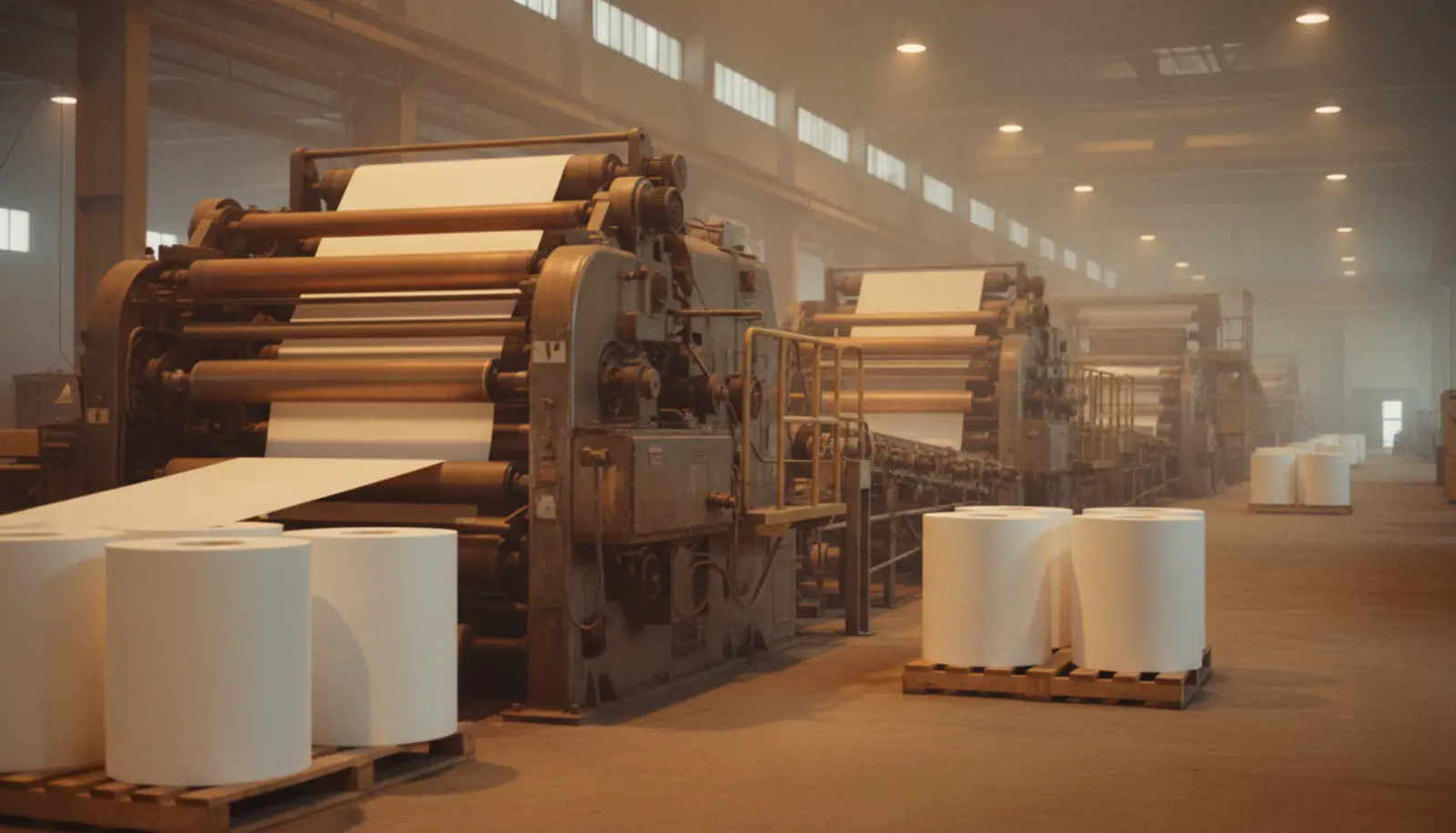
Answer first: in paper, calcium carbonate is used both inside the sheet as a filler and on the surface as a coating pigment. In both roles it raises brightness and opacity and replaces fibre. Grade choice follows particle size distribution, brightness and how the material reaches the mill.
Filling. Filler is added to the fibre suspension before the sheet forms. It lifts brightness and opacity, improves smoothness and print quality, and can cut fibre use. Filler particles do not bond like fibres, so too much weakens the sheet and adds dust in converting. The mill balances filler content against strength.
Coating. Coated papers carry a thin layer of pigment and binder. Fine, narrowly graded calcium carbonate is a major coating pigment where gloss, smoothness and printability matter. Particle size distribution and shape strongly affect coating gloss, and oversize particles can show as defects.
Process compatibility. Calcium carbonate dissolves in acid, so it suits neutral or alkaline papermaking, not acidic systems. A mill that changes its process chemistry must confirm compatibility first.
Dry powder or slurry. Large mills often take slurry, or have precipitated material made on site, and those supply chains are specialised. Importers of dry powder usually serve smaller mills, converters and coating operations. If you need slurry, say so in the enquiry, because the logistics and specification differ.
GCC or PCC. PCC can be made in controlled crystal shapes with a narrow size range, which is why it is chosen when bulk, opacity or brightness must be pushed. GCC is the usual economical choice for general filling and many coating roles. Ask the mill's technical team what it has already qualified.
Construction materials
Answer first: in construction products calcium carbonate is a filler, workability aid and finish improver. It rarely carries structural load, but it changes how a product mixes, spreads and sets, so consistency matters more than headline quality.
Cement-based products. Mortars, tile adhesives, renders, self-levelling compounds and repair mixes often contain fine mineral fillers alongside cement. Ground calcium carbonate fills gaps between larger particles, improves workability and surface finish, and can reduce the costlier binder needed. Small shifts in grading alter water demand, so batch-to-batch consistency is the main concern. Moisture matters too, because a damp filler can begin to react with cement in a dry-mix bag.
Adhesives and sealants. Non-cementitious adhesives and sealants use calcium carbonate to build body, control sag and cut cost. Surface-treated grades are common because the coating helps the filler disperse into the resin, lowers viscosity at a given loading and can improve water resistance. Fine precipitated grades are often chosen for sealants where flow control and smooth extrusion matter.
Plasterboard-type products and jointing. Gypsum boards and the compounds used on them are built mainly on gypsum. Calcium carbonate appears as a filler in many jointing compounds and finishing plasters, adjusting workability, sanding behaviour and finish. Whether it is used in the board itself depends on the manufacturer's formulation, so ask the technical team before assuming.
What construction buyers should look for:
- A consistent particle size distribution from shipment to shipment.
- Controlled moisture, with packaging that protects it.
- A bulk density that suits your feeders, silos and mixers.
- No oversize or contamination that would show in a finish coat.
Particle size and top cut
Answer first: the median size tells you how fine the material is, and the top cut tells you how coarse the worst particles are. Buy on both.
Particle size is a distribution, not a single number. Two values are normally quoted:
- Median size (often written D50). Half the particles by volume are finer than this value.
- Top cut (often D97, D98 or D99 depending on the supplier). The size below which nearly all particles fall. It describes the coarse tail.
Why both matter:
- A fine median with a loose top cut can still contain coarse particles that cause defects in a gloss coat, coated paper or sealant bead.
- Two products with the same median can behave differently because their distributions differ in width.
- Suppliers report different percentiles. Do not compare a D97 on one certificate with a D98 on another.
Ask how size was measured. Laser diffraction and sedimentation give different results for the same powder, so name the method. Residue on sieve is a different test again, and some construction buyers prefer it as a simple oversize check.
Particle size also drives specific surface area, and so oil absorption, binder demand and viscosity. Finer is not automatically better: a finer grade costs more, takes more binder and can thicken a system beyond what the process tolerates.
Whiteness and brightness
Answer first: whiteness and brightness are measured on a particular scale with a particular instrument, so a figure means something only when you know the method.
- Brightness is reflectance of light in a defined band, and is the common measure in paper work.
- Whiteness and colour coordinates describe how white and how neutral a material looks. A slight yellow tint can matter even when brightness looks acceptable.
- Sample preparation changes the reading. A pressed tablet, a loose powder and a slurry give different values.
Decision rules:
- Specify the scale and method, and say whether you need a minimum, a range or a target with tolerance.
- Pay for high whiteness only where it shows. A filler inside a dark or heavily pigmented product gains little from it.
- Whiteness of natural material depends on the deposit, so a change of raw material source can shift colour between lots. If colour consistency matters, ask how the supplier controls the mill feed.
- Read whiteness alongside particle size. Iron-bearing and other mineral impurities lower whiteness.
Oil absorption
Answer first: oil absorption shows how much liquid the powder needs to be wetted into a paste, and it predicts binder demand, viscosity and cost.
Oil absorption is a laboratory test in which a liquid, commonly an oil, is worked into a weighed sample until a defined paste forms. A higher value means the powder holds more liquid, because it has more surface area or a more structured particle. In practice:
- A higher value raises viscosity and binder demand in paint, sealants and adhesives, which can cap the loading you can reach.
- A lower value usually allows more filler for the same flow, which can cut cost if other properties hold.
- The method and the liquid vary, so a number from one method does not transfer to another. Name the method.
Oil absorption matters most in paints, sealants and adhesives. In dry construction mixes the related concern is water demand.
Ground or precipitated, by use
Answer first: choose GCC when cost and general filling are the aim, and PCC when you need a finer, more uniform particle, a controlled shape or the highest brightness. Decide on needed properties and trial results, not habit.
| Use | GCC tends to suit | PCC tends to suit |
|---|---|---|
| Flat paint, textured and masonry coatings | General extension, cost control, matt finish | Rarely needed |
| Premium or high-opacity paint | Fine, narrow-cut grades where cost matters | Where fineness, opacity support and brightness are required |
| Paper filling | General filling where cost drives the choice | High-bulk or high-opacity needs, where the mill specifies it |
| Paper coating | Fine ground grades in many coating roles | Where a specific shape and narrow distribution are needed |
| Mortar, tile adhesive, render, jointing compound | The normal choice | Seldom justified on cost |
| Sealants and some adhesives | Treated GCC for general-purpose products | Fine treated PCC for flow control and extrusion |
Treat the table as a starting point, since a fine, well-classified GCC can outperform a poorly made PCC in some roles. The masterbatch filler guide covers the plastics side of the same material.
Coated or uncoated
Answer first: coating is a surface treatment, usually fatty acid based, that makes the powder water-repellent and easier to disperse in organic systems. Buy coated for oily, non-polar systems and uncoated where water is the carrier.
- Uncoated material is hydrophilic. It disperses well in water-based systems such as emulsion paints, paper slurries and cementitious mixes.
- Coated material is hydrophobic. It disperses better in solvent-based paints, sealants, adhesives and polymers, picks up less moisture and often lowers viscosity at a given loading.
- A coated grade in a water-based system can wet poorly, foam or float on the surface. Do not substitute without a trial.
- State coated or uncoated in the RFQ. A coated grade shipped against an uncoated order is a common cause of rejected lots.
Moisture and bulk density
Moisture affects flow, caking, packing and shelf life, and it can damage the product it goes into. In cement-containing dry mixes a damp filler can react in the bag. In sealants and polymer systems, water can cause bubbles or side reactions. In every case it also shifts the effective weight you pay for.
- Specify a maximum moisture content, the test method and where it is measured (at the mill, at loading or on arrival).
- Ask how the product is packed. Coated grades pick up less moisture than uncoated, but neither is immune once a bag is damaged.
- Store dry, off the floor and away from damp walls, and keep opened bags closed.
Bulk density is how much mass fits in a given volume of loose powder. It is easy to forget and it controls practical things:
- How much product fits in a bag, jumbo bag or container before volume, not weight, becomes the limit.
- How the powder flows from a silo or hopper and how far it compacts in storage.
- How feeders and mixers need calibrating, if they dose by volume.
Say whether you mean loose or tapped density, and treat it as a range to confirm unless your process needs a strict limit.
Packaging and shipping format
Answer first: match the pack to how you will unload, store and feed the material. The cheapest pack per tonne is not always the cheapest pack in your plant.
- Small bags on pallets. Suited to smaller users and manual handling. Easy to store and count, but labour intensive at scale. Look for sound bag material, moisture protection and secure palletising.
- Jumbo bags. Suited to medium and large users with a hoist or forklift and a discharge station. They cut labour and packaging waste. Check lifting loops, liners and discharge spout design.
- Bulk. Delivery in tankers or lined containers, discharged pneumatically into silos. Economical for large steady users, but it needs silos, filters and compatible equipment, and dust control at discharge.
Shipping points:
- Palletised bags in containers need correct stuffing and protection from condensation, since fine powders lose quality when damp.
- Jumbo bags need stable stacking and a decision on liners.
- Label packs so grade, batch and net weight can be traced. In a dispute, the batch number links a complaint to a certificate, and the quality claims and disputes guide explains how to document a claim.
What to specify when buying
Write the specification so a stranger could check it. A good enquiry covers:
- Application and process. Paint (water or solvent based, gloss level), paper (filling or coating, process pH range), construction (product type, wet or dry mix).
- Type. GCC or PCC, and whether marble, limestone or chalk origin matters to you.
- Particle size. Median and top cut, the percentile used and the method.
- Whiteness or brightness. Scale, method and limit.
- Oil absorption. Method and limit, if your application is sensitive to it.
- Surface treatment. Coated or uncoated, and the agent if relevant.
- Moisture. Maximum value and method.
- Bulk density. The range your equipment needs, with the method.
- Oversize. Residue on sieve, if coarse particles hurt you.
- Impurity limits. Any contaminants your process or regulation cares about, by agreement.
- Packaging. Bag type and size, jumbo bag details or bulk, plus labelling and moisture protection.
- Documents. Certificate of analysis per batch, technical data sheet, safety data sheet and any declarations.
- Quantity and delivery. Volume, shipment size, Incoterm and port. Chemineral exports from Sohar and Salalah and quotes Suez and Cape routing side by side.
- Samples. A pre-shipment sample for approval, with a sealed retained sample on both sides.
If you want independent evidence for a batch, Chemineral can arrange SGS or Intertek pre-shipment inspection. Decide beforehand which properties it will test, because testing every line above is more than most buyers need.
Frequently asked questions
Is calcium carbonate an extender or a pigment in paint?
Mainly an extender. It does not hide like titanium dioxide, but it takes up volume, supports the white pigment in a well-designed formulation and sets part of the gloss and flow behaviour. Whether it helps or hurts opacity depends on dispersion, particle size and loading.
Why does the top cut matter more than the average size?
Because defects come from coarse particles. A coarse tail can spoil a gloss finish, scratch a coating blade or leave specks in a smooth sealant. The average hides it, so ask for both values and the method.
Should I choose coated or uncoated calcium carbonate?
Uncoated for water-based systems such as emulsion paints, paper slurries and cementitious mixes, and coated for solvent-based, oily or polymer systems such as many sealants and adhesives. Trial any change, because the wrong choice can disturb wetting, viscosity and foaming.
How should I protect calcium carbonate in storage?
Keep it dry, off the floor and in sound, closed packaging, and use older stock first. Moisture is the main enemy. For fine powders, control dust at discharge and follow the safety data sheet for handling and protective equipment.
What if a delivery does not match the specification?
Record the batch number, take sealed samples and photographs, compare the certificate of analysis with the contract, and notify the supplier in writing within the contractual claim period. The quality claims and disputes guide sets out the steps.
Next step
If you are specifying calcium carbonate for paint, paper or construction products, send the trade desk your application, the properties above, the packing you want and the quantity. See the calcium carbonate product page for the range, and send an RFQ through our contact page. Firm offers are valid for 72 hours.
Our trade desk can turn the views in this report into firm offers on today's indicative prices — valid 72 hours, with complete documentation.
Request a quote