Quality Claims and Disputes in Bulk Chemical Trade: A Buyer's Guide
How quality disputes arise on bulk chemical cargoes and how they are settled: retained samples, quality clauses, notice periods, umpire labs, arbitration versus courts, and evidence to keep.
Most quality disputes in bulk chemical trade are won or lost on three things settled before the cargo sails: what the contract says the quality is, who sampled the cargo and when, and whether a sealed sample exists that both sides accept. The chemistry usually matters less than the paperwork. A buyer with a clear quality clause, a joint sample and prompt written notice has a claim; a buyer with a vague clause, an unsealed sample and a notice sent late may have only an argument.
This guide explains how disputes arise, what a good quality clause contains, how sampling and retained samples work, how umpire laboratories settle technical disagreements, how arbitration and courts differ at a general level, and what evidence to keep. It is general guidance, not legal advice. Time limits, procedures and remedies vary from contract to contract and between legal systems, so nothing below should be read as a standard deadline. Check your own contract and take legal advice before you act on a claim.
How quality disputes arise
A dispute starts when the buyer's result and the seller's result disagree, or when the buyer's result disagrees with the contract. The usual causes are:
- An ambiguous specification. The contract says "minimum 99% purity" without naming a test method, or lists a typical value instead of a guaranteed limit.
- Different test methods or laboratories. Two accredited laboratories can produce different results on the same material, because every test method has a stated precision. A difference inside that precision is not necessarily a fault with the cargo.
- Unrepresentative samples. A sample from the top of a tank, one bag or one end of a stockpile may not reflect the whole parcel.
- Change after loading. Moisture pick-up, caking, contamination in shore tanks or hoses, heat damage, or product settling in transit. Whether this is the seller's problem or the buyer's depends on where risk passed and what the contract says about the point where quality is determined.
- Mixed-up documents. The certificate of analysis relates to a different batch, or the batch numbers on bags do not match the paperwork.
- A falling market. Rejecting the cargo or claiming a discount becomes attractive when prices fall, so expect every weak point in the contract to be tested.
Quantity disputes are a separate matter, handled by weighing, draft survey and shore tank measurement. See our draft survey guide.

The quality clause: where the dispute is really decided
If you improve one thing in your contracts, improve the quality clause. A good one answers these questions in writing:
- What is the specification? A table of parameters with minimum or maximum limits, not "typical" values. Say clearly which values are guaranteed.
- Which test method applies to each parameter, named precisely, including the edition if it matters.
- Where and when is quality determined? At the loading port, at discharge, or both. A common structure is that the loading-port independent inspector's certificate is final and binding on quality unless there is fraud or a manifest error. Another is that discharge-port results govern. Each shifts risk, so the choice must be deliberate.
- Who appoints the inspector, who pays, and whether both parties may attend.
- How tolerances and precision are treated. Will a result outside the limit but inside the reproducibility of the test method count as a failure? If you want to avoid arguments over small deviations, say so.
- What the remedies are. Rejection, price reduction on an agreed scale, replacement, or a right to use the cargo for another purpose. A price adjustment scale for minor deviations avoids rejecting a whole cargo over a marginal shortfall.
- What the claim procedure is. Who gives notice, in what form, to whom, with what supporting evidence, and within what period.
- What happens if the parties disagree on the analysis. The umpire laboratory, and whether its result is final.
- Governing law and the dispute forum.
Typical versus guaranteed. A data sheet that lists "typical" properties does not promise those values. If a parameter matters to your process, make it a guaranteed limit in the contract.
Reading the certificate of analysis. A certificate is evidence of quality at the time and place of sampling, not a promise about the cargo's condition on arrival. For what independent certificates prove and what they do not, see our SGS certification guide. Chemineral can arrange SGS or Intertek pre-shipment inspection for buyers who want an independent certificate in the contract.
Sampling: who, when and how
A dispute about analysis is often a dispute about the sample.
Agree who samples. An independent inspector, appointed under the contract and not employed by either party, produces the most credible sample. If a party's own staff sample, expect the other side to challenge it.
Agree when. Common sampling points are during loading (from the line, the tank or the conveyor), from bags selected at random from the lot, and on discharge. The contract should say which sampling governs quality. If both loading and discharge samples are taken, state which one prevails if they differ.
Make the sample representative. The method depends on the product: composite samples from several levels for liquids; samples taken across a flow for solids on a belt; random selection from different pallets and layers for bagged goods. The inspector should record the method and the points.
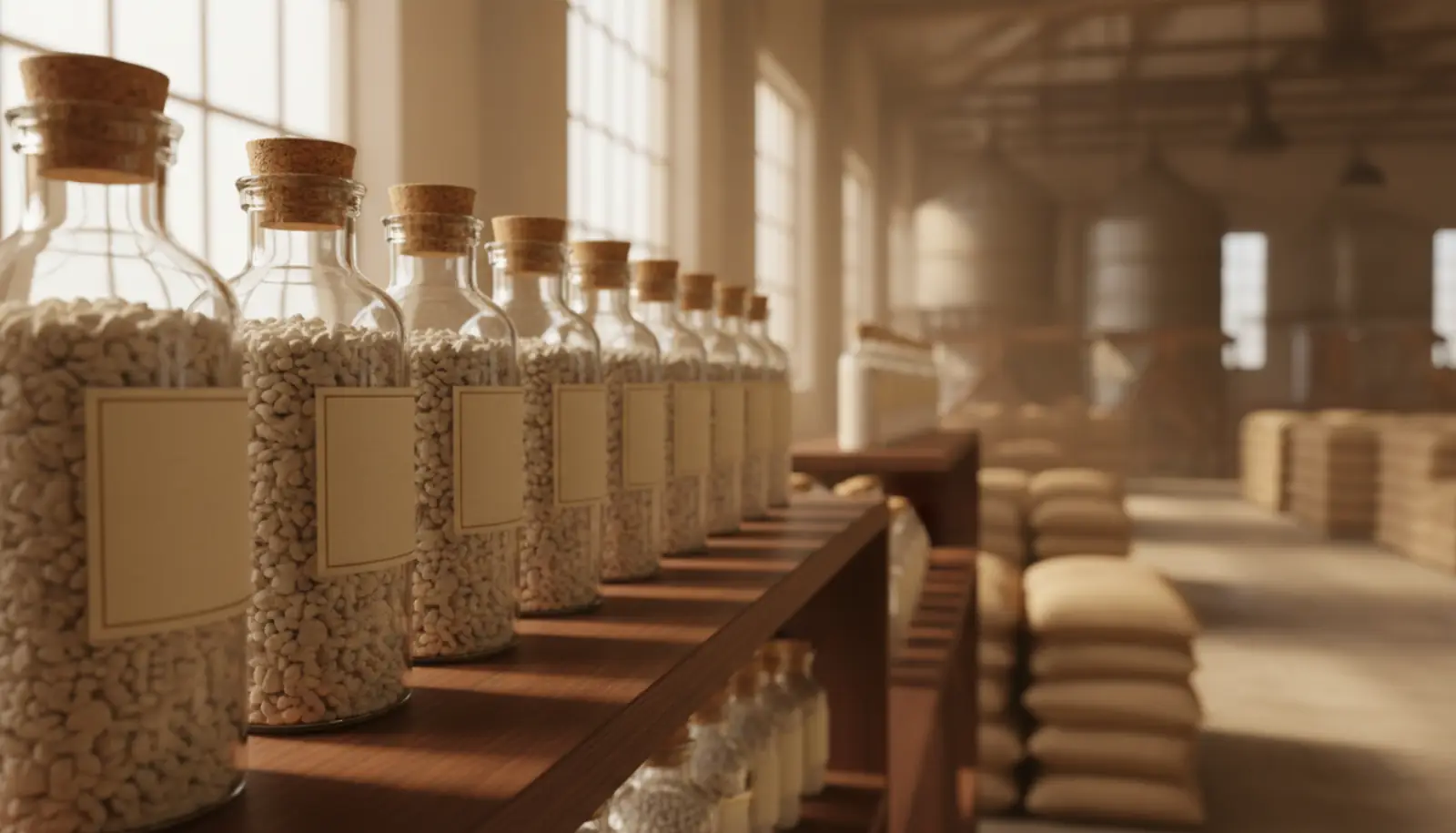
Seal and split. The sample should be divided into several identical portions in clean, suitable, labelled containers, each sealed with a numbered seal. A typical split is one for the seller, one for the buyer, one retained by the inspector or held for an umpire, and a spare. Record the seal numbers on the sampling report.
Retain and store properly. A retained sample is only useful if it stays unchanged. Heat, light, moisture and air exposure change many products. Store it as the product requires, record the storage location and custody, and keep it for the period the contract specifies. If the contract is silent, agree a period before it expires, not after.
Product notes:
- Bitumen. Samples must be taken at representative temperatures and containers must be suitable; repeated reheating of a sample can change its properties. See our bitumen quality tests guide for the tests and how the figures should cross-check.
- Polymer resin. Sample from sealed bags, record lot numbers, and keep sample bags dry and closed, because moisture and contamination from open handling change results. Our polymer resin quality checks guide lists the routine checks.
- Granular and prilled solids such as urea and sulphur can change through moisture and handling, so sample before as well as after discharge where the contract allows.
Notice periods and time limits
Almost every contract limits the time within which a quality claim may be made. If you miss it, the claim may be lost however good the evidence. There is no universal period. It can be a matter of days or weeks, can run from different events (arrival, discharge, delivery to the buyer's premises, receipt of the certificate), and can require different steps (a short notice first, a full report later).
Look for these in your contract:
- What starts the clock. Arrival at the port, completion of discharge, or receipt of documents.
- How notice must be given. Written, by a named method, to a named address. A phone call usually does not count.
- What the notice must contain. A description of the problem is often enough for the first notice, while the full analysis and supporting documents follow.
- Whether late notice bars the claim or only reduces it.
- Whether using the cargo counts as acceptance. Processing or blending cargo before objecting can weaken a claim.
A hypothetical timeline. The following numbers are invented to show how the steps interlock. Suppose a clause requires written notice within 14 days of the end of discharge and a full laboratory report within 45 days of it. A buyer who finds a problem on day 13, phones the seller on day 15 and sends written notice on day 16 is two days late, whatever the evidence says. A buyer who gives short written notice on day 5 and the report on day 40 meets both deadlines. The lesson is to send a short written notice quickly, even before the analysis is complete, and to diarise every deadline on the day the cargo is discharged.

Independent umpire laboratories
When the buyer's result and the seller's result differ beyond the precision of the method, the usual solution is to send a sealed retained sample to a third laboratory. This is the umpire. For the process to work:
- Name the umpire, or the way to choose one, in the contract. Agreeing a laboratory after the dispute starts invites a second dispute.
- Choose an independent laboratory with relevant expertise and the appropriate accreditation. Accreditation to ISO/IEC 17025 is the general international standard for testing laboratories, but it does not itself guarantee the lab is competent for your particular test, so check the scope.
- Use sealed retained samples with intact, matching seal numbers. A sample with a broken or unrecorded seal weakens the whole exercise.
- State the test methods the umpire must use, the same as those in the quality clause.
- State whether the umpire's result is final and binding on quality, or only evidence. Finality is the point of the umpire.
- Allocate the umpire's costs. A common approach is that the losing party pays, but that is a contract choice, not a rule.
The umpire settles technical facts, such as whether the cargo met the specification. It does not necessarily decide what follows, such as compensation, so the contract should say what happens next.
What to do when you suspect a problem
If a buyer finds a result that does not look right, work through this order.
- Stop and quarantine. Do not blend, process or consume the cargo while the question is open, except as needed to limit loss. Photograph and label the material.
- Read the contract first: notice clause, specification, method and umpire provisions.
- Give written notice immediately, in the form the contract requires, stating that analysis and a full claim will follow.
- Preserve the evidence. Keep the sealed retained samples, bag labels, seals and documents (see the list below).
- Arrange a joint or independent sampling at the discharge point if the contract allows, with the seller or its representative invited to attend.
- Test at a suitable laboratory using the contract's methods. Compare the result to the guaranteed limit, and allow for the precision of the method.
- Present the claim with the evidence and propose a remedy the contract allows.
- Escalate to the umpire if the analyses differ, then to the contract's dispute procedure if the matter does not settle.
- Tell your insurer if the damage may have occurred in transit.
Evidence to keep
Good evidence is dated, signed, linked to a particular lot, and made at the time. Keep:
- The signed sale contract, all amendments, and the offer and acceptance.
- The specification as agreed, with the test methods.
- The certificate of analysis and any independent inspection certificates, including the inspector's sampling report.
- Sample records: who took it, when, where, how, seal numbers, custody log.
- The bill of lading, packing list and weight documents. For bulk cargo, the draft survey and shore tank figures.
- Photographs of containers, seals, bag markings, pallet labels and the condition of the cargo on arrival, with dates.
- Temperature, storage, tank cleanliness and line flushing records where they matter.
- The laboratory reports, with method, date and analyst, and the laboratory's accreditation scope.
- All correspondence, including notes of calls, in date order. Confirm every phone conversation in writing.
- Insurance documents and any survey report, as explained in our marine cargo insurance guide.
Insurance is a different track
Cargo insurance is designed to respond to damage from insured events during transit, such as sea water damage or accident. It does not generally respond to cargo that was off-specification when it left the plant, or to ordinary quality disagreements. If the damage could have occurred during the voyage, tell the insurer promptly and follow the policy's survey and notification conditions. A claim against the seller and a claim on the insurance can run in parallel, so keep both in view.
Payment and quality claims
If the buyer pays by letter of credit, the bank pays against compliant documents whatever the quality, so a quality claim has to be pursued after payment. Withholding payment under other structures is a contract matter. See our guide to payment terms for how payment structure changes who holds leverage when a dispute starts. Retaining part of the price until quality is confirmed is a common compromise, provided the release conditions are specific.
Arbitration or courts
If the technical question is settled but the parties disagree about money or liability, the contract's dispute clause decides where the case goes. At a general level:
| Arbitration | Courts | |
|---|---|---|
| Privacy | Normally private | Normally public |
| Choice of decision-maker | Parties usually agree the tribunal or the method | Fixed by the court system |
| Procedure | Flexible, set by agreed rules | Governed by court rules |
| Cross-border enforcement | Awards are generally enforceable in many countries through international treaty arrangements, subject to local law | Depends on treaties between the countries involved and can be difficult |
| Appeal | Limited | Usually available, subject to local rules |
| Cost and speed | Can be quicker or slower depending on the case; costs include tribunal and institution fees | Depends on the court's workload and local rules |
Many international commodity contracts choose arbitration, because it is neutral and awards are easier to enforce abroad. That is a common pattern, not a rule; the right choice depends on the parties, countries and amounts at stake.
If you choose arbitration, write the clause carefully: the institution or rules, the seat (the legal home of the arbitration), the number of arbitrators, the language and the governing law. Defective clauses cause delay before the case even starts. Many contracts add a step before arbitration, such as negotiation between senior managers or mediation. Governing law and forum are separate choices.
Take legal advice at this stage: limitation periods, rules on evidence and the effect of your contract wording all vary.
How to avoid disputes
Prevention costs less than a claim.
- Write a specification with guaranteed limits and named methods.
- Appoint an independent inspector at loading, with joint attendance if possible, and agree what the certificate decides.
- Take sealed, split samples and record the seals.
- Name the umpire laboratory and state that its result is final.
- Agree a price adjustment scale for minor deviations.
- State the notice period and procedure, and treat the clause as a diary entry the day the cargo arrives.
- Match documents to the contract. A certificate with the wrong batch number is an invitation to argue.
- Inspect on arrival promptly, while the seals, bags and containers are intact and photographs are meaningful.
- Keep tanks, lines and containers clean, and record it.
- Put every agreement in writing, especially waivers and extensions.
Frequently asked questions
How long do I have to make a quality claim?
It depends entirely on your contract, and it can be short. Find the notice clause, identify what starts the clock, and send written notice straight away, even if the analysis is not finished.
Who should take the samples?
An independent inspector appointed under the contract gives the most credible sample. Both parties should be able to attend. Seal and number the split portions, and agree in advance which sample governs.
What if two laboratories give different results?
First check whether the difference is within the precision of the test method. If not, the usual route is the umpire laboratory named in the contract, testing a sealed retained sample. The contract should say whether the umpire's result is final.
Does an independent certificate at loading end the dispute?
Only if the contract says so. Many contracts make the loading-port certificate final on quality unless there is fraud or an obvious error, but others let discharge results govern. Read the clause before assuming.
Can I use the cargo while the claim is open?
Be careful. Using, blending or processing the cargo can be treated as acceptance or can destroy evidence. Check the contract, notify the seller in writing, preserve sealed samples first, and limit loss in a way the contract allows.
Does cargo insurance cover off-specification product?
Generally not. Marine cargo insurance responds to damage from insured events during transit. It is not normally a remedy for product that was off-specification at loading.
Next step
If you are planning a purchase from Sohar or Salalah and want the specification, sampling, inspection and claims procedure written into the offer before you commit, send your product, quantity and destination to the Chemineral trade desk. Firm offers are valid for 72 hours.
Our trade desk can turn the views in this report into firm offers on today's indicative prices — valid 72 hours, with complete documentation.
Request a quote