Quality Checks for Imported Polymer Resin: What to Test and When
A practical buyer's checklist for imported PE and PP resin: documents, bag markings, MFI, density, ash, moisture, gels and black specks, plus how to sample and what to do when results fail.

The most reliable way to protect yourself on imported polymer resin is a short, disciplined routine: verify the paperwork and bag markings, sample properly across the lot, and run a small set of tests (melt flow index, density, ash, moisture, and a visual check for gels and black specks) before any material goes near your production line. None of this is expensive. What is expensive is finding out on the extruder that a whole container is not what you bought.
This guide sets out what to check, why each check matters, how to sample, what the common failure patterns look like, and what to do if a result is out of range. It applies mainly to polyethylene and polypropylene, the grades most commonly traded in bulk, but the logic carries over to other thermoplastics.
The short version
- Before shipment, agree the specification in writing, ask for a certificate of analysis (CoA) for the lot, and consider independent pre-shipment inspection.
- On arrival, check bag markings, lot numbers and packing condition before you open anything.
- Sample from several bags and several pallets, not just the most accessible ones.
- Test MFI and density at minimum; add ash, moisture and a gel and contamination check where your process needs them.
- Quarantine the lot until results are in. Do not mix it into stock.
- Record everything, including lot numbers and photographs, so a claim is possible if something is wrong.
What "quality" means for resin
Resin quality is not a single number. It is the combination of four things:
- Identity: is it the polymer type and grade you ordered?
- Conformity: do its measured properties sit inside the agreed specification?
- Cleanliness: is it free from contamination, cross-polymer mixing, gels and foreign particles?
- Consistency: is the second bag the same as the first, and is this lot comparable with the last one?
A CoA addresses the first two, for the sample the producer tested. Arrival checks address all four for the material that actually reached you.
Quality tiers in brief
The tier of the material shapes everything that follows. These are descriptions, since exact usage varies in the trade; our guide to prime, near-prime, off-grade and wide-spec polymers goes into the commercial detail.
- Prime: meets the producer's published specification for the grade.
- Off-grade or off-spec: virgin material that missed one or more specification limits, such as MFI outside the band or elevated gels, sold at a discount. Often it arises from transitions between grades or process upsets.
- Wide-spec: virgin material deliberately sold against a broader specification window than prime, with the limits stated on the offer.
- Recycled or reprocessed: material that has been through a processing cycle, from regrind, post-industrial or post-consumer sources. It should be sold as such.
The checks below apply to all tiers, but the pass criteria differ. For off-grade and wide-spec material, test against the specification stated in the offer, not against the prime datasheet.
Step 1: Documents before shipment
Ask for these before you pay or load:
- Written specification agreed with the supplier: polymer type, grade or target MFI with test conditions, density range, tier, additive package, packing, quantity and tolerance.
- Certificate of analysis for the specific lot or production batch, showing measured values (not just typical values) and the test method.
- Safety data sheet for the product.
- Packing list showing bag count, pallet count, lot or batch numbers and net and gross weights.
- Inspection report if pre-shipment inspection has been agreed.
Pay attention to what the CoA does and does not say. A CoA that reproduces typical datasheet values rather than measured results is a datasheet with a different title. A CoA that lists a batch number which does not match the bag markings is a warning sign. Ask the supplier to explain any mismatch before the ship sails, not after it arrives.
Pre-shipment inspection
Independent inspection by a firm such as SGS or Intertek puts a third party in the warehouse or at the loading point. Typical scope includes checking quantity and packing, verifying markings against the documents, witnessing sampling and, if requested, laboratory testing of the sample. It will not guarantee what happens in transit, but it significantly reduces the chance of a gap between the document and the cargo. Chemineral offers SGS or Intertek pre-shipment inspection; you can ask for it at enquiry stage and agree the scope with the trade desk.
Step 2: Bag markings and lot traceability
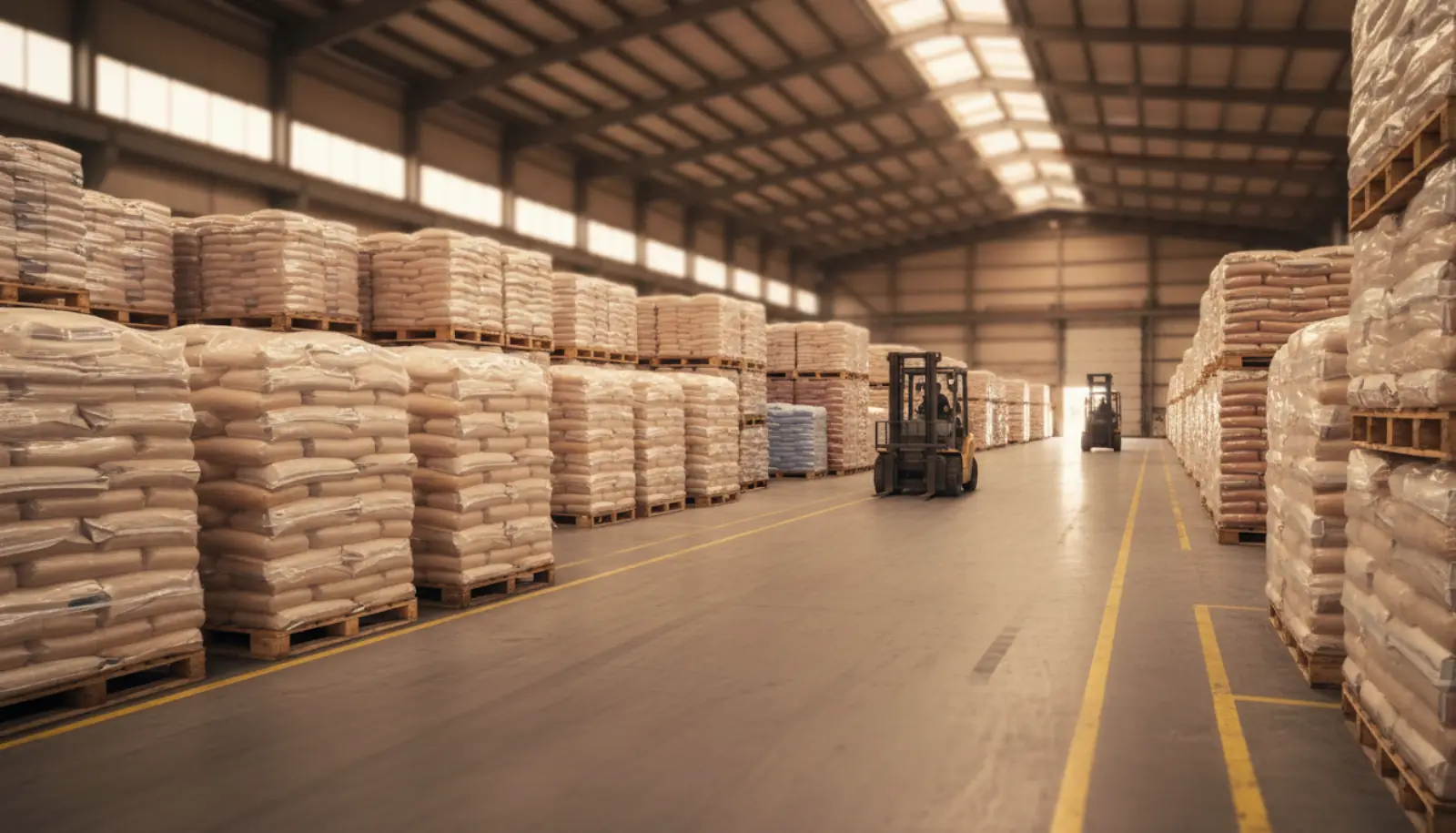
The bag is your first source of evidence. Before opening anything, check that every bag in your sample carries:
- Producer or brand name, and the product or grade designation.
- A lot, batch or production date marking that can be traced to the CoA.
- Net weight (commonly 25 kg per bag on pallets, though sizes vary).
- Country of origin.
- Handling and safety pictograms where required.
Warning signs on bags
- Blank bags, or generic bags with no producer marking. This is not a fault in itself, since some producers supply unbranded packing, but it removes a layer of traceability. Compensate with stronger documentation and testing.
- Print that differs between bags in the same lot, such as different fonts, colours, bag construction or print quality.
- Re-stitched or heat-sealed bags that suggest opening and re-closing.
- Over-stickered bags, where a new label sits over an older one.
- Different bag materials, thicknesses or weights within a single consignment.
- Brand-new bags with old, dirty or damaged pallets, or the reverse.
- Visible dust, discolouration or foreign particles around the bag seams.
None of these alone proves a problem, but each justifies extra sampling. Photograph the bags, pallet labels and container seal number as soon as the container is opened. If there is a dispute later, those photos are your best evidence.

Step 3: Visual and physical inspection of the cargo
Before sampling, look at the consignment.
- Container condition: seal intact and matching the documents, no signs of water ingress, no strong odours.
- Pallet and wrap condition: damaged wrap, crushed bags and torn bags suggest handling or storage issues.
- Moisture and condensation: water inside bags or under the wrap points to a sweating container or leaks.
- Pellet appearance: open a bag and look. Pellets should be consistent in size and shape, free of dust ("fines"), angel hair (stringy plastic strands) and conjoined pellets ("tails" or "doubles"), and uniform in colour.
- Odour: a strong burnt, acrid or solvent smell is not normal and may point to degradation or contamination.
- Foreign matter: spread a few hundred grams on a white sheet and look for paper, metal, wood, rubber or other-coloured pellets.
Record observations per bag. Note which bags you opened and from which pallets.
Step 4: Sampling
Testing is only as good as the sample. Sampling mistakes are the most common reason for disputes that cannot be resolved.
- Sample from several bags across several pallets, top, middle and bottom of the stack, not only from the nearest pallet.
- Use clean tools and clean containers. A scoop that touched another resin will contaminate the sample.
- Take enough: several hundred grams from each bag is common practice, enough for repeat tests.
- Label every sample with bag number, pallet, lot, date and sampler.
- Keep retained samples, sealed and stored away from heat and light, until the lot is consumed and any claim period has passed.
- Do not sample from a bag that has been open in a humid warehouse and expect moisture results to be meaningful.
If the contract involves an independent inspector, follow the sampling plan in the contract. Sampling plans exist for good reason, and a plan that is agreed in advance cannot be disputed afterwards.
For key tests, composite samples (a blend of material from several bags) tell you the lot average, while individual samples tell you the spread. Use both if you suspect inconsistency: test several bags individually, then test a composite.
Step 5: Laboratory and line tests
Melt flow index (MFI)
What it tells you: how easily the melt flows, which is a proxy for molecular weight and a primary processing parameter.
How it is tested: a standard melt flow indexer extrudes molten polymer through a defined die under a fixed load and temperature, and the mass extruded in ten minutes is reported. The methods are ISO 1133 and ASTM D1238. Conditions depend on the polymer: polypropylene is conventionally tested at 230°C with a 2.16 kg load; polyethylene is conventionally tested at 190°C, with the load chosen to suit the grade (2.16 kg is common for general-purpose grades, and a higher load for some high-density grades). The CoA should state the conditions.
What to look for:
- A result within the specification band, with the same conditions as the CoA.
- Bag-to-bag consistency. A wide scatter across individual bags suggests blending or mixed lots, even when the average is on target.
- A result far from the CoA value. Allow for test-to-test variation between laboratories; but a large gap is a reason to retest and escalate.
Common pitfalls: testing at the wrong temperature or load, testing damp or contaminated material, and comparing results between laboratories that use different equipment or procedures. If a result matters commercially, use a laboratory both parties accept.
Density
What it tells you: the polymer family and structure. For polyethylene it separates the HDPE, LDPE and LLDPE families and helps detect blending. For polypropylene it is less discriminating, but fillers and contamination can shift it.
How it is tested: common methods include ISO 1183 and ASTM D792 (displacement methods) and the density-gradient column method of ASTM D1505. Samples are often compression-moulded or taken from conditioned pellets.
What to look for: a result within the datasheet band. Density in a polyethylene grade that sits between the expected range and a different family can indicate a blend, mislabelled grade or recycled content.
Limitations: density alone cannot confirm the grade. A material can match density and miss on MFI, or the reverse. Read both together.
Ash (inorganic content)
What it tells you: how much non-combustible inorganic material (fillers, catalyst residues, pigments, contamination) is in the resin.
How it is tested: a weighed sample is burned off in a furnace under defined conditions and the residue weighed. ISO 3451-1 is the relevant general standard for plastics ash determination.
What to look for: virgin resin normally has a very low ash figure, unless the grade is filled or contains inorganic pigment. A high figure in a grade that should be unfilled points to filler, contamination or mixing with filled or recycled material. For raffia and film, ash can also warn of calcium carbonate or other fillers blended in without disclosure.
Practical note: the test is simple and inexpensive, and it is one of the best screens for undisclosed filled or recycled content.
Moisture and volatiles
What it tells you: surface water or volatile content that can cause bubbles, splay marks, voids, poor film and unstable extrusion.
How it is tested: moisture analysers (loss-on-drying), Karl Fischer titration for low moisture levels, or simple drying tests. Polyolefins absorb very little moisture inside the pellet, so most moisture in PE and PP is surface water, from condensation, rain or poor storage. This is less of a problem for polyolefins than for hygroscopic resins such as PET or nylon, but it still matters for film, fibre and thin-wall work.
What to look for: visible condensation in bags, wet pallets, mould on packaging and a result above your process limit. Surface moisture usually dries off with proper storage, but investigate the cause, since wet bags can also mean a leaking container or poor loading.
Gels, black specks and visible contamination
What they are: gels are small, undispersed lumps of high-molecular-weight or crosslinked polymer. Black specks are carbonised or burnt material, or foreign particles. Both show up as defects in film, and as breaks in tape and fibre.
How to check:
- Visual check of pellets: spread pellets on a white surface under good light and count dark or off-colour pellets in a fixed quantity. Compare with a retained reference sample from a lot you know to be good.
- Film test: extrude or blow a thin film from the sample and count gels and specks per unit area. This is the real test for film grades, and many converters run it routinely on new lots.
- Melt filtration: for high-spec fibre and BOPP, a pressure rise on a screen pack during a test run indicates contamination.
What to look for: gel counts in line with the lot you normally run, no black or discoloured pellets, and no unexpected colour variation. Because there is no universal numerical limit, define an acceptance criterion with your supplier in advance, in the contract if possible.
Other useful checks
- Colour and yellowness index: matters for natural, white and clear products. A yellow tint suggests heat damage or recycled content.
- Polymer identification: thermal analysis (differential scanning calorimetry) or infrared spectroscopy can confirm polymer type and detect cross-contamination, for example polyethylene in polypropylene. Useful when you suspect mixing, though it needs laboratory equipment.
- Processing trial: the ultimate test. Run a limited quantity on your actual line and compare it with your standard material for output, melt pressure, defects and end-product properties.
Step 6: Reading the results
A pragmatic approach:
| Result pattern | Likely meaning | Action |
|---|---|---|
| All tests inside the specification, bags consistent | Lot conforms | Release to production, keep retained samples |
| MFI inside the band on average, wide scatter between bags | Mixed lots or blending | Test more bags, ask the supplier to explain, restrict use until clarified |
| MFI out of band, density in range | Different grade or processing history | Retest; if confirmed, notify supplier in writing |
| Density out of range | Wrong family, blend, or contamination | Retest; consider polymer identification test |
| High ash in an unfilled grade | Filler, contamination or recycled content | Confirm with a second laboratory; escalate |
| High gels or black specks | Poor-quality or off-grade material, or contamination | Film trial; quarantine; claim |
| Wet bags, condensation | Storage or container issue | Dry and retest; document damage for insurer |
Where a result is borderline, do not guess: retest, use a second laboratory, and remember that measurement uncertainty is real. The point is to build an evidence file that stands up if you need to make a claim.
Step 7: If something fails
- Quarantine the lot. Do not mix it with existing stock, as that spoils both and weakens your claim.
- Notify the supplier promptly and in writing, attaching test reports, photographs, bag and lot numbers, and container details. Check your contract for claim deadlines.
- Preserve the evidence: retained samples, packaging, documents and photos.
- Involve the independent inspector if one was engaged, and the insurer if the damage is transit-related.
- Agree a resolution path: replacement, price adjustment, or return, depending on the failure and how the contract defines it.
- Do not process the material and then claim. Once it is in the extruder, proving the cause becomes much harder.
Frequently asked questions
Which tests are essential if I can only run two?
MFI and density. Between them they confirm that the material matches the intended grade family and processing behaviour. Add ash if you suspect filler or recycled content, and a film or visual check if gels and specks would hurt your product.
Is a certificate of analysis enough on its own?
No. A CoA tells you what the producer or seller reported for a sample. It does not prove that the bags in front of you came from that batch, or that nothing happened in storage and transit. Pair the CoA with bag markings, lot traceability and an arrival test.
How can I tell recycled material from virgin?
Not reliably by eye. Clues include colour variation, a yellow tint, odour, higher ash, higher gel and speck counts, wide scatter in MFI between bags and unusual density. A laboratory test such as thermal analysis can reveal cross-contamination between polymers. The dependable route is to buy against a written specification that states the tier, and to test.
Does moisture matter for polyethylene and polypropylene?
Less than for hygroscopic resins, because polyolefin pellets absorb little water internally. Surface moisture still causes defects in film, fibre and thin-wall moulding, and wet bags indicate a handling or container problem worth documenting.
What if the supplier says my test method is wrong?
Agree the method, conditions and laboratory in the contract before shipment. If a dispute arises, use a mutually accepted third-party laboratory on retained samples. This is also a good reason to use an independent inspector at origin.
Next step
If you would like resin supplied against a written specification, with SGS or Intertek pre-shipment inspection available and documentation agreed up front, send your requirements to the Chemineral trade desk through our contact page. Include the grade or MFI window with test conditions, density range, tier, packing and destination. Our firm offers are valid for 72 hours, with Suez and Cape routing quoted side by side from Sohar or Salalah. For grade guidance, see our product pages for HDPE, LDPE and polypropylene.
Our trade desk can turn the views in this report into firm offers on today's indicative prices — valid 72 hours, with complete documentation.
Request a quote