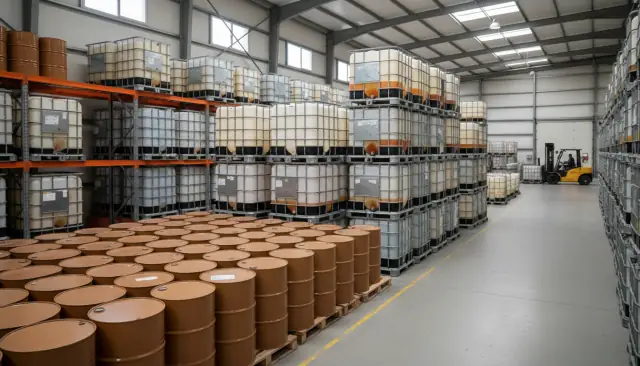
Storing and Handling Caustic Soda: Solid and Liquid, at the Buyer's End
How to store and handle caustic soda flakes, pearls and liquor after delivery: moisture and CO2 pick-up, tank materials, dissolving heat, freezing, PPE, spills and segregation.
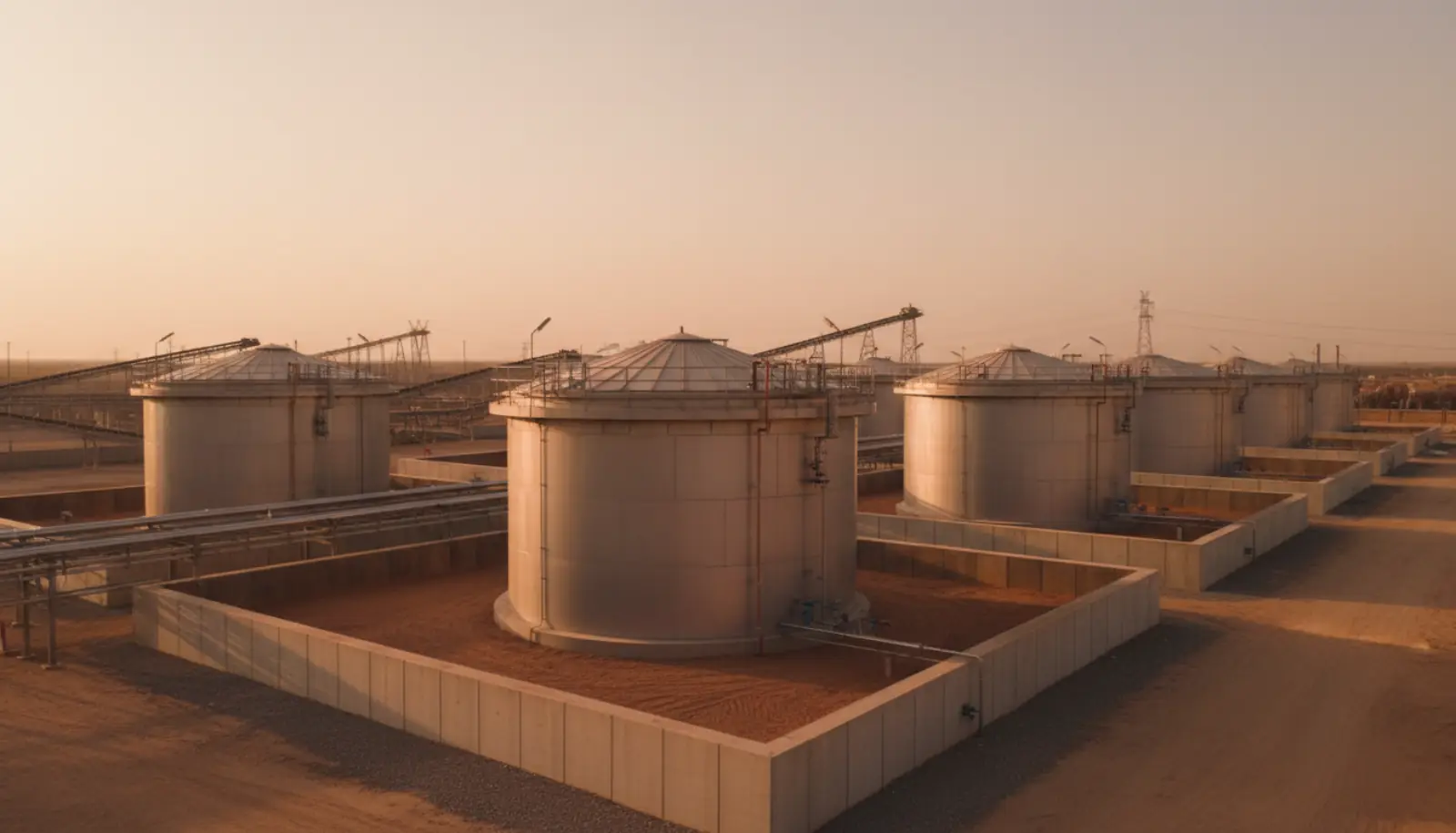
Caustic soda is stable and forgiving if you respect three things: it pulls moisture and carbon dioxide out of the air, it releases a lot of heat when it meets water, and it attacks skin, eyes and some metals. Most storage and handling problems at the buyer's end come from one of those three, and almost all are prevented by sealed storage, controlled dissolving, the right materials and disciplined segregation.
This guide covers solid (flakes and pearls) and liquid caustic soda after the cargo arrives. It is general information only. Specifics such as concentrations, temperatures, materials, PPE ratings and first-aid steps depend on the product grade, your equipment and local law. Always work from the supplier's safety data sheet (SDS) and your own site procedures and risk assessment, and take advice from a qualified safety professional. Where this guide gives a rule of thumb, treat it as a prompt to check the SDS, not as an instruction.
Solid or liquid: which are you storing?
Caustic soda (sodium hydroxide, NaOH) reaches buyers either as solid flakes or pearls, or as a liquid solution, often called liquor or lye, at a stated strength. Our guide to caustic soda forms explains how to choose between them. Storage needs differ:
| Solid (flakes, pearls) | Liquid (solution) | |
|---|---|---|
| Typical containers | Bags, big bags, drums, lined containers | Road tankers, ISO tanks, fixed storage tanks, drums or IBCs |
| Main storage risk | Moisture and CO2 pick-up, caking, dust | Freezing or crystallising in cold weather, material compatibility, leaks |
| Main handling risk | Dust, and heat and splashing when dissolving | Splashing, leaks, heat when diluting, dangerous mixing in the wrong tank |
| Space and cost | Compact, but needs dry, covered storage | Needs tanks, bunds, pumps and often heating |
Solids suit small and irregular users and long-distance shipping. Liquid suits steady, higher-volume users with proper tanks, pumps and a use for the solution as it is. If you are storing both, keep the equipment, labels and procedures clearly separate.
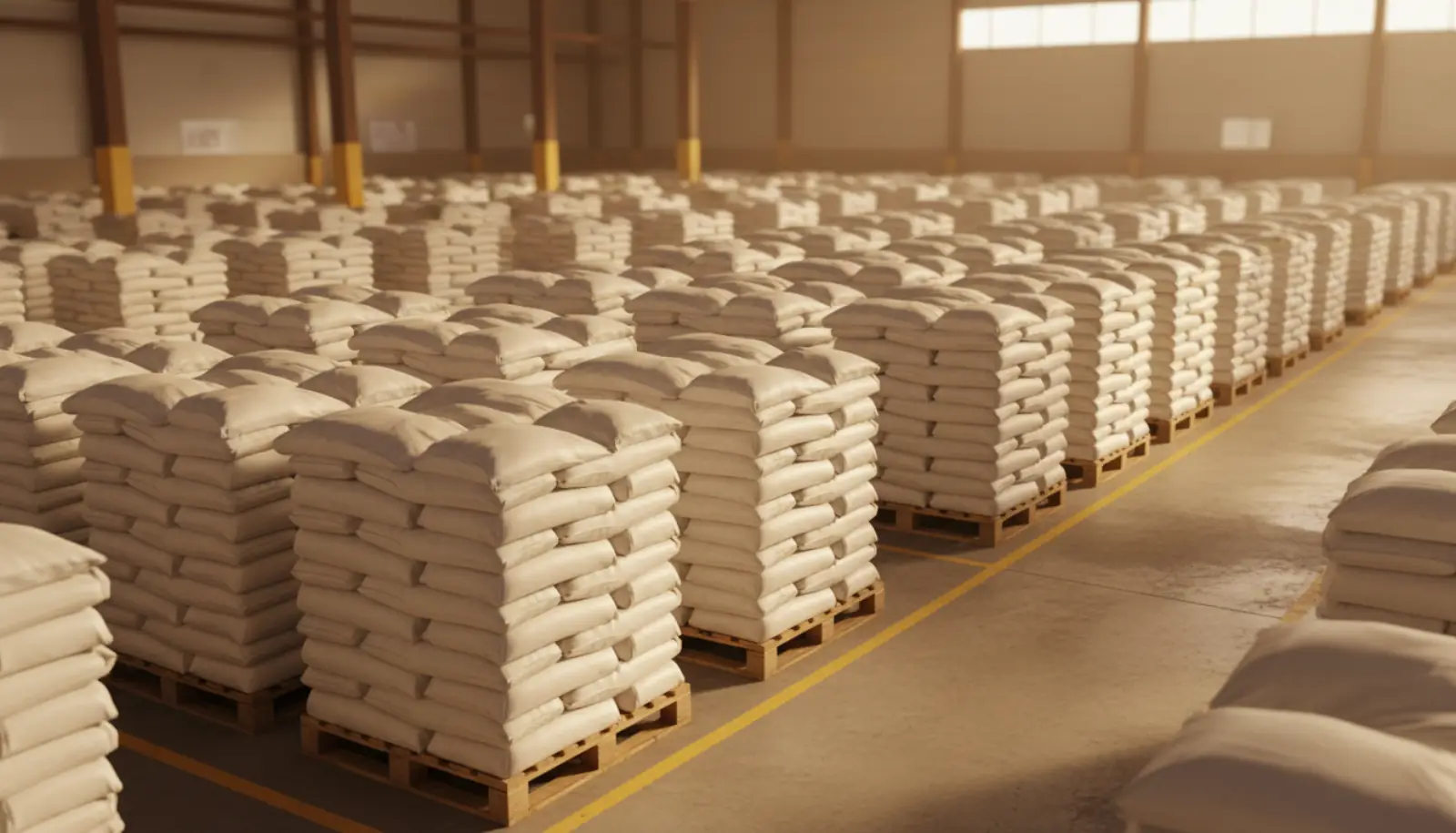
Solid caustic soda: keep it dry and sealed
Why moisture and CO2 matter
Solid caustic soda is hygroscopic: it absorbs water vapour from the air, and if left exposed it can become damp, then sticky, and in extreme cases dissolve in the water it has absorbed. It also reacts with carbon dioxide in the air to form sodium carbonate. The result is a surface crust and a product that is slightly less pure than it was.
What this means in practice:
- Exposed solid slowly loses effective strength as the carbonate fraction grows.
- The crust and the absorbed moisture bind particles together, causing caking.
- Damp material is harder to meter and convey, and can block hoppers and feeders.
- The effect is worst in humid climates and on opened or damaged packaging.
How fast this happens depends on humidity, temperature, particle form and how well the packaging is sealed. Treat any exposure as cumulative.
Storage rules for solids
- Store indoors or under a weatherproof cover, on pallets or a raised floor, away from walls and drains where water can collect.
- Keep packaging sealed until use. Close or re-tie opened bags promptly and re-seal liners.
- Use up opened packs first. Do not leave part-used bags standing open between shifts.
- Keep the store cool, dry and ventilated, and avoid temperature swings that cause condensation inside packs.
- Follow the stacking limits on the packaging and the supplier's guidance; do not over-stack pallets.
- First in, first out (FIFO): use older stock first, and date-mark deliveries.
- Inspect regularly for damaged bags, caking, wet patches and leaking roofs.
- Never return spilled or contaminated product to the pack. It may be wet or mixed with something else.
Caking: what to do
Mild caking at the edges of a pack may only affect the surface, but treat it as a signal. Check the packaging, the store and the age of the stock. Do not use sharp tools to break up caked material in a way that creates dust or splashing, and do not add water to loosen it. If a large part of a delivery arrives caked or damp, photograph it, note the packaging condition and batch numbers, and follow the claims route in our guide to quality claims and disputes. Prompt notice and good evidence matter.
If the product is going into a process that is sensitive to carbonate or moisture, ask the supplier what the specification covers and test samples before using a suspect lot. The usual place to check is the certificate of analysis, and the usual route to resolve doubts is an independent laboratory.
Dust
Solid caustic soda dust irritates the eyes, nose and throat, and contact with damp skin and eyes can cause burns. Control dust with closed transfers, careful pouring, local extraction where the SDS or your assessment calls for it, and appropriate respiratory and eye protection. Do not sweep dry dust vigorously; follow your procedure for cleaning it up.
Liquid caustic soda: tanks, materials and temperature
Tank materials and compatibility
Materials that are suitable for caustic soda depend on the concentration, temperature and the presence of contaminants, and no single answer fits every site. As general orientation only:
- Carbon steel is commonly used for storing caustic solutions at moderate temperatures, but it can suffer corrosion and, at higher temperatures and concentrations, a form of cracking sometimes called caustic stress corrosion cracking. Warm or hot service often calls for stress-relieved welds or different alloys.
- Stainless steels and nickel-containing alloys are used in more demanding duties. Not every grade is suitable, so check with the equipment supplier.
- Plastics and lined or coated vessels, such as certain polyethylene, polypropylene or fibreglass-reinforced designs, are widely used for some duties, subject to temperature limits and the manufacturer's chemical resistance data.
- Aluminium, zinc (including galvanised steel), tin and some brass or bronze fittings are attacked by caustic soda and should not normally be in contact with it. See the section on hydrogen below.
- Seals, gaskets, hoses and valve parts need compatible elastomers and materials; a good tank with the wrong gasket is a leak waiting to happen.
Ask your tank, pump and pipework suppliers to confirm compatibility for your actual concentration and temperature range, in writing, and use the SDS and the supplier's compatibility data as a cross-check. Label dedicated lines and fittings for caustic service so they are not changed for something else.
Tank design and operation points
- Dedicated tank. Use a tank reserved for caustic soda. Residues of other chemicals can react.
- Bunding. Secondary containment sized and drained according to local rules and your risk assessment, with a way to remove spilled liquid safely, and without drains leading to the environment.
- Vents. Tanks need proper venting. Where a tank is open to the air, the liquid will slowly absorb carbon dioxide and form carbonate, which can slightly change strength and produce deposits.
- Level control and overfill protection with alarms and a defined procedure for tanker unloading, including who checks the right tank is being filled.
- Unloading connections that are clearly labelled and, where practical, keyed or locked so the wrong product cannot be pumped into the wrong tank.
Freezing and heat tracing
Strong caustic solutions do not behave like water in the cold. Depending on concentration, a solution can crystallise or freeze at temperatures that occur in cool climates or in unheated stores, and the relationship is not a simple straight line: some strengths freeze at higher temperatures than weaker or stronger ones. Frozen or slushy product blocks lines, valves and pumps, and can damage equipment.
Check the freezing or crystallisation point for your product concentration with the supplier, and then:
- Keep tanks and lines above the recommended minimum temperature, using insulation, heat tracing or tank heating as designed for the duty.
- Check that heating is suited to caustic service and that there are temperature controls and limits, so you do not overheat the contents.
- Insulate exposed pipework and low points.
- Plan for delivery in cold weather. A tanker arriving cold, or a transfer through cold lines, can freeze in the line.
- Do not try to thaw blocked lines with uncontrolled heat or open flame. Follow your procedure, because trapped liquid and gas can build pressure.
Hot liquid
Some caustic solutions are delivered or stored warm. Hot caustic is harder on materials and on people: it burns skin more severely and can flash into hazardous steam or splash on contact with water. If your product is handled warm, your procedure and PPE must reflect that, and the SDS will say more.
Heat of dilution and dissolving
Dissolving solid caustic soda in water, or diluting a strong solution with water, releases a large amount of heat. The mix can become hot enough to boil locally, spit and splash, and damage plastic or glass containers. This is among the most common sources of caustic injuries.
Rules of thumb that appear in typical guidance (check your SDS and procedure):
- Add caustic to water, in small amounts, and mix. Do not add water to a bulk quantity of solid caustic soda. Water poured onto a mass of solid can heat very quickly and spit, particularly if it pools.
- Add slowly and in portions, allowing the heat to dissipate. Do not dump a bag into a tank in one go.
- Use a vessel and agitation suited to the heat, in a material that is compatible and rated for the temperature, with enough volume to absorb heat.
- Use cool water to start and monitor the temperature if the procedure calls for it.
- Stand back and wear splash protection, including face protection over eye protection.
Where possible, buy the strength you need or use a designed dissolving system, so staff are not improvising with bags and buckets.

Segregation: acids, metals and other chemicals
Caustic soda reacts strongly with several things. Keep it physically separate and prevent accidental mixing.
- Acids. Neutralisation releases heat and can cause violent boiling and spitting. Store acids and caustic in separate areas and bunds, and avoid shared drains and shared transfer hoses.
- Aluminium, zinc and some other metals. Caustic soda can react with aluminium, and with zinc and some other metals, to produce flammable hydrogen gas. In an enclosed or poorly ventilated space this can create an explosion risk. Do not use aluminium containers, tools, ladders, fittings or galvanised parts with caustic, and check that nothing nearby, such as an aluminium cladding or cover, could drip into contact with it.
- Certain organic chemicals and some chlorinated solvents can react dangerously with caustic. Check the SDS for incompatibilities.
- Ammonium salts (including some fertilisers) can release ammonia gas when mixed with caustic soda, a point that matters on sites that handle both. Check the SDS and keep them apart.
If you are unsure whether two materials may be stored together, assume they should not be until the SDS and a competent person say otherwise. For how caustic soda is classed and shipped, see our dangerous goods shipping guide; the classification that governs transport is a separate matter from site storage rules, but both start with the SDS.
Personal protective equipment
PPE is the last line of defence, not the first. It comes after elimination, closed systems and training. Typical PPE for caustic soda work includes, subject to your risk assessment and the SDS:
- Eye and face protection: chemical splash goggles, and a face shield where there is a splash risk.
- Hand protection: chemical-resistant gloves of a material specified for caustic soda at your concentration. Check the manufacturer's data, since not all gloves suit all duties.
- Body protection: chemical-resistant apron or suit and boots, with trouser legs over (not tucked into) boots where the procedure says so, so liquid does not run in.
- Respiratory protection where there is dust or mist and the risk assessment calls for it.
- Emergency equipment: eyewash stations and safety showers close to where caustic is handled, tested regularly, with clear access.
Spills and first aid, in general terms
This section is a general orientation only. First aid and emergency response must follow your SDS, site procedures and trained responders.
Spills
- Raise the alarm and keep people away, upwind, and keep unnecessary people out.
- Only trained people in the right PPE should deal with a spill.
- Stop the leak if it is safe to do so.
- Contain it: use bunds, barriers or compatible absorbents, and keep it away from drains and watercourses.
- Do not use incompatible absorbents or metal tools that could react with caustic.
- Do not flood a spill of solid with water; follow your procedure on collecting solid carefully and dry, and on what is done with the residue.
- Neutralisation of larger spills is a task for trained people with a procedure, not a quick fix, because of the heat released.
- Dispose of residues in line with the SDS and local waste rules.
First aid
Caustic burns can be serious and may worsen after exposure ends. In general terms:
- Skin or clothing contact: remove contaminated clothing and flush the skin with plenty of clean water, for as long as the SDS and your first-aid procedure state, and get medical attention.
- Eye contact: this is an emergency. Rinse the eyes with plenty of clean water immediately and continuously, holding the eyelids open, and get urgent medical help. Do not delay rinsing to look for other help.
- Inhalation of dust or mist: move to fresh air and get medical advice.
- Swallowing: this is a medical emergency. Call emergency services and follow the SDS. Do not give anything unless a medical professional tells you to.
Make sure first-aiders know where the SDS is, that it is available to emergency services, and that everyone knows where the eyewash is. Practise it.
Labelling and information
- Label every container, tank, line and valve with the product name and the hazard information required by local rules and the SDS. Keep the supplier's labels intact; do not decant into unlabelled or food-type containers.
- Mark storage areas and restrict access to trained staff.
- Keep the SDS current and accessible, in the language staff use, and replace it when the supplier issues a new version.
- Train people on arrival of new staff and whenever procedures change, and record the training.
Hazard communication and labelling requirements are set by law and differ by country, so check what applies to your site.
Housekeeping
Good housekeeping prevents most of the small incidents that turn into large ones.
- Keep the store tidy and walkways clear, with a clear route to eyewash and exits.
- Clean up small spills and dust promptly in line with procedure, and do not allow residue to build up.
- Inspect packaging, bunds, hoses and fittings regularly and replace worn parts.
- Keep a log of inspections, deliveries, incidents and near-misses.
A receiving checklist
- Check the delivery against the order: product, form, strength or grade, quantity and batch.
- Check packaging condition, seals and labels, and the SDS and certificate of analysis.
- For liquid, confirm the right tank, the right connection and the available volume before unloading.
- Record any damage or shortfall, photograph it and notify the supplier promptly.
- Date-mark and place stock in the right store.
Frequently asked questions
How long can solid caustic soda be stored?
There is no universal figure. Sealed, undamaged packaging in a cool, dry store can hold the product for a long time, but exposure to humid air and carbon dioxide degrades it. Ask the supplier for guidance for your grade and packaging, and use FIFO.
Can I add water to caustic soda flakes in a tank?
Follow your procedure and the SDS. As a general rule, dissolve by adding solid to water in controlled amounts with mixing, not by pouring water onto a bulk of solid, because of the heat and the risk of spitting.
Why has my liquid caustic soda gone cloudy or solid in cold weather?
Strong caustic solutions can crystallise or freeze in cold conditions. Ask the supplier for the crystallisation point for your concentration, and check that tank, line and heat tracing design suit it. Do not apply uncontrolled heat to blocked lines.
Why must I keep caustic soda away from aluminium?
Caustic soda can react with aluminium and some other metals to release flammable hydrogen gas. Avoid aluminium and galvanised parts in contact with it, and keep spaces ventilated.
What should I do first if caustic soda gets in someone's eye?
Rinse with plenty of clean water immediately and continuously, and get urgent medical help. Follow your SDS and site first-aid procedure, and make sure eyewash is easy to reach.
What if a delivery of flakes arrives caked or wet?
Photograph the packaging and product, record batch numbers, stop using the affected lot and notify the supplier promptly. Our guide to quality claims and disputes explains the evidence to collect.
Next step
If you are specifying caustic soda for a plant or a trading programme and want to discuss form, strength, packaging and inspection before you instruct logistics, view the caustic soda product page and send an RFQ to the Chemineral trade desk. We can arrange SGS or Intertek pre-shipment inspection, and firm offers are valid for 72 hours.
Our trade desk can turn the views in this report into firm offers on today's indicative prices — valid 72 hours, with complete documentation.
Request a quote