Shipping Chemicals as Dangerous Goods by Sea: A Buyer's Guide
How sea shipments of dangerous goods are classified, packed, marked, declared and stowed, and what importers should settle with the seller and carrier before booking.
Whether a cargo counts as dangerous goods is decided by its classification, and classification drives almost everything that follows: the packaging, the marks, the declaration, where the cargo can be stowed, whether a carrier will take it and what it costs. Get it wrong, or settle it late, and the usual result is a held booking, a rejected container or a cargo stuck at a port. The fix is to confirm the classification in writing, for the exact form of the product you are buying, before you book space.
This guide explains in general terms how dangerous goods move by sea and what buyers of bulk chemicals, fertilisers, minerals and bitumen should ask for. Regulations change, and the details differ by product, form, carrier, port and country. This is general information, not legal or compliance advice. Check the product's safety data sheet and the current rules, and take advice from your freight forwarder, carrier or a qualified dangerous goods adviser before you ship.
Why classification comes first
Classification answers two questions: is this product regulated for sea transport at all, and if so, how? Every later requirement hangs from the answer.
- Packaging that meets performance rules for the hazard.
- Marking and labelling on the package and the container.
- Documents: a dangerous goods declaration is added to the normal shipping set.
- Stowage and segregation: where the cargo goes on the ship, and what it can sit next to.
- Acceptance: carriers, terminals and ports can each apply their own limits.
- Cost and time: surcharges, earlier documentation deadlines and fewer sailing options are common, though they vary by carrier and lane.
Classification follows the product's properties, such as flammability, corrosivity, toxicity and reactivity, as documented by the producer. It is not decided by the buyer's preference or by what a previous shipment of "the same" product was called. Two grades of one material, or one material in solid and liquid form, can be classified differently.
The framework in general terms
Sea transport of dangerous goods in packages is governed internationally by the International Maritime Dangerous Goods (IMDG) Code, published by the International Maritime Organization and made mandatory through the SOLAS convention (the International Convention for the Safety of Life at Sea). The IMDG Code is built on the UN Model Regulations, the common classification system also used as the basis for the rules for road, rail and air. The IMDG Code is amended on a regular cycle, so always work from the edition currently in force.
Three practical consequences follow.
- Road and rail legs have their own regulations, and national rules can add to the international framework.
- Other codes cover bulk cargoes. The IMDG Code is about packaged goods, including goods in containers. Solid cargoes carried loose in a hold, and liquid chemicals in a tanker, sit under separate codes (the IMSBC Code for solid bulk and the IBC Code for chemical tankers are the usual references).
- Your carrier's rules sit on top. A carrier can refuse or restrict cargo that the regulations technically allow.
The nine hazard classes at a high level
The UN system sorts dangerous goods into nine classes. Some are split into divisions.
- Class 1: Explosives.
- Class 2: Gases (flammable, non-flammable non-toxic, and toxic).
- Class 3: Flammable liquids.
- Class 4: Flammable solids, substances liable to spontaneous combustion, and substances that emit flammable gas when in contact with water.
- Class 5: Oxidising substances and organic peroxides.
- Class 6: Toxic and infectious substances.
- Class 7: Radioactive material.
- Class 8: Corrosive substances.
- Class 9: Miscellaneous dangerous substances and articles, which includes some substances hazardous to the environment and some materials that present a hazard mainly during transport, for example when carried at elevated temperature.
Most bulk trade in petrochemicals, fertilisers and minerals touches only a few of these, typically Classes 3, 4, 5, 8 and 9. Many commodities are not classed as dangerous goods for sea transport at all. Being industrial or unpleasant to handle does not make a product dangerous goods, and being sold in large volumes does not exempt it.
The class tells you the kind of hazard. It does not tell you how severe the hazard is, which is the job of the packing group.
UN numbers, proper shipping names and packing groups
Three identifiers appear on almost every dangerous goods document.
UN number. A four-digit number, written "UN" followed by the digits, that identifies a substance or a group of similar substances. It is an identifier, not a ranking. A higher number is not a worse hazard.
Proper shipping name (PSN). The official name under which the goods must be described in documents and, usually, on packages. It is not the trade name or a name of your choosing. Some entries are generic ("n.o.s.", meaning not otherwise specified) and often require a technical name in brackets so that responders know what is inside.
Packing group (PG). A rating of the degree of danger for many substances, from I (great danger) through II (medium) to III (minor). It affects what packaging is permitted and, in some cases, limits on quantity. Not every class uses packing groups, so a missing packing group is not necessarily an error.
These three, plus the class, must agree across the safety data sheet, the packaging marks, the declaration, the bill of lading and the booking. A mismatch between any two is a common reason for a carrier to query a booking.
The safety data sheet
The safety data sheet (SDS) is the producer's document describing the product's hazards and how to handle it. Under the internationally harmonised format it has sixteen sections, and a buyer needs at least four of them for shipping.
- Hazard identification: the product's classification for supply and use.
- Handling and storage: conditions to avoid, incompatible materials.
- Physical and chemical properties: for example flash point where relevant, physical form, melting range.
- Transport information: the class, UN number, proper shipping name and packing group for each mode, or a statement that the product is not regulated for that mode.
Treat the SDS as the starting point, not the last word. Rules for workplace supply and rules for transport are separate, so a product can be hazardous in the workplace and unregulated at sea, or the reverse. Before relying on one:
- Check that it is current and issued by the producer or an authorised source, not copied from an unrelated supplier.
- Check that it describes your form and grade. A sheet for a solution does not cover a solid, and a sheet for one concentration does not cover another.
- Read the transport section for sea transport specifically, and note any conditions attached, such as a temperature, a concentration or a packaging type.
- Ask the seller to confirm in writing that the classification in the sheet applies to the shipment you are buying.
Packaging, marking and labelling
Dangerous goods are normally carried in packaging that is designed and tested for the hazard. Packaging that has passed the required performance tests carries a UN marking, a code that tells inspectors the type of packaging and the packing groups it may be used for. A drum without it may not be accepted.
In general terms:
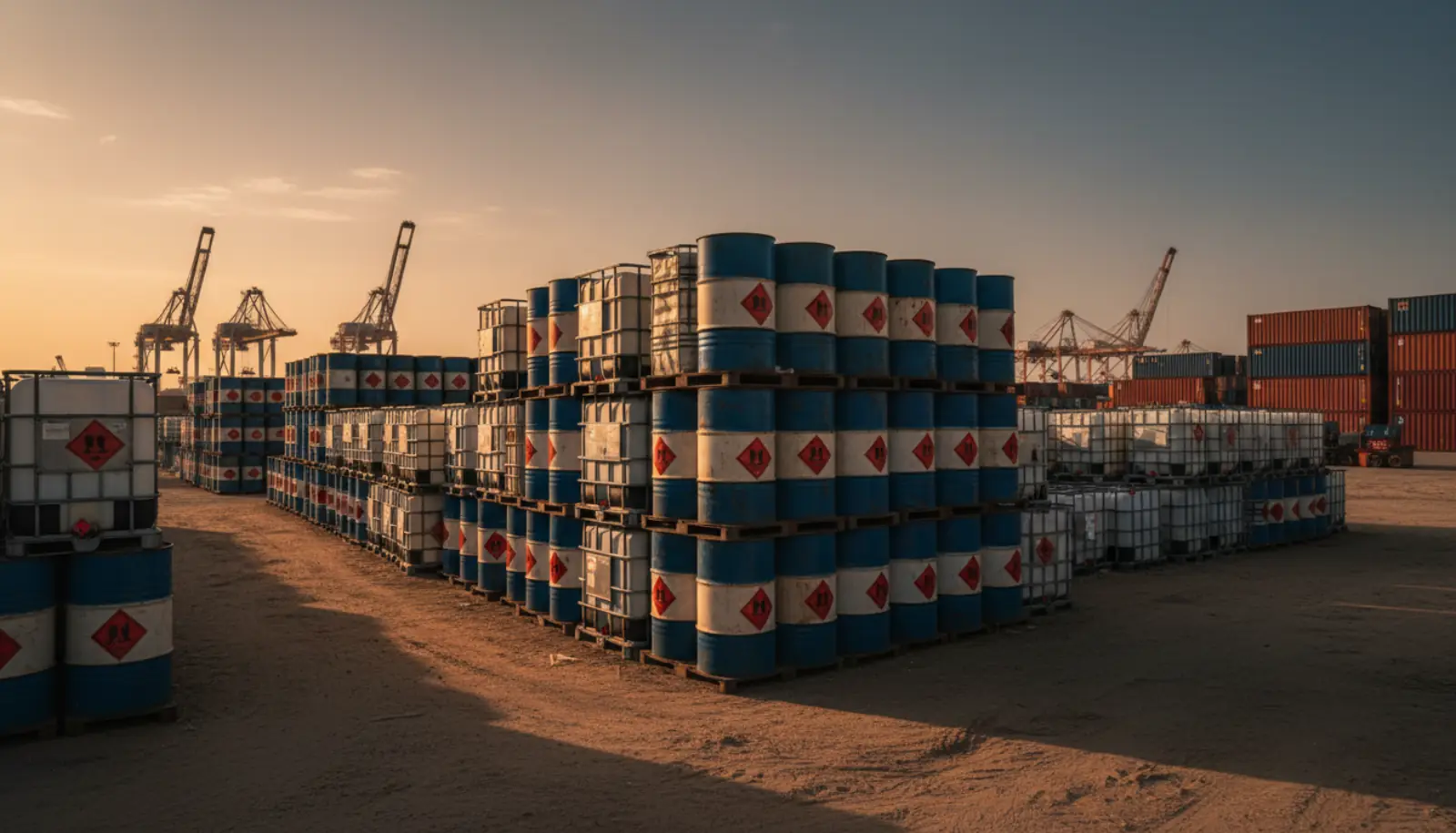
- Packages carry the proper shipping name, the UN number and a hazard label (a diamond-shaped label showing the class) for each hazard.
- Containers carry placards on the outside showing the class, and the UN number where the rules require it, so that port workers and responders can see what is inside.
- Marine pollutant goods carry an additional mark.
If you buy packaged cargo, ask the seller to state the packaging type, its approval status for the relevant packing group and the marks that will appear, before the packaging is ordered. Repacking filled drums is expensive. Reduced "limited quantity" provisions for small packages rarely apply to commercial bulk trade, so do not assume your shipment qualifies.
The dangerous goods declaration
The dangerous goods declaration is a signed statement, made by the shipper, describing the dangerous goods in the consignment. It accompanies the normal shipping documents. In general terms, it states:
- the UN number, proper shipping name, class and packing group;
- any subsidiary hazards, and whether the cargo is a marine pollutant;
- the number and type of packages and the total quantity;
- flash point, where the rules call for it;
- an emergency contact;
- a declaration that the contents are properly described, classified, packed, marked and labelled and in proper condition for transport.
When dangerous goods are packed into a container, a container packing certificate (sometimes combined with the declaration in a single form) is normally required, confirming that the container was clean and suitable, the cargo was secured and the marks were applied.
Three cautions:
- The declaration is a legal statement. Whoever signs it takes responsibility for its accuracy.
- Consistency matters. The description on the declaration, the invoice, the packing list and the bill of lading should match. Our guide to export shipping documents explains how the document set fits together and where discrepancies arise. If a letter of credit is involved, a mismatch can also become a payment problem; see the letter of credit guide.
- Timing. Carriers often require dangerous goods details well before the normal documentation cut-off. Ask for the deadline at booking.
Segregation and stowage
Some dangerous goods react dangerously with each other, and others should not be near heat, food or accommodation. The IMDG Code therefore sets segregation requirements between classes, using a table, and stowage requirements for each substance, such as on deck or under deck, away from heat sources, or away from living quarters.
At a high level:
- Incompatible classes, for example acids and alkalis, flammable materials and oxidisers, are kept apart by set distances or by being in separate containers or holds.
- Some goods must be kept away from foodstuffs, and some are restricted to deck stowage.
The carrier plans the stowage, but what you tell the carrier determines the plan. An incomplete or inaccurate description can lead to unsafe stowage or a rejected booking.
Port and carrier acceptance
Compliance with the international code is necessary but not enough. A dangerous goods cargo passes through several gatekeepers, each with discretion.
- The carrier may accept only specified classes or products, may require advance approval and may charge surcharges.
- The loading terminal may have its own limits and require advance notice.
- Transhipment ports each apply local rules. A route that includes a transhipment adds more parties who can refuse the cargo.
- The discharge port and country may restrict imports of certain goods, require permits or limit what may be discharged at which berth.
Ask early which of these apply on your routing. Chemineral exports from Sohar and Salalah, and the loading port affects the carriers available, so raise dangerous goods at the RFQ stage, not after the offer is accepted.
Packaged cargo versus bulk cargo
The same product can fall under different rules depending on how it travels.
| How it travels | Typical regime in general terms | What changes for the buyer |
|---|---|---|
| In drums, bags or IBCs, stowed on a ship or in containers | IMDG Code (packaged dangerous goods) | Packaging approvals, marks, labels, declaration, container packing certificate, segregation |
| Loose in the hold as a solid bulk cargo | Separate solid bulk code, with the cargo's schedule | Cargo declaration and properties, loading conditions, sampling and moisture or hazard checks |
| In a tanker as liquid bulk | Chemical tanker or oil rules, depending on the product | Vessel type, cargo tank requirements, pollution category |
A product that is unregulated in packages is not automatically free of rules in bulk, because bulk codes have their own cargo-specific requirements, and the reverse also happens. The choice between bulk and packaged is therefore partly a regulatory choice. Our guide to bagged versus bulk fertiliser shipping covers the commercial side of that decision for fertilisers.
Three examples, in general terms only
The examples below show how form changes treatment. They are illustrations, not classifications. For any shipment, use the safety data sheet for the exact product and the rules in force on the date of shipment.
Caustic soda (sodium hydroxide). Caustic soda is generally treated as a corrosive, which is the Class 8 category, in both solid and liquid forms. The proper shipping name, UN number and packing group usually differ between solid and solution forms and may vary with concentration, so the form you buy matters. Corrosives are normally kept apart from acids and from certain other materials, and the packaging has to resist the product. Our caustic soda forms guide explains flakes, pearls and liquid, and the caustic soda product page lists what is offered.
Sulphur. Sulphur's treatment depends on its form and how it is carried. Solid sulphur can be treated as a flammable solid in some contexts, and some rules treat formed sulphur such as granules or pastilles differently from lump or powder. Molten sulphur is a separate case with its own conditions. Sulphur dust can form flammable mixtures with air, which is one reason handling rules matter. Our granular sulphur buyer's guide covers the product, and the sulphur product page the offer. Confirm the transport classification for your form from the safety data sheet and the current rules.
Bitumen. Hot and cold bitumen are not treated the same way. Bitumen that is solid at ambient temperature, for example in drums or in blocks in bags, is commonly not treated as dangerous goods for packaged sea carriage, though that is not a safe general assumption, because it depends on the product's properties and the rules in force. Bitumen carried hot as a liquid may be regulated under provisions for substances transported at elevated temperature, with conditions on the vessel, the packaging and the loading. Cutback bitumen, which contains solvent, is different again, because the solvent can make the product flammable. A grade name does not tell you the regulatory status. Ask for the classification that applies to the packaging and temperature at which your cargo will actually travel.
A pre-booking checklist for buyers
- Get the current safety data sheet for the exact product, form and grade, and read the sea transport entry.
- Get the classification in writing: class, UN number if any, proper shipping name, packing group, marine pollutant status and any conditions.
- Confirm the packaging is approved for that packing group, and the marks that will appear on it.
- Tell the carrier or forwarder at the RFQ and booking stage, with the same description used on every document.
- Ask about the whole routing, including any transhipment, and the discharge port's rules and permits.
- Ask for the documentation deadline, and arrange for the declaration and the container packing certificate to be ready before it.
- Identify who is the shipper of record and who signs the declaration. Under FOB terms the buyer's forwarder books the vessel while the seller supplies the cargo, so the information has to travel between them early.
- Tell your insurer. Cover can be affected by misdescribed or undeclared dangerous goods, so check the policy conditions with your broker. See the marine cargo insurance guide.
- Keep a margin in the schedule for queries.
Decision rules
- If the safety data sheet and the carrier disagree, ask each for the basis of their position in writing, and do not load until it is resolved.
- If the sheet says "not regulated" for sea transport, ask which form, concentration and packaging that statement covers.
- If the form or packaging changes, recheck the classification.
- If you cannot get a written classification, treat that as a reason not to book, not a detail for later.
Frequently asked questions
Are all industrial chemicals dangerous goods?
No. Many are not classified as dangerous goods for sea transport. Whether a product is, depends on its properties and form as set out in the regulations, which is why the written classification matters more than the product's general reputation.
Who is responsible for the dangerous goods declaration?
Under the international rules, the shipper declares the goods and signs the declaration. Who the shipper is on a given sale depends on the contract and the shipping terms, so settle it early with the seller and your forwarder.
Does a UN number mean the cargo is more dangerous?
No. A UN number identifies a substance or group of substances. The hazard class and packing group describe the type and degree of hazard.
The carrier says my cargo is dangerous goods but my supplier says it is not. Who is right?
Neither can be assumed. Ask both for the basis in writing, starting with the safety data sheet's transport section for the exact form. A carrier can also apply its own acceptance policy beyond the regulations.
How early should I tell the carrier?
As early as you can, ideally when you request rates, because acceptance, vessel choice and documentation deadlines can all depend on the answer. There is no single universal lead time, so ask your carrier or forwarder for theirs.
Next step
If you are planning a purchase from Sohar or Salalah and the product, form or packaging raises a classification question, say so in your RFQ and include your discharge port and preferred packaging. Send it through the Chemineral trade desk so the question can be handled before the offer is finalised.
Our trade desk can turn the views in this report into firm offers on today's indicative prices — valid 72 hours, with complete documentation.
Request a quote