Granular Urea in NPK and Bulk Blends: Size, Moisture and Compatibility
Why blenders choose granular urea, and how to match granule size, limit segregation, control moisture and caking, check compatibility and write a purchase specification.

Blenders choose granular urea because it is the form most likely to stay mixed with the other materials in a blend, and a bulk blend only works if its components behave as one. Success comes down to three things: urea whose granule size matches the other components, a store and process that keep it dry, and a compatibility check for every material it touches. When you buy, write those requirements into the specification instead of leaving them to the producer's default.
This guide is for buyers and blend plants that mix granular urea with phosphate, potash and other materials. It covers why granular urea suits blending, size matching, segregation, moisture and caking, compatibility, storage, coatings, and what to specify at purchase. It is general guidance, not agronomic, engineering or safety advice. Your fertiliser technical adviser, the producers' technical bulletins and the safety data sheets decide what is right for your plant and your blends.
Bulk blends and compound NPK: the difference
A bulk blend is a physical mixture of separate granular fertilisers, such as urea, a phosphate and potash, mixed to a target analysis. Each granule is a single material. A compound NPK is made by granulating the nutrients together so that each granule contains all of them. This guide concerns the first. In a bulk blend the mixture is only as good as the weakest link between its components: their size, density, strength and moisture behaviour.
Why blenders choose granular urea
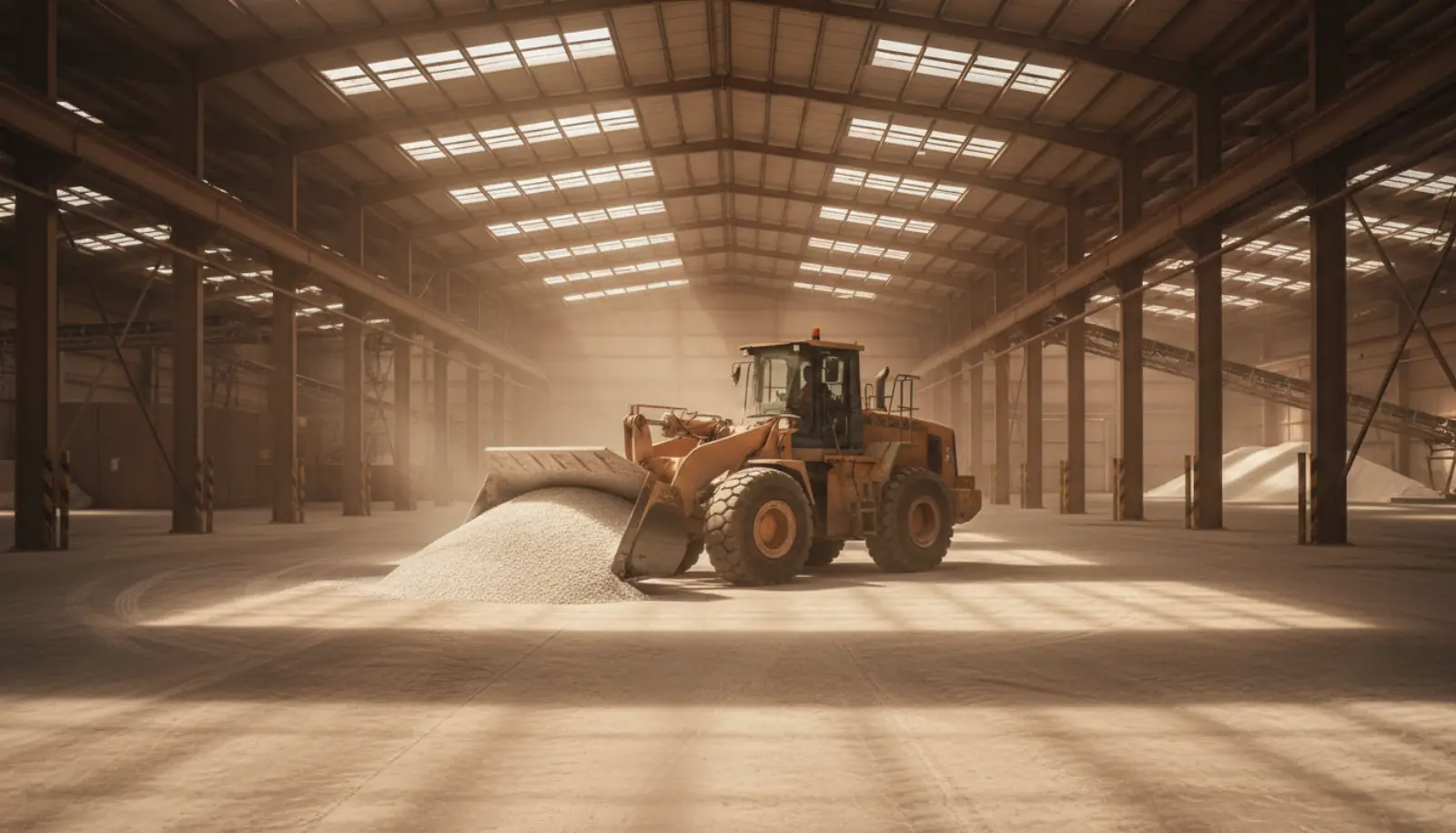
Granular urea is made by building up or spraying and solidifying layers of urea melt on seed particles, producing granules that are larger, rounder, harder and more uniform in size than prills. Our companion guide on prilled versus granular urea covers the manufacturing difference. For blending, the advantages are practical.
- Size closer to the other components. Granular phosphates and potash are commonly coarser than prilled urea. A urea that is closer in size is less likely to separate from them.
- Strength. Harder granules survive conveyors, loaders and spreaders with less breakage, so there are fewer fines to segregate.
- Less dust. Dust is lost nutrient, a housekeeping problem and a source of non-uniform blends.
- Better spreading. Evenly sized granules spread more uniformly in the field, which is where blend quality is finally judged.
- High nitrogen content. Urea contains around 46% nitrogen by weight, which leaves more room in the blend for other nutrients per tonne. See the granular urea 46% product page.
None of this makes granular urea automatically good. Two granular cargoes can differ in size distribution, hardness, moisture and treatment, and the differences decide how they blend.
Size matching: SGN and UI
Two measures describe a fertiliser's granule size on a certificate of analysis.
- Size Guide Number (SGN). A single number for the average or median granule size, where a higher number means coarser granules. It exists so that materials from different producers can be compared quickly.
- Uniformity Index (UI). A measure of how narrow the spread of sizes is around that average. A higher figure means the granules are more alike. A lower one means a wider mix of fine and coarse.
Neither number is enough alone. Two materials can share a median size and still segregate if one has a wide spread and the other a narrow one. A full sieve analysis, showing the percentage retained or passing at each sieve, tells you more than a single figure.
How to compare components
- Collect the size data for every component, from the certificates of analysis or the producers' datasheets, in the same units and on the same test method.
- Identify the outlier. The component most different in size, whether the urea or something else, is the one most likely to separate.
- Compare the spread as well as the average. A material with a lot of fines or oversize needs particular attention.
- Agree a tolerance with your technical team. How close is close enough depends on your equipment, your handling steps and your quality target. We do not give a numeric rule here, because it differs by plant and by process.
- Consider density too. Size is the main driver of separation, but materials of different density can behave differently under the same handling.
- Test before committing to a supplier. Blend a sample and check the result (see below).
A hypothetical illustration
The following is invented to show the method. A blender plans to mix a granular urea, a granular phosphate and potash. The certificates show the phosphate and potash close together in size, but the urea is visibly finer and has a wider spread, with plenty of small granules. In handling, the fine urea granules sift down through the larger ones during loading and vibration, so the first part of the load discharged is rich in coarse potash and the last part is rich in urea. The analysis varies along the load even though the recipe was weighed correctly. The remedy is to change the urea to a coarser, more uniform grade closer to the others, not to blend harder.
Segregation: how it happens and how to limit it
Segregation is the separation of a blend into its components. It is the most common blend quality problem, and it cannot be fixed afterwards by re-mixing a load that has already travelled.
Main mechanisms, in general terms:
- Sifting (percolation). Smaller granules fall through gaps between larger ones when the mass is moved or vibrated, such as during transport.
- Heaping. When material falls onto a heap, the larger and rounder granules tend to roll further down and out, and the finer granules stay near the point of impact.
- Trajectory. When material is thrown from a belt or spinner, larger granules travel further than smaller ones.
- Dusting. Fine particles are carried off by air movement.
Ways to limit it:
- Match sizes first. It is the cheapest and most effective control.
- Reduce handling. Each transfer, drop and pile is a chance to separate. Use fewer transfers and shorter drops.
- Avoid building cones. Pile in layers or use methods that do not let material roll down a heap.
- Blend close to the point of use, and load into bags, trucks or spreaders soon after mixing.
- Limit travel and vibration for loose blends, or consider bagging.
- Sample properly. Take samples from the start, middle and end of a load, and check size and nutrient analysis at each point. A single sample can hide a problem.
- Minimise fines. Keep granule strength high, handle gently and avoid breakage on conveyors.
Hygroscopicity, critical relative humidity and caking
Urea is hygroscopic: it takes up moisture from humid air. Each fertiliser has a critical relative humidity (CRH), the air humidity above which it begins to absorb moisture from the air and below which it stays dry or gives up moisture. Two points matter most.
- CRH falls as temperature rises. The same air that is safe for a material in a cool store can be risky in a warm one.
- A blend usually has a lower CRH than its components. Mixing two materials generally lowers the humidity at which the mixture begins to absorb moisture, so a blend can become damp in air that either component alone would tolerate. Urea's CRH is relatively low compared with some other common fertilisers, which is why blends containing it need care.
Why caking happens
Moisture absorbed at the granule surface partly dissolves it. When the damp air dries or the temperature changes, the dissolved material recrystallises and forms bridges between neighbouring granules. Pressure from the weight of stacked bags or deep piles, and temperature cycling, make this worse. The result is lumps, hardened bags, blocked hoppers and uneven spreading.
Practical rules
- Keep urea and blends away from humid air, especially during humid seasons and in coastal stores.
- Keep bulk piles covered and bags sealed. Use opened bags first, and re-close them.
- Avoid temperature swings that cause condensation inside bags or on stored material.
- Do not blend wet or lumpy material. Moisture already in a component carries into the blend.
- Do not keep a blend longer than necessary. There is no universal safe storage time, because it depends on humidity, temperature, the materials, the packaging and any coatings.
Compatibility with other fertiliser materials
Not every combination of fertilisers is suitable. Some combinations are unsafe, and others reduce quality by releasing moisture, increasing caking, or losing nitrogen. Compatibility can depend on moisture content, particle size, additives, temperature and time, so it is a technical question for each recipe, not a rule of thumb. Always check a recognised fertiliser compatibility chart, the producers' technical bulletins and the safety data sheets before blending a new combination, and test it in a small trial.
In general terms, the points below are the ones to look for. They are examples of categories, not a complete list.
- Strongly hygroscopic nitrate-based materials. Some combinations of urea with certain nitrate-containing fertilisers produce a mixture that attracts moisture very readily and is commonly regarded as unsuitable for blending or storing. Materials containing ammonium nitrate also carry their own storage, handling and regulatory requirements, so do not improvise with them. Take advice and follow the safety data sheet and local rules.
- Some phosphate fertilisers. Certain phosphate carriers, notably some superphosphates, can interact with urea in ways that release moisture and cause wetness and caking. Charts often advise limited compatibility or mixing only shortly before use.
- Alkaline materials. Alkaline materials such as lime can promote loss of nitrogen as ammonia from urea.
- Powders and additives. Fine powders, such as some micronutrient forms, segregate easily in a coarse blend. Granulated forms behave better. Check the granule size of each trace element source.
- Coated and slow-release products. These are different products from standard urea. Coatings can be damaged by abrasion in handling, which changes how the nutrient is released. Check handling guidance from the producer.
- Residues in equipment. Residues of a previous material in hoppers, belts and mixers can react with, or contaminate, the next. Clean and dry equipment between incompatible materials.
Decision rule: if you cannot find a recognised compatibility reference for a pair of materials, do not blend them commercially until your technical adviser has approved the combination and you have run a trial.
Storage and handling
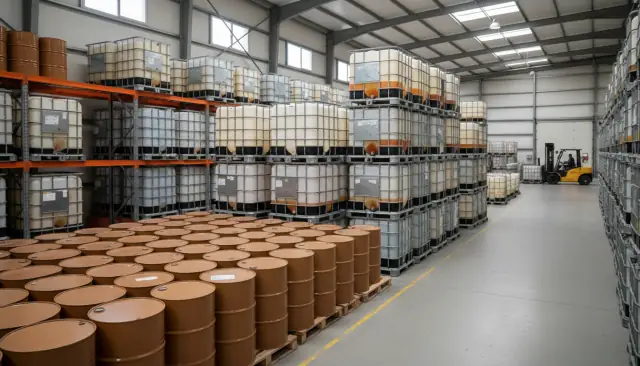
- Store dry. A covered, ventilated building with a sound floor is the baseline. Bagged stock should sit on pallets, off the floor and away from walls.
- Respect stack height. Follow the packaging maker's guidance, because pressure at the bottom of tall stacks promotes caking and can split bags.
- Keep apart. Separate urea and blends from incompatible materials, including nitrate-based products and alkaline materials such as lime, and from sources of water.
- Rotate stock. Use older stock first, and track batch numbers.
- Keep equipment dry and clean. Wet hoppers, belts and loader buckets transfer moisture directly to the product.
- Manage dust. Dust from granular urea is less than from prills but still present. Use suitable dust control and personal protective equipment as your safety data sheet and risk assessment indicate.
- Check the packaging on arrival. Torn or wet bags are a warning of moisture damage inside. See our guide to bagged versus bulk fertiliser shipping for how the cargo format affects risk during the voyage and discharge.
Moisture, coatings and conditioners
Moisture content. The lower the moisture in the urea going into the blend, the longer it resists caking. Moisture should be a stated maximum in your specification, with a test method, and measured at loading. See our urea specification guide for how the figure is reported.
Conditioners and coatings. Granular urea is commonly treated to improve hardness and moisture resistance, either by an additive in the melt during granulation, a surface coating, or both. The type varies by producer, and our specification guide notes that formaldehyde-based conditioners are widely used. This matters for blending in three ways:
- Two granular cargoes of similar size and strength can behave differently if their treatments differ.
- Some end uses and markets are sensitive to additives, so declare your end use at enquiry and ask for the safety data sheet and a statement of the treatment.
- A coating that helps in storage can be abraded during handling, so keep handling gentle.
Troubleshooting a blend
| Symptom | Likely causes | First checks |
|---|---|---|
| Nutrient analysis varies along a load | Size mismatch, wide spread, long drops, heaping | Compare size data for all components; sample at start, middle and end |
| Lumps and hardened bags | Moisture pick-up, humid store, tall stacks, incompatible components | Moisture of each component, store humidity, stack height, compatibility chart |
| Wet or sticky blend | A combination with low CRH or moisture-releasing interaction | Review the recipe against a compatibility reference; stop using the blend |
| Excess dust | Fines, soft granules, rough handling | Granule strength, fines content, transfer heights |
| Uneven spreading | Segregation or size variation in the blend | Re-check the load samples; review spreader settings |
What to specify when buying granular urea for blending
Write the following into the RFQ and the contract. Items that your producer cannot meet are better discovered before the offer, not after loading.
- Product and nitrogen content: the grade, with a minimum total nitrogen figure.
- Particle size: the sieve range required, the percentage that must fall inside it, and limits on fines and oversize. State the SGN and UI you need if your blend plant works with them, chosen to match your other components.
- Granule strength: a crushing strength figure and the test method.
- Moisture: a maximum at loading, with the method.
- Biuret: a maximum, as for any agricultural urea.
- Treatment: the conditioner or coating, declared and agreed, and the safety data sheet.
- Free-flowing and caking behaviour: ask what evidence the producer has, and say how long you expect to store the product.
- Packaging or bulk: bag type, liner and weight, or bulk loading requirements, and how the cargo will be protected from moisture in transit.
- Samples: a representative pre-shipment sample for a blending trial, if timing allows.
- Inspection: SGS or Intertek pre-shipment inspection of quality and quantity, with the sampling and test methods named. Chemineral can arrange this on request.
- Documents: a certificate of analysis that includes the size distribution, plus the safety data sheet.
Decision rules:
- If urea is the finest component in your recipe, change the urea grade before you change the process.
- If you cannot hold the stock in dry conditions, shorten the blend-to-use time or move to bagging.
- If a producer will not state its size distribution and treatment, treat that as a reason to look elsewhere.
Frequently asked questions
Can I blend prilled urea with granular fertilisers?
You can, but prills are smaller and softer, so the risk of segregation is higher and the blend may stratify in handling and transport. If you do, match sizes as closely as you can and test the result. Our prilled versus granular guide explains the trade-offs.
What do SGN and UI actually tell me?
SGN indicates the average granule size and UI indicates how uniform the sizes are. Together they let you compare components quickly, but a full sieve analysis is more informative if a blend is giving trouble.
Why does my urea blend cake?
Most often because moisture has reached it. Check the moisture of each component, the store's humidity and temperature, stack height, and whether any component interacts with urea. A blend is more hygroscopic than its components, so it can cake in conditions where the urea alone would not.
Is urea compatible with all other fertilisers?
No. Some combinations are unsafe or reduce quality. Check a recognised compatibility chart, the producers' technical bulletins and the safety data sheets, and trial any new recipe before commercial production.
How long can I store a urea blend?
As short a time as practical. There is no single safe period, because it depends on humidity, temperature, the components, the packaging and any coating.
Next step
If you are planning a granular urea purchase for a blend plant, send your RFQ with the size range you need, your other blend components, your storage conditions and your packaging preference to the Chemineral trade desk. Firm offers are valid for 72 hours, so it helps to have the specification ready before you ask.
Our trade desk can turn the views in this report into firm offers on today's indicative prices — valid 72 hours, with complete documentation.
Request a quote