Draft Surveys for Bulk Cargo: Accuracy, Outturn and Shortage Claims
How a draft survey weighs a bulk cargo from the ship's draft, where its errors come from, how it compares with shore scales, and how to handle bill of lading versus outturn differences.
A draft survey weighs a bulk cargo by measuring how deep the ship sits in the water before and after loading, and converting the difference into tonnes. It is the standard way to determine the weight of dry bulk cargoes loaded without a weighing system, but it is an estimate with real error margins, so the contract must say which figure governs and what happens when two figures disagree.
This guide explains how a draft survey works, where its errors come from, how it compares with shore scales and belt weighers, why the bill of lading quantity and the outturn quantity rarely match exactly, and how to handle a shortage. It is general guidance, not legal or survey advice; the contract and the surveyor's method statement decide the details on any shipment.
What a draft survey measures
A floating ship displaces a weight of water equal to its own weight. If you know how much water the ship displaces before loading and after loading, the difference is the weight added to the ship. Subtract the things that changed besides cargo, such as ballast water, fuel and fresh water, and what remains is the cargo.
The ship's draft tells the surveyor how much water it displaces. Each ship has a table (the hydrostatic tables) that converts draft into displacement for water of a stated density. The surveyor reads the drafts, measures the water density, looks up the displacement, applies corrections and does the sum twice: an initial survey before loading and a final survey after loading. At discharge the process runs in reverse, with the cargo weight equal to the drop in displacement after allowing for changes in deductibles.
How a survey works step by step
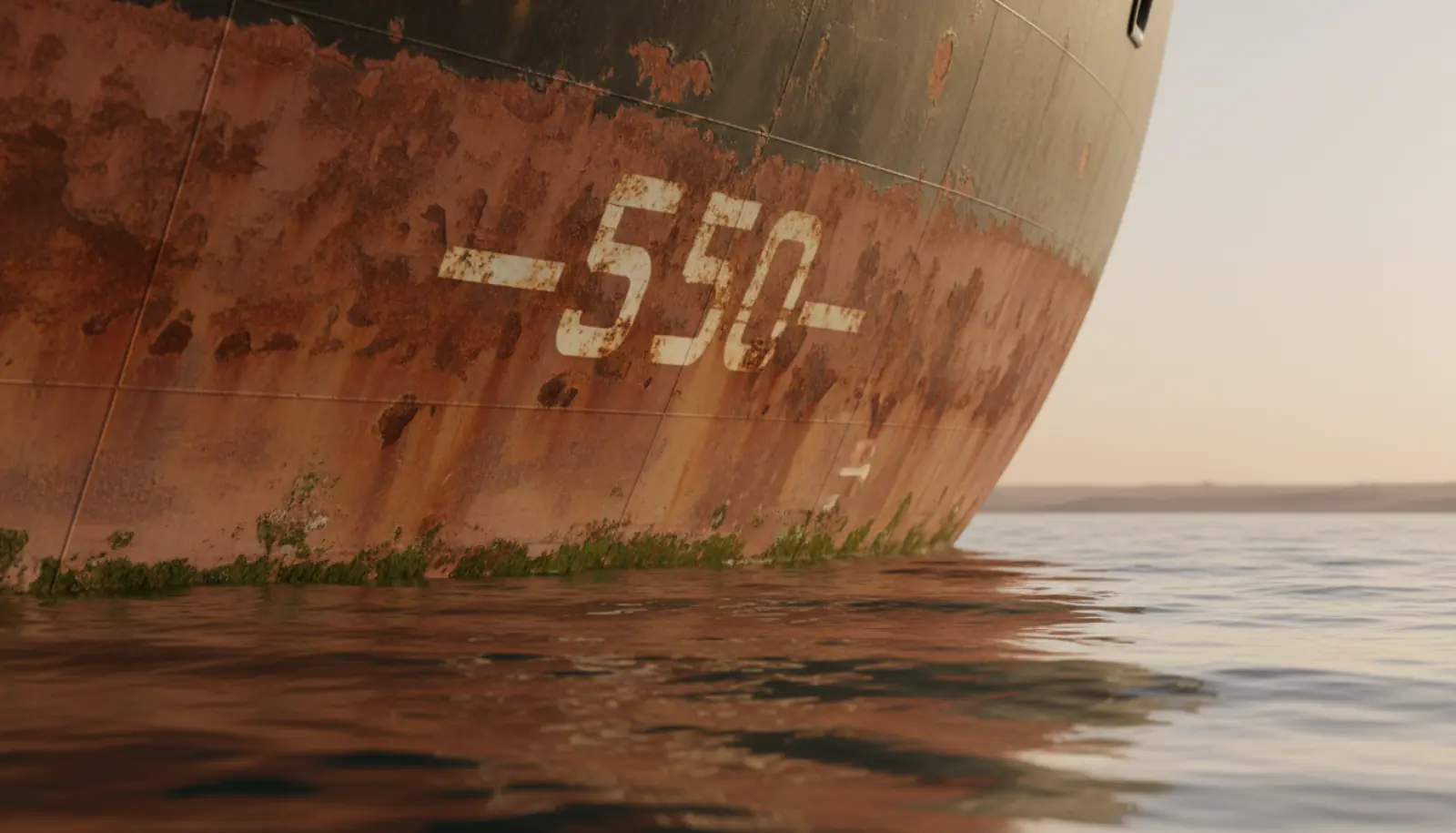
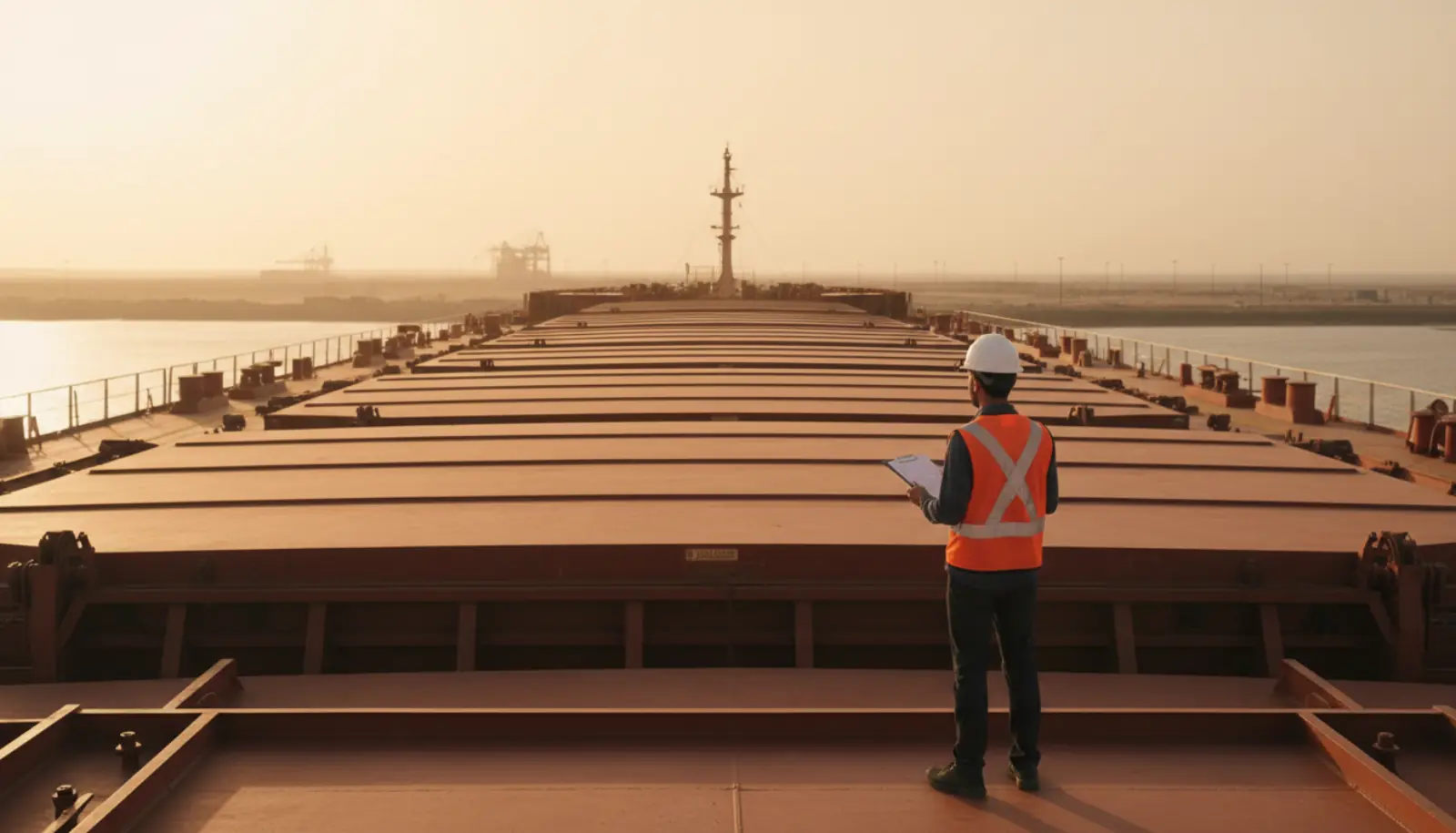
- Read the draft marks. The surveyor reads the marks at six points: forward, midships and aft, on both sides. Readings are taken to the nearest centimetre, often from a boat, in the presence of the ship's officer.
- Correct for trim, list and bending. If the ship is trimmed (deeper at one end), listing to one side, or bending along its length (hogging or sagging), the readings are corrected so that the draft represents an even keel.
- Measure the water density. A water sample is taken alongside the ship, at the depth of the hull, and read with a hydrometer. The density changes between fresh river water and sea water, so this reading matters.
- Calculate displacement. From the corrected draft and the density, the surveyor reads displacement from the ship's tables and adjusts it for the density of the water the ship is in.
- Sound the tanks. Ballast tanks, fuel and diesel tanks, fresh water tanks and slop tanks are sounded or measured to establish how much liquid the ship carries. These are the deductibles.
- Account for the ship's constant. This is a figure covering unknown weights on board such as stores, spares and residues. For the difference method it cancels out if it is the same at both surveys, which is itself an assumption.
- Repeat after loading. The final survey follows the same steps. The cargo weight is the change in displacement minus the change in deductibles.
What counts as a deductible
Anything on board that is not cargo and that changes between the initial and the final survey:
- Ballast water, which is usually the largest and the hardest to measure.
- Fuel oil, diesel oil and lubricating oil.
- Fresh water, both drinking and boiler water.
- Slops and bilge water.
- Stores and other movable weights, if they change.
Ballast is the big one. Ships often discharge ballast as they load cargo, and the quantity they discharge can be several thousand tonnes. Any error in sounding the ballast tanks passes straight into the cargo figure.
A worked example (hypothetical)
The numbers below are invented round figures chosen to show the method. They describe no real vessel or cargo.
| Item | Initial survey (tonnes) | Final survey (tonnes) |
|---|---|---|
| Corrected displacement | 20,000 | 45,000 |
| Ballast water | 6,300 | 1,500 |
| Fuel, diesel and lubricating oil | 1,200 | 1,100 |
| Fresh water | 500 | 400 |
| Total deductibles | 8,000 | 3,000 |
The change in displacement is 45,000 − 20,000 = 25,000 tonnes. The change in deductibles is 3,000 − 8,000 = −5,000 tonnes, because the ship carried 5,000 tonnes less ballast, fuel and water at the end than at the start. So the cargo weighs 25,000 + 5,000 = 30,000 tonnes.
Notice that 5,000 of the 30,000 tonnes came from correcting for ballast and bunkers. The cargo figure is only as good as those measurements.
Accuracy: where the error comes from
A draft survey is an inference, not a weighing. When conditions are good and the surveyors are careful, results are commonly within a fraction of a percent of the true weight. When conditions are poor, the error can be larger. There is no universal figure, and anyone who quotes one for your shipment is guessing. The main sources are below.
- Draft reading. Waves, swell, current and poor light make marks hard to read. On a large ship a small reading error is a large weight. Take a hypothetical ship that takes up 50 tonnes for each centimetre of extra draft (a figure called tonnes per centimetre immersion). A 1 cm error in the mean draft at the final survey is 50 tonnes, which is about 0.17% of a 30,000 tonne cargo. Errors at both surveys can add up.
- Water density. Displacement is proportional to density. An error of 0.001 in a density near 1.025 is roughly 0.1% of displacement. On the final displacement in the example above that is about 44 tonnes. Density can also vary across the berth, so a single sample taken from the wrong place misleads.
- Ballast and tank soundings. Ballast tanks that are partly full have a moving free surface and are hard to sound accurately. Tanks that cannot be fully pumped out leave unmeasured residue. An error of 100 tonnes in ballast is an error of 100 tonnes in cargo, or about 0.33% of 30,000.
- Trim, list and hog or sag. Large trim or list makes corrections bigger and less reliable. Surveyors normally prefer the ship close to even keel and upright.
- Ship's tables and marks. The tables are calculated for a design condition. Old ships, hull damage or modifications can make them less reliable, and marks may be faded or misplaced.
- Changing conditions. Cargo or ballast operations during a survey, strong wind, or a ship moving at its berth, all reduce reliability.
Decision rule. For a large cargo, accept a draft survey as the contractual weight only when both sides agree on the method, the surveyor and the conditions in which it is valid. If the weather is bad on the day, ask the surveyors to record the conditions and agree whether to wait or to proceed with a recorded reservation.

Draft survey versus shore measurement
Draft survey is not the only way to find a quantity. The right method depends on the cargo and the equipment at the terminal.
| Method | What it measures | Best for | Main limits |
|---|---|---|---|
| Draft survey | Ship's displacement change | Dry bulk loaded or discharged without scales | Estimate; sensitive to conditions, ballast and density |
| Weighbridge | Truck weight before and after loading | Cargo moved by truck | Needs a calibrated, certified scale and a clear tare procedure |
| Belt weigher | Weight passing a conveyor | Continuous loading and discharge at terminals | Needs calibration and checks; accuracy depends on the installation |
| Shore tank gauging | Level, temperature and density in tanks | Liquids such as bitumen, base oil and caustic solution | Needs calibrated tanks and temperature corrections |
| Bag count and sample weighing | Count of bags times average weight | Bagged cargo | Depends on the count and on sampling the bag weights |
A calibrated, certified weighbridge or belt weigher usually measures weight more directly than a draft survey, so where one is available and the contract accepts it, buyers often prefer it. The draft survey is the usual fallback for dry bulk where no suitable scale exists or where the contract names it. Which one governs is a matter for the contract; do not leave it open.
Liquids and bagged cargo
For liquid cargoes, quantity normally comes from tank measurement. Surveyors record level, temperature and density in the shore tanks and the ship's tanks, then correct to a standard temperature. Differences between ship and shore figures are normal, and the oil trades often manage them with a ship-specific factor based on past voyages.
For bagged cargo, a count of the bags is the main quantity evidence, along with checks of sample bag weights. A draft survey can be a cross-check but is not usually the primary figure. Our guide to bagged versus bulk fertiliser shipping explains how the two formats are handled, measured and claimed differently.
Bill of lading quantity versus outturn
The bill of lading (B/L) quantity is the weight written on the bill when the cargo was loaded. It normally comes from the load-port measurement: a draft survey, a shore scale or a tank gauge. The outturn is the quantity measured at discharge. A difference between the two is a shortage if the outturn is lower and an overage if it is higher.
The B/L quantity is evidence of what was shipped, but its force depends on how the bill is worded. Carriers frequently add qualifications such as "said to weigh" or "weight and quantity unknown", which limit its value as evidence against the carrier. The legal effect varies with the governing law, so get advice before relying on the bill alone in a dispute.
Why the two figures differ
A difference does not automatically mean cargo went missing. Many causes are measurement or condition effects:
- Different methods. A draft survey at the load port and another at the discharge port will not give identical answers, even for a cargo that has not changed.
- Different surveyors and conditions. Different people, tides, water densities and ballast states.
- Moisture. Some cargoes gain or lose moisture on the voyage. A hygroscopic cargo can take up moisture and weigh more at discharge, while drying can reduce weight.
- Residues. Material left in holds, on conveyors, on the quay or in lines is not in the outturn.
- Dust and spillage. Loss during handling, especially for fine or granular cargo.
- Real loss. Leakage, damage, theft or pilferage, or cargo discharged to the wrong place.
The task is to separate normal measurement difference from real loss. That needs good data from both ends, which is why independent surveys at load and discharge matter.
Trade tolerance: what it is and what it is not
Contracts use "tolerance" for different things. Keep them apart.
- Quantity tolerance. The "more or less" clause lets the seller deliver a quantity within a stated range of the contract quantity (for example, plus or minus a percentage at the seller's or buyer's option). It decides whether the seller has delivered the right quantity. It does not deal with shortage in transit.
- Shortage or transit-loss allowance. A figure in the contract that sets how much difference between B/L and outturn is accepted as normal. It decides whether the buyer can claim.
- Franchise versus deductible. Under a franchise, no claim lies for a shortage below the threshold, but the whole shortage is claimable once the threshold is passed. Under a deductible (an excess), the threshold is subtracted from every claim. The two give different results for the same shortage, so the contract should say which applies.
Use only the figures your contract states. Percentages vary by product, packaging and trade, and any rule of thumb you hear from others may not match your terms.
Decision rule for the contract
State, in this order: which method sets the load-port quantity, which method sets the discharge quantity, who appoints and pays the surveyors, whether the allowance is a franchise or a deductible and how big it is, and whose figure governs if the two sides' surveys disagree.
Handling a shortage claim
If the outturn is lower than the B/L quantity by more than the contract allows, act quickly. Evidence disappears within days.
- Record it at discharge. Make sure the discharge survey is done by an independent surveyor, ideally attended by both sides. Do not sign delivery or tally documents as clean if you disagree with the figures; add remarks.
- Give written notice. Notify the seller, the carrier or its agent, and your insurer as soon as the shortage is known. The contract of carriage and the sale contract each set notice requirements. Under the Hague-Visby Rules, where they apply, notice of loss is due at or before delivery, or within three days if the loss is not apparent, and legal action must be started within one year of delivery. The rules apply only if the carriage contract incorporates them, so check which regime governs your bill.
- Preserve the evidence. Keep the survey reports, hold or tank inspection findings, samples, photographs and tally sheets. Keep the bill of lading, the load-port quantity certificate and the discharge records together.
- Compare like with like. Check the load-port certificate against the discharge survey method, the density used, the ballast and the conditions. A mismatch in method may explain the whole difference.
- Quantify the claim. Shortage in tonnes, minus any allowance, at the contract value.
- Decide who to claim against. The seller under the sale contract, the carrier under the bill of lading, or the insurer under the policy. The route depends on the Incoterm, where the loss happened and what the documents say. Our marine cargo insurance guide covers the insurance side.
Policies often treat ordinary loss in weight as outside cover and may apply an excess to shortage on bulk cargo, so do not assume that insurance will pay a small shortage.
Preventing disputes before loading
Disputes are cheapest to settle before the ship sails.
- Appoint an independent inspector at the load port. Chemineral offers SGS or Intertek pre-shipment inspection. Agree in the contract whether the scope covers quantity as well as quality. See SGS certification for petrochemicals for what the certificates contain.
- Agree the governing method in the contract. Draft survey, shore scale or tank gauge, and which figure appears on the bill of lading and the certificate of weight.
- Invite both sides to the survey. Joint attendance removes the argument that one side was not present. If you cannot attend, appoint your own surveyor or agree a single independent one.
- Ask for the working papers. Draft readings, density, tank soundings and calculation sheets, not just the final certificate.
- Check the conditions. Ask the surveyor to record weather, trim, list and anything unusual.
- Match documents. The B/L, the quantity certificate and the invoice should show the same quantity and unit. If a letter of credit is involved, mismatches can also cause discrepancies; see our letter of credit guide.
Frequently asked questions
How accurate is a draft survey?
It depends on the ship, the conditions and the surveyors. In good conditions, results are commonly within a fraction of a percent of the true weight, but errors in draft readings, density and ballast soundings can make them larger. No single figure applies to every survey.
Is a draft survey as reliable as a weighbridge or belt weigher?
Usually not. A calibrated, certified weighbridge or belt weigher measures weight more directly. A draft survey infers weight from displacement. It remains the practical method where no suitable scale exists.
Why does my outturn differ from the bill of lading quantity?
The two figures are measured by different methods, at different places, by different people. Moisture, residues, dust and handling losses add to the difference. A shortage claim has to show that the difference is more than normal measurement variation and any allowance in the contract.
Who pays for the draft survey?
The contract decides. Commonly each side pays for its own surveyor, or the cost is shared when a single independent surveyor is appointed. State it in the contract rather than leaving it to custom.
What is the difference between a franchise and a deductible?
With a franchise, no claim is payable below the threshold, but the full shortage is payable above it. With a deductible, the threshold is always subtracted from the claim. The same shortage can give different results under each, so the contract should name the one that applies.
How soon must I claim for a shortage?
As soon as you know. Time limits come from the sale contract, the bill of lading terms, any convention that applies and the insurance policy, and they vary. Give written notice to all possible respondents immediately, then confirm the deadlines with your adviser.
Next step
If you are buying a bulk cargo from Sohar or Salalah and want the quantity method, surveyor and shortage terms written into the offer, send your product, quantity and discharge port to the Chemineral trade desk through our contact page. Firm offers are valid for 72 hours.
Our trade desk can turn the views in this report into firm offers on today's indicative prices — valid 72 hours, with complete documentation.
Request a quote