
Particle Size, Sieve Analysis and Mesh: How to Read and Specify Size for Granules, Powders and Pellets
Why size distribution decides flow, blending, dissolving and dust, how sieve and laser methods work, how mesh numbers relate to microns, how to read a size table, and how to write a size specification that can be tested.
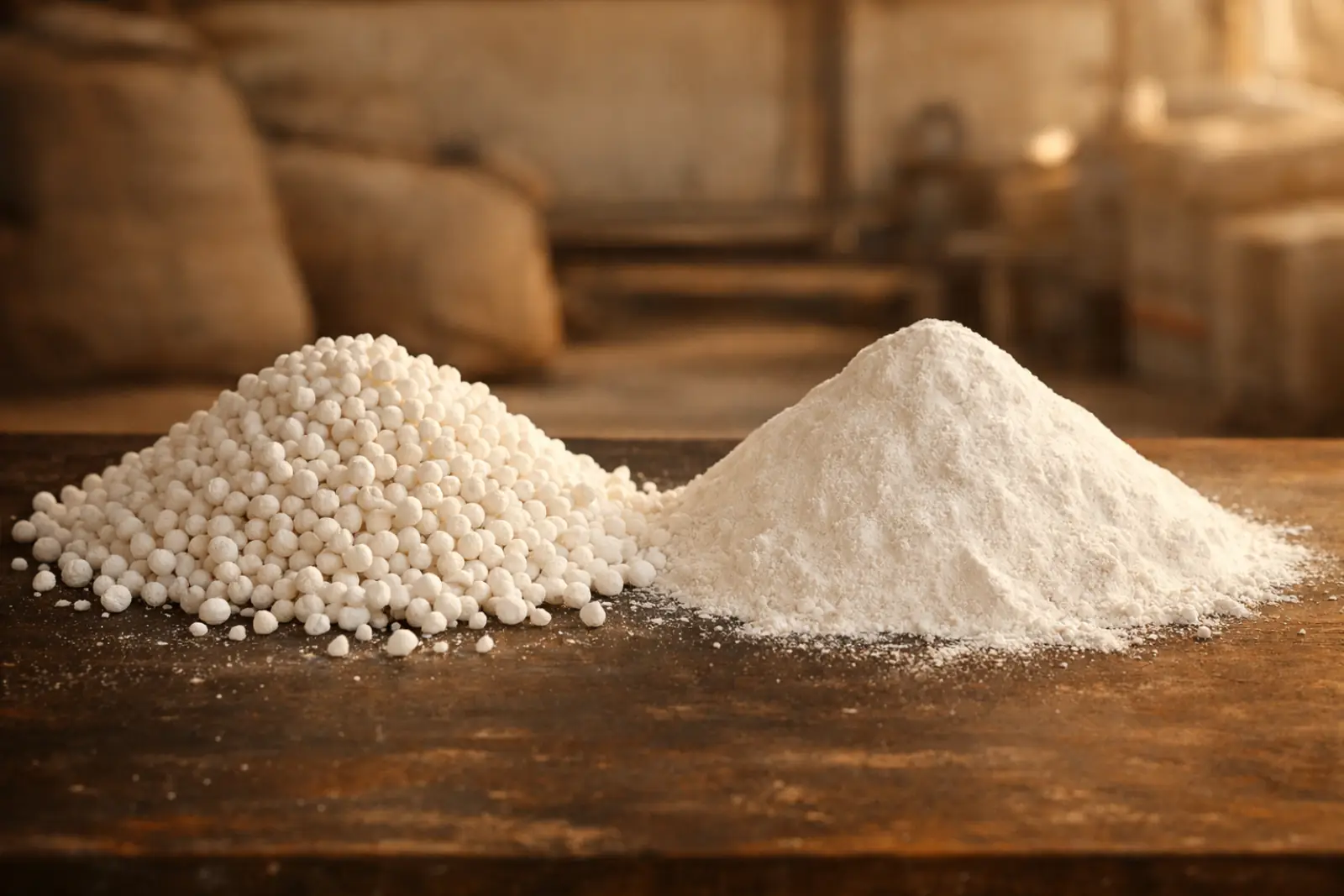
Two cargoes of the same product, with the same purity and the same moisture, can behave very differently in your plant. One flows from the hopper like water and blends evenly. The other bridges, dusts, segregates in the mixer and leaves the spreader streaky. The difference is often particle size: not the average size, but the spread of sizes around it. Size is one of the most commonly specified properties in bulk solids, and one of the most commonly misread.
This guide explains why size matters, how it is measured, how to read a size table, how mesh numbers relate to millimetres and microns, and how to specify size so that it can be tested and agreed. It is general guidance. The method named in your contract decides what a figure means, and the numbers that suit your process come from your own engineers. For product-specific size points, see our guides to the urea specification, calcium carbonate GCC and PCC, activated carbon selection and granular sulphur.
Why size matters
Answer first: size controls how a solid flows, mixes, dissolves, dusts and packs. Because every use depends on some of these, size appears on most specifications.
Flow
Coarse, round, uniform granules flow freely. Fine powders are cohesive, hold air, bridge over hopper outlets and stick to walls. A cargo with a lot of fines may flow badly even if most of its particles are coarse, because the fine fraction fills the gaps and binds the rest together.
Blending and segregation
When products of different sizes are mixed, the particles tend to separate during handling. Fine particles sift down and coarse particles roll to the edges of a pile, so a blend that was even in the mixer arrives uneven in the field or the bag. Fertiliser blenders pay close attention to this, and keep the size ranges of the components close together so they stay mixed. Our guide to urea in NPK blending discusses how size compatibility affects a blend.
Dissolving and reactivity
Fine particles have more surface area per tonne, so they dissolve and react faster. That is useful for a product that must go into solution quickly, and a drawback where a slow release or a controlled reaction is wanted. Surface area also affects how quickly a solid takes up moisture.
Dust and safety
Fine particles create dust, which is a handling nuisance, a health concern and, for combustible materials, an explosion risk. Limiting fines reduces dust. See our guide to sulphur dust and fire safety.
Caking and storage
A wide size range packs densely, which increases contact points and can worsen caking in hygroscopic products. See urea storage and caking.
Application performance
- Fertiliser spreading. Uniform size lets a spreader throw evenly across a wide width.
- Filler in plastics and paint. Size distribution sets opacity, gloss, smoothness, viscosity and mechanical effects. See calcium carbonate in paint, paper and construction and in masterbatch.
- Activated carbon. Size affects flow resistance in a bed, adsorption speed and how well a carbon is retained by screens.
- Polymer pellets. Size and uniformity affect feeding and melting in an extruder.
Bulk density
Size and size distribution change bulk density, and therefore how much fits in a bag, container or hold. See stowage factor and bulk density.
Measuring size: the main methods
Sieve analysis
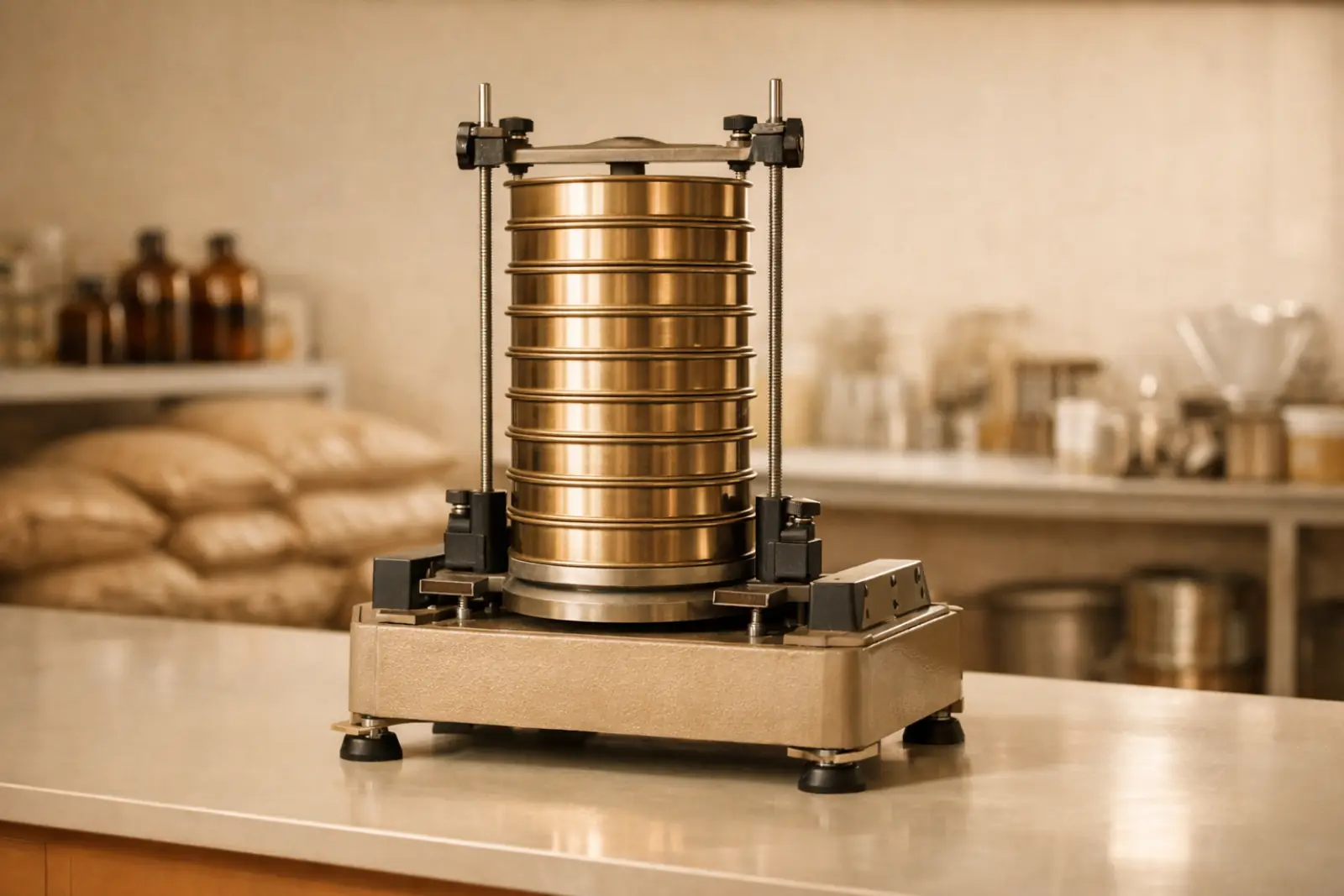
Answer first: sieve analysis passes a weighed sample through a stack of sieves with progressively smaller openings and weighs what stays on each. It is simple, cheap and standard for granules and coarse powders.
The steps are straightforward:
- A representative sample is dried if the method requires it, and weighed.
- It is placed on the top sieve of a stack, with the coarsest openings at the top and the finest at the bottom, over a collecting pan.
- The stack is shaken for a set time, by machine, so particles can fall through the openings they fit.
- The material retained on each sieve and in the pan is weighed.
- Results are expressed as the percentage retained on each sieve, or the cumulative percentage passing or retained.
Points that affect the result:
- Sample size and representativeness. Too much material overloads the sieves, and an unrepresentative sample misses fines or oversize. See representative sampling.
- Shaking time and intensity. Too short and particles do not reach their sieve. Too long, and soft particles break.
- Moisture. Damp material clumps and sticks to the mesh, giving a coarser result.
- Particle shape. Needle or flake-shaped particles may pass an opening end-on, so sieves measure the second smallest dimension, not a diameter.
- Sieve condition. Worn or blinded sieves give wrong results, so sieves should be inspected and calibrated.
Laser diffraction
For fine powders, from a few microns up to a millimetre or so, laser diffraction is common. A sample is dispersed in air or liquid and passed through a laser beam, and the pattern of scattered light is converted by software into a size distribution. It is fast and gives a full distribution, but the result depends on the dispersion method, the assumed optical properties and the software model, so two instruments or two operators can differ. Always state the method and the dispersion conditions.
Other methods
- Sedimentation. Measures how fast particles settle in a liquid.
- Image analysis. Photographs particles and measures them, which gives shape information as well as size.
- Air jet sieving. Uses air to pull fine powder through a single sieve, useful for cohesive fines.
- Caliper or count methods for pellets, such as the number of pellets per gram or measured pellet dimensions.
Different methods, different numbers
A result from one method does not translate neatly into another, because each measures a different property of the particle. A powder analysed by laser diffraction and by sieve can give different answers. This is why a specification must name the method, and why you should not mix figures from different methods when comparing offers.
Mesh numbers, millimetres and microns
Answer first: sieve openings are given in millimetres or microns, or by a mesh number. A higher mesh number means a finer sieve. The mesh scale depends on the standard, so always check which one is meant.
Aperture
The clear opening between the wires of a sieve is its aperture. It is given in millimetres for coarse sieves and microns (millionths of a metre, written µm) for fine ones. One millimetre is 1,000 microns.
Mesh number
The mesh number, in the system most commonly met in the trade, describes how many openings fit in one linear inch of the screen. More openings per inch means smaller openings, so a higher number means a finer sieve. There are several standard series, such as US and Tyler, and their numbers differ slightly, so a conversion table from the standard in use is safer than memory. As a rough guide for fine powders, a 325 mesh sieve has an opening in the region of 45 microns. Do not rely on rough conversions for contract limits.
Why mesh numbers can mislead
- The mesh number alone does not give the opening if the wire thickness differs between standards.
- "Minus 325 mesh" means everything passes through a 325 sieve, so particles are smaller than its opening. "Plus 325 mesh" means material is retained on it.
- A product described as "200 mesh" may mean a nominal top size, a median or a percentage passing, depending on the supplier.
When you write a specification, give the aperture in millimetres or microns and name the sieve standard, in place of relying on a bare mesh number.
Activated carbon notation
Granular activated carbon is often described with two mesh numbers, such as 8 by 30. This means that most of the granules pass the coarser sieve and are retained on the finer one, so the sizes lie between the two openings. The specification should also state the tolerances on oversize and undersize. See our activated carbon selection guide.
Reading a size table
A typical sieve table looks like this, with invented numbers for illustration:
| Sieve opening | Retained on sieve | Cumulative retained | Cumulative passing |
|---|---|---|---|
| 4.0 mm | 1% | 1% | 99% |
| 3.15 mm | 14% | 15% | 85% |
| 2.5 mm | 52% | 67% | 33% |
| 2.0 mm | 28% | 95% | 5% |
| 1.0 mm | 4% | 99% | 1% |
| Pan | 1% | 100% | 0% |
How to read it:
- Retained is the weight on each sieve as a percentage of the total sample.
- Cumulative retained adds those percentages going down the stack.
- Cumulative passing is 100 minus the cumulative retained, and tells you what fraction is finer than that opening.
- The pan holds everything finer than the smallest sieve.
From the table you can read statements such as "99% passes 4.0 mm", "95% is larger than 2.0 mm" or "90% lies between 2.0 and 3.15 mm". A common specification is written as a minimum percentage within a size band, and maximum percentages of oversize and fines.
Median and percentiles
Single numbers summarise a distribution.
- D50, or the median. Half the sample by weight is finer, half coarser.
- D10 and D90. The sizes below which 10% and 90% of the sample lie. The ratio between them describes the spread.
- D97, D98 or "top cut". A size near the coarse end, used where oversize particles cause problems. In fillers for thin film, fibre or paint, the top cut often matters more than the median, because a few large particles cause defects.
Uniformity
In fertiliser trade, a size guide number is commonly used, with a uniformity index. The size guide number is based on the median size in millimetres, scaled to a convenient number, and the uniformity index compares the fine and coarse ends of the distribution. Together they describe how well two components will blend. Ask your blending partners how they define them, since the exact calculation is a matter of convention.
Fines and oversize
Answer first: the extremes matter more than the middle. Specifications therefore limit the fines and the oversize, as well as setting the main band.
- Fines. Material below a stated size, often limited because it causes dust, caking and segregation. Fines can also develop in transit, because granules abrade and break during handling.
- Oversize. Material above a stated size. It may block screens, nozzles or feeders, or leave visible defects in a thin product.
- Lumps. Agglomerated material is a separate problem, caused by moisture or caking, and is usually reported separately.
Size changes in transit
Size is not fixed at loading. Handling, vibration and conveying break particles, and soft or poorly hardened granules break more. Fines increase and the median falls. This is why crushing strength is often specified together with size for fertilisers, and why discharge-port results may show more fines than loading results. A specification should say where the size is measured, at loading or at discharge, and the claims process should recognise normal degradation. See quality claims and disputes.
Moisture and size
Moisture alters how a sample sieves and can make particles stick together or grow. Measure size on material in the condition the contract specifies, and avoid comparing a dry result with an as-received one.
Size by product
The right figures come from your process, but the typical concerns differ.
- Urea and other fertilisers. Granule size range, fines, oversize, crushing strength and uniformity, tied to the spreading and blending equipment.
- Sulphur. Granule size range, and fines that create dust and fire risk. Powder grades are specified by fineness for particular uses.
- Calcium carbonate. Median size, top cut and sometimes a surface area figure, set by the application, whether paint, paper, plastics or construction.
- Activated carbon. Mesh range for granular carbon, with limits on oversize and undersize, or fineness for powdered carbon.
- Polymers. Pellet dimensions or count, fines and angel hair (stringy particles), which affect feeding and extrusion. See polymer resin quality checks.
- Caustic soda. Flakes and pearls have size and shape differences that affect dissolving and dust. See the forms guide.
How to write a size specification
- State the property in a way that can be tested. For example, a minimum percentage within a size band, with a maximum fines and a maximum oversize.
- Give apertures in millimetres or microns, and name the sieve standard, instead of a bare mesh number.
- Name the method. Sieve analysis, laser diffraction or another, with the standard or procedure.
- Set the basis. Dry or as received, and the sample size.
- Set where it is measured. Loading, discharge or both, and which result is final.
- Allow a realistic tolerance for method variation and normal handling breakdown.
- Link size to related properties such as crushing strength, moisture and bulk density.
- Describe sampling, since size is especially sensitive to unrepresentative samples.
- Say how often it is tested, and who tests it.
- Ask for results on the certificate. See how to read a certificate of analysis.
Chemineral can arrange SGS or Intertek pre-shipment inspection, and size analysis can be included in the scope if you ask for it in advance.
A worked example, for illustration only
The numbers are invented to show the reasoning.
A blender specifies that 90% of a granular fertiliser must lie between 2.0 and 4.0 mm, with no more than 3% below 1.0 mm. The loading certificate reports 93% in the band and 1% below 1.0 mm. At discharge, after several handling stages, the buyer's laboratory reports 88% in the band and 4% below 1.0 mm.
Is it a claim? The first question is the contract. If it says size is measured at loading, the shipped cargo met the specification and the arrival result is normal degradation. If it says discharge, the result is out of limits and the next questions are the method and the sample. The buyer checks that the laboratory used the same sieve standard and shaking time as the contract, that moisture was comparable, and that the sample was drawn from across the cargo and not from the bottom of a bag stack where fines collect. If the retained loading sample, tested by the same method, still shows 93%, the difference is handling. If it shows 88%, the product was marginal at loading.
The same arrival number leads to opposite conclusions depending on three things written in the contract: where size is measured, which method applies and what tolerance is allowed. That is why it pays to agree them before the cargo is shipped.
Common mistakes
- Giving an average size only, with no limit on fines or oversize.
- Using a bare mesh number without the standard or the aperture.
- Mixing methods, comparing laser results with sieve results.
- No sampling plan, so the size result is unrepresentative.
- Ignoring moisture in the sieve test.
- Measuring at loading but complaining at discharge, or the reverse, without a clause.
- Expecting no change in transit.
- Forgetting the top cut for fillers used in thin products.
- Specifying size without crushing strength for fertiliser granules.
- Not matching the size of blend components.
Frequently asked questions
What does a higher mesh number mean?
A finer sieve, with smaller openings. A 325 mesh sieve is much finer than a 20 mesh sieve. The exact opening depends on the sieve standard, so check the aperture in millimetres or microns.
What is D50?
The median particle size: half of the sample by weight is finer and half is coarser. It describes the middle of the distribution but not its spread, so it is usually specified together with a top size or percentile such as D90 or D97.
Why do fines matter if most of the product is the right size?
Fines cause dust, caking, poor flow and segregation, and can be a safety hazard with combustible materials. A small percentage of fines can affect the behaviour of the whole cargo.
Can size change between loading and discharge?
Yes. Handling and transport break particles, so fines increase and the median falls. Agree where size is measured and allow for normal degradation in the contract.
Which method should I specify, sieve or laser?
Sieves suit granules and coarse powders. Laser diffraction suits fine powders. Choose the method that suits the product and your quality control, name it in the contract and use it consistently.
Next step
If you need a product within a particular size range, send the trade desk your product, size requirement and test method, packing and destination through the contact page. We quote Suez and Cape routing side by side for shipments from Sohar and Salalah, and firm offers are valid for 72 hours.
Our trade desk can turn the views in this report into firm offers on today's indicative prices — valid 72 hours, with complete documentation.
Request a quote