
Storing Urea Without Caking: Moisture, Humidity and Handling for Importers
Why urea cakes, how moisture and temperature drive it, what to specify for moisture and conditioning, and practical rules for warehouse stacking, bulk piles, bags and outloading in humid climates.
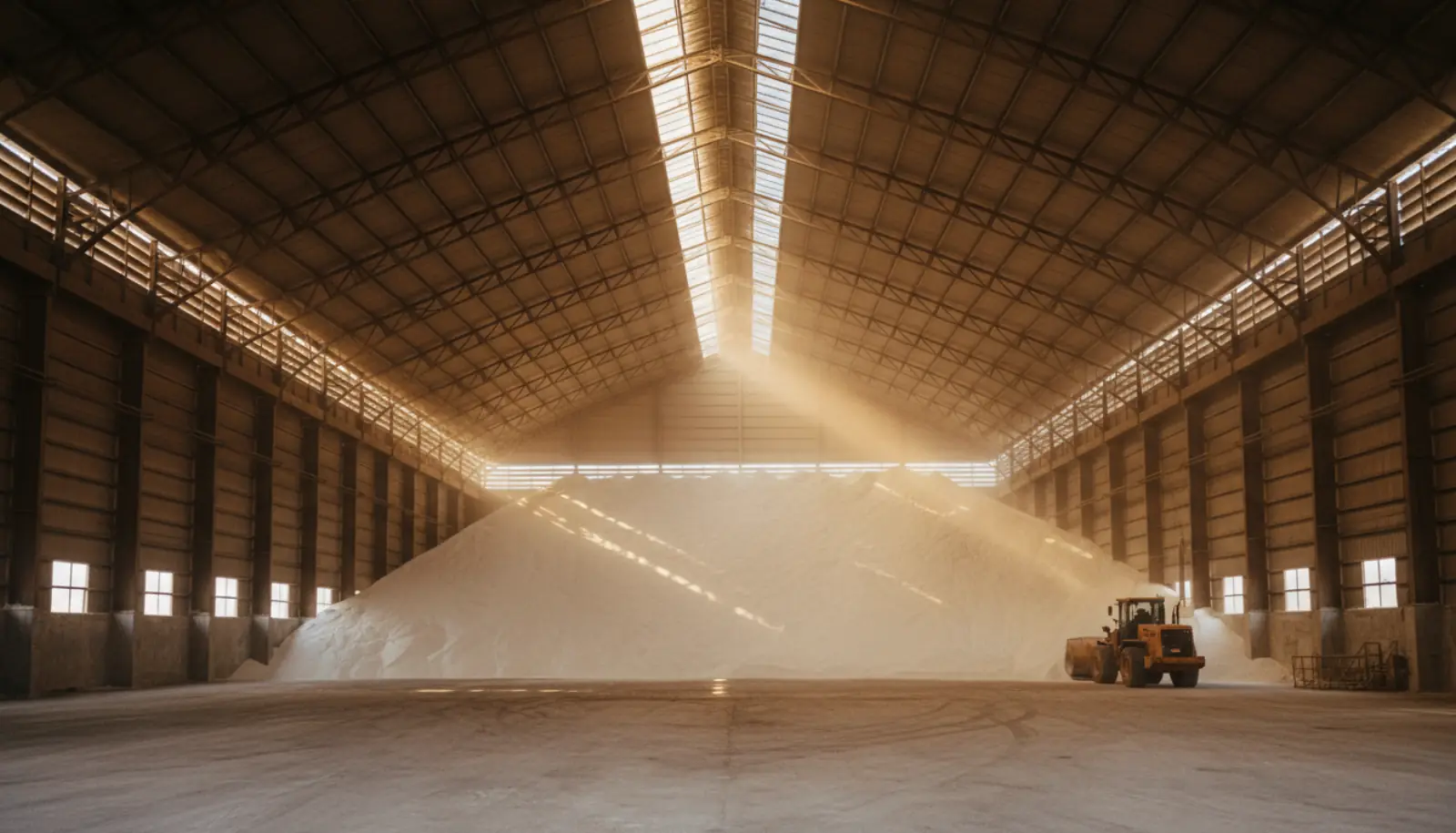
Urea that arrives in good condition can still leave your store as a pile of hard lumps. Almost every case traces back to one thing: moisture getting to the granules or prills, then drying out again and leaving crystal bridges between them. The product was fine at loading. What changed was the air around it, the way it was stacked, or how long it sat.
This guide is for importers, blenders and distributors who hold urea for weeks or months. It explains why urea cakes, which specification points reduce the risk, how to store bagged and bulk product, and what to do at outloading. It is general guidance, not a substitute for the supplier's safety data sheet, your local regulations or an engineer's assessment of your building. For the product forms themselves, see our guide to prilled versus granular urea, and for the specification, the urea specification guide.
Why urea cakes
Answer first: urea is hygroscopic, which means it takes up water from humid air. When the moisture later leaves, dissolved urea recrystallises at the contact points between particles and glues them together.
The basic mechanism
Each granule or prill has a thin surface. When humid air touches it, a film of moisture forms and a little urea dissolves into it. That film is concentrated urea solution. If the air then dries or the temperature changes, the water evaporates and the dissolved urea crystallises, forming tiny bridges between neighbouring particles. Repeat the cycle enough times, or press the stack under its own weight, and the bridges become a hard mass.
Three conditions work together:
- Available moisture. Either moisture already in the product, or moisture arriving from the air, from a leaking roof, from a wet floor or from condensation.
- Contact and pressure. Particles touching each other, with weight on top. The bottom of a tall bag stack is under the most load.
- Cycling. Day and night swings in temperature and humidity, which repeatedly wet and dry the surface.
Remove any one of the three and caking drops sharply. That is why storage advice always comes back to keeping the product dry, keeping it cool and steady, and limiting how high it is stacked.
Humidity is the trigger
Every hygroscopic solid has a humidity level above which it takes up water from the air and below which it does not. For urea this level is relatively low compared with the humidity of many coastal and monsoon climates, and it gets lower as temperature rises. In plain terms, in a warm and humid port town urea will absorb moisture from the air if it is left exposed, and it will do so quickly. You do not need rain for this to happen. Open doors on a humid night are enough.
Because the exact threshold depends on temperature and on the product, ask the supplier for the manufacturer's storage guidance rather than relying on a single number from memory.
Why granules and prills behave differently
Granular urea is usually harder, rounder and more uniform, and it tends to be more resistant to crushing and to dust. Prilled urea is made by a different process and has a different particle structure. Both can cake. In general, harder particles with fewer fines give fewer contact points and less dust to bridge the gaps, but this is a tendency, not a guarantee. Proper storage matters more than the form. Our guides on prilled versus granular and the prilled product page and granular product page cover the differences in detail.

What to specify to reduce risk
Answer first: specify a maximum moisture content, say how and where it is measured, and ask whether the product is conditioned or coated to resist caking. A moisture figure with no test method and no sampling point is easy to dispute.
Moisture content
Moisture is the most important single number for caking. A lower moisture at loading gives a longer safe storage life. Your specification should state:
- The maximum moisture, as a percentage by weight.
- The test method (for example, a recognised oven-drying or Karl Fischer approach, agreed in writing).
- The sampling point: at loading, at the discharge port, or at your warehouse.
- Who pays for testing and which laboratory has the final say.
Moisture can rise between loading and receipt if the cargo is stowed carelessly or hatches are opened in rain. For that reason many buyers ask for loading-port inspection by an independent surveyor, and then compare against a discharge sample. See choosing an independent inspector or laboratory for how to set that up. Chemineral can arrange SGS or Intertek pre-shipment inspection on request.
Biuret and other chemistry
Biuret is a by-product of urea manufacture that matters mainly for agronomic reasons, because high levels can harm certain crops when applied to leaves. It is not primarily a caking factor, but it sits in the same specification, so confirm the limit that suits your crop and your customers. Our urea specification guide walks through the parameters, and your agronomist can advise on suitable limits.
Size and crushing strength
Particle size range and crushing strength influence both handling and caking. A wide size range means small particles fill the gaps between larger ones, which increases contact points. Low crushing strength means particles break under load, producing fines and dust that bridge more easily. If your business is sensitive to caking, ask for the size distribution and a crushing strength figure, and check that your blending partners are comfortable with both.
Conditioning and anti-caking treatment
Producers sometimes apply a conditioning or anti-caking agent to the surface, or adjust the process to reduce caking tendency. Whether a given product has such treatment, and what it is, varies by producer and grade. Ask the supplier:
- Is the product treated, and with what?
- Is the treatment compatible with your end use (direct application, blending, industrial use)?
- Does the treatment change the safety data sheet or the labelling?
Do not assume the answer. Get it in writing, and make sure it appears on the product specification you receive.
Storing bagged urea
Answer first: keep bags off the floor, under a sound roof, away from walls and moisture, stacked no higher than the bag and your floor can safely take, with the stack rotated first in, first out.
The building
- Roof and walls. The store should be weatherproof, with no leaks and no gaps that let driving rain or humid air flow through freely. Check after every heavy rain.
- Floor. A damp floor sends moisture up through the bottom layer. Use a sealed or sealed-and-covered floor, and put bags on pallets or dunnage rather than directly on concrete. A plastic sheet between the floor and the pallets helps, but sheeting that traps condensation under it can make things worse if it is not managed. Inspect it.
- Doors and ventilation. Keep doors shut in humid weather except when loading or unloading. Ventilation lets the building breathe, but opening it on a humid night brings in moist air. Where possible, move product in and out during the driest part of the day.
- Away from other products. Keep urea apart from acids, strong bases and certain other chemicals. Your safety data sheet and local rules tell you what must be separated.
Stacking
- Height. The lower bags carry the weight of everything above. Tall stacks squeeze the bottom layers and raise caking risk. Use the height limit recommended by the bag manufacturer or the supplier and keep to it, and do not exceed what your floor and racking are rated for.
- Pattern. Cross-stack bags so the stack is stable, and leave a gap between the stack and the walls so air can move and you can inspect for damp.
- Gangways. Keep clear aisles for inspection and for first-in, first-out rotation.
- Opened bags. A torn or opened bag takes up moisture quickly. Reseal it, or use it first, and do not leave partly used bags standing.
Bag quality
A bag that breathes lets humid air reach the product. Many fertiliser bags use a polyethylene liner or a laminated woven polypropylene outer, but quality varies. Ask about the bag construction, whether there is an inner liner, and whether the bag is sewn or heat-sealed. For options and trade-offs on packing, see bagged versus bulk fertiliser shipping.
Storing urea in bulk
Answer first: bulk urea needs a roofed, walled, dry building with a sound floor, kept as full as practical and as cool and steady as practical, and handled as little as possible.
Why bulk is different
A bulk pile has far less exposed surface area for each tonne than a stack of bags, but it holds a lot of weight on itself, so the lower layers are under more pressure. Once a surface crust forms it can protect the pile underneath, which is useful, but the crust itself can be hard to break and may need crushing before the product goes through blending.
Good practice
- Enclosed and roofed. Bulk urea should not sit in the open. Even a short exposure to rain or humid air can create a crust.
- Dry floor and walls. Line contact surfaces if needed and check that the floor does not wick moisture.
- Minimise handling. Every loader pass breaks particles and creates dust and fines, which increase caking.
- Keep a working face. Use a first-in, first-out approach where one end of the pile is used while the other is filled.
- Cover temporarily. If you must pause outloading, cover the exposed face so it does not take up humid air.
- Watch for heat. Large piles can warm up, and warm product sheds and takes up moisture more easily. Do not place bulk product against hot surfaces or in direct sun.
Dust and housekeeping
Dust is both a housekeeping issue and a safety matter. Follow the safety data sheet and your local rules on dust, spillage and personal protective equipment. Sweep and bag spills rather than hosing them down, because urea in solution runs off into drains and can cause environmental harm, and wet residue on the floor feeds a caking cycle.

Humid climates and seasonal risks
Answer first: in humid or coastal regions, assume that anything not protected from moist air will pick up water, and plan storage time to match the product's moisture level at loading.
Seasonal patterns
Monsoon and wet-season months bring the highest risk, but a dry season with cool nights and warm days can also cause cycling as temperature moves around the dew point. Watch for condensation on cold roofs, metal walls and bag surfaces. If you see droplets on the inside of the roof, moisture is moving through your store.
Dehumidification and ventilation
Some stores use dehumidifiers or controlled ventilation. These can help, but they need to be sized to the building and operated correctly. Poorly managed ventilation just brings in more humid air. Ask an engineer or the supplier's technical team whether it is worth the cost in your climate.
Plan around your sales cycle
The longer urea sits, the more chances it has to cycle. If your sales are seasonal, try to arrange deliveries so the stock is turned over before the wettest weeks. Our guide to planning urea purchases around demand seasons covers staggered contracts and lead times that help you avoid holding stock longer than you need to.
From the vessel to the store
Answer first: caking risk starts at loading and discharge, not only in your warehouse. Hatch discipline, dry weather handling and short transfers protect the product on the way.
Loading and the voyage
- Hatches. Hatches should be closed in rain and kept closed when loading stops. A cargo that takes up moisture during a delay may arrive wetter than it left.
- Holds. Holds should be clean, dry and free of residues from earlier cargoes. A pre-loading hold inspection by an independent surveyor is a common safeguard.
- Ventilation at sea. Cargo ventilation rules for fertilisers are specific. Leave it to the master and surveyor, following the vessel's cargo procedures.
For how surveys work on bulk cargoes, see our guide to draft survey for bulk cargo. Chemineral exports from Sohar and Salalah, and the loading-port moisture sample is the baseline everyone compares against.
Discharge and transfer
- Plan to discharge in dry weather where possible, and do not leave open trucks standing in rain.
- Cover trucks and conveyors. A few minutes of rain on an open conveyor is enough to wet the surface layer.
- Keep transfers short. The more times the product is moved, the more it breaks and the more dust and fines it creates.
- Check the first truck. If the first load shows lumps or damp, stop and investigate before the rest follows it.
Containers and bags in transit
Bagged cargo shipped in containers can suffer from "container rain": condensation forming on the container roof when temperature drops and dripping onto the cargo. Desiccant bags, container liners and proper packing help, and your freight forwarder can advise on suitable options. For polymers the equivalent risks are discussed in our container shipping guide, and the principles apply here too.
Testing and monitoring in the store
Answer first: check stock regularly. Catching early caking is cheap, and catching it after months is not.
Simple checks
- Squeeze test. Take a handful from the bottom layer and squeeze. Free-flowing granules are fine. Granules that hold together in a lump need attention.
- Visual inspection. Look for dark patches, damp bags, crust on the pile and lumps at the bottom of stacks.
- Moisture sampling. At intervals, send samples to a laboratory to measure moisture, particularly after a wet spell or after repairs to the roof. Keep a record so you can see the trend.
- Temperature and humidity log. Even a low-cost sensor in the store helps you see when conditions turn and what that does to the product.
Keep records
Record the date of arrival, the batch, the stack location, the conditions you saw and any complaints. If a dispute arises with the supplier, a dated record of when the problem appeared and how the product was stored is the first thing anyone will ask for. Our guide on quality claims and disputes explains why storage evidence matters when a buyer raises a claim.
What to do when urea has already caked
Answer first: separate the causes, treat the lumps carefully, and protect your safety. Lumps can often be crushed and used, but check the effect on size distribution before blending or applying.
- Find the cause. Roof leak, wet floor, open doors, a delay at the port, bad bags or tall stacks? Fix it first, or the next batch will do the same.
- Isolate the affected product. Do not mix caked product into good stock without testing.
- Break up lumps carefully. Use suitable equipment and the right personal protective equipment, and follow your safety procedures. Avoid creating excess dust.
- Re-screen. After crushing, screen the product so oversize and fines are managed, then test size distribution and moisture.
- Decide the use. Crushed urea may suit some applications and not others. Spreaders, blenders and seeders may be sensitive to size, so ask your customer or equipment supplier.
- Document everything. Keep photographs, sample results and dates, particularly if you may raise a claim.
Do not attempt to dry or heat urea in a way that raises the temperature without guidance. Urea decomposes on heating and can release ammonia and other products. Follow the safety data sheet.
Common buyer mistakes
- No moisture limit or test method. The figure is uncheckable, so nobody can be held to it.
- Storing in the open "for a few days". A few days in humid air is enough.
- Stacking bags too high to save floor space, which crushes the bottom layer.
- Leaving opened bags standing, so moist air reaches the product.
- Ignoring condensation on the roof or in containers.
- Rotating stock last in, first out, so old product sits at the back for months.
- Not keeping samples from loading, so there is no baseline when a dispute arises.
- Mixing caked and good product without testing.
A short storage checklist
Before the next shipment arrives, check:
- Is the roof sound and are the walls and doors weatherproof?
- Is the floor dry, and are pallets or dunnage in place?
- What is the maximum stack height and is it respected?
- Is there a first-in, first-out plan with clear aisles?
- Do you have a moisture limit, test method and sampling point in the contract?
- Do you know whether the product is conditioned or treated?
- Is there a plan for discharge in wet weather?
- Who inspects the cargo at loading and who keeps the retained sample?
- Are you logging temperature and humidity in the store?
- Do you have a process for dealing with early caking?
Frequently asked questions
Why does urea turn into hard lumps in storage?
Urea absorbs moisture from humid air. When the moisture later evaporates, the dissolved urea recrystallises between granules and bonds them together. Pressure from tall stacks and repeated day and night changes in temperature and humidity make this worse.
Does granular urea cake less than prilled urea?
Often, because granules are usually harder and more uniform, but it is a tendency and not a guarantee. Storage conditions matter more than the form. Both need a dry, enclosed, steady environment.
What moisture level should I specify?
Ask the supplier for the producer's typical and maximum figures, and set a maximum in your contract with a test method and sampling point. The right figure depends on your storage time and climate, so discuss it with the trade desk and your technical team.
How high can I stack bagged urea?
Follow the height limit given by the bag manufacturer or supplier, and make sure your floor and building are rated for the load. Lower stacks reduce pressure on the bottom bags and reduce caking.
Can I still use caked urea?
Often yes, after crushing and re-screening, but check size distribution and moisture first, and make sure your spreader or blender can handle the result. Follow your safety procedures when breaking up lumps and avoid dust.
Next step
If you import urea and want a specification that covers moisture, size and packing, send the trade desk your volume, form, storage conditions and target market through the contact page. We quote Suez and Cape routing side by side for shipments from Sohar and Salalah, and firm offers are valid for 72 hours.
Our trade desk can turn the views in this report into firm offers on today's indicative prices — valid 72 hours, with complete documentation.
Request a quote