Big Bags (FIBC) Explained: Types, Safe Working Load, Liners and How to Specify Them
A buyer's guide to flexible intermediate bulk containers: construction, safe working load and safety factor, static protection types A to D, liners, filling and discharge options, handling rules and a specification checklist.
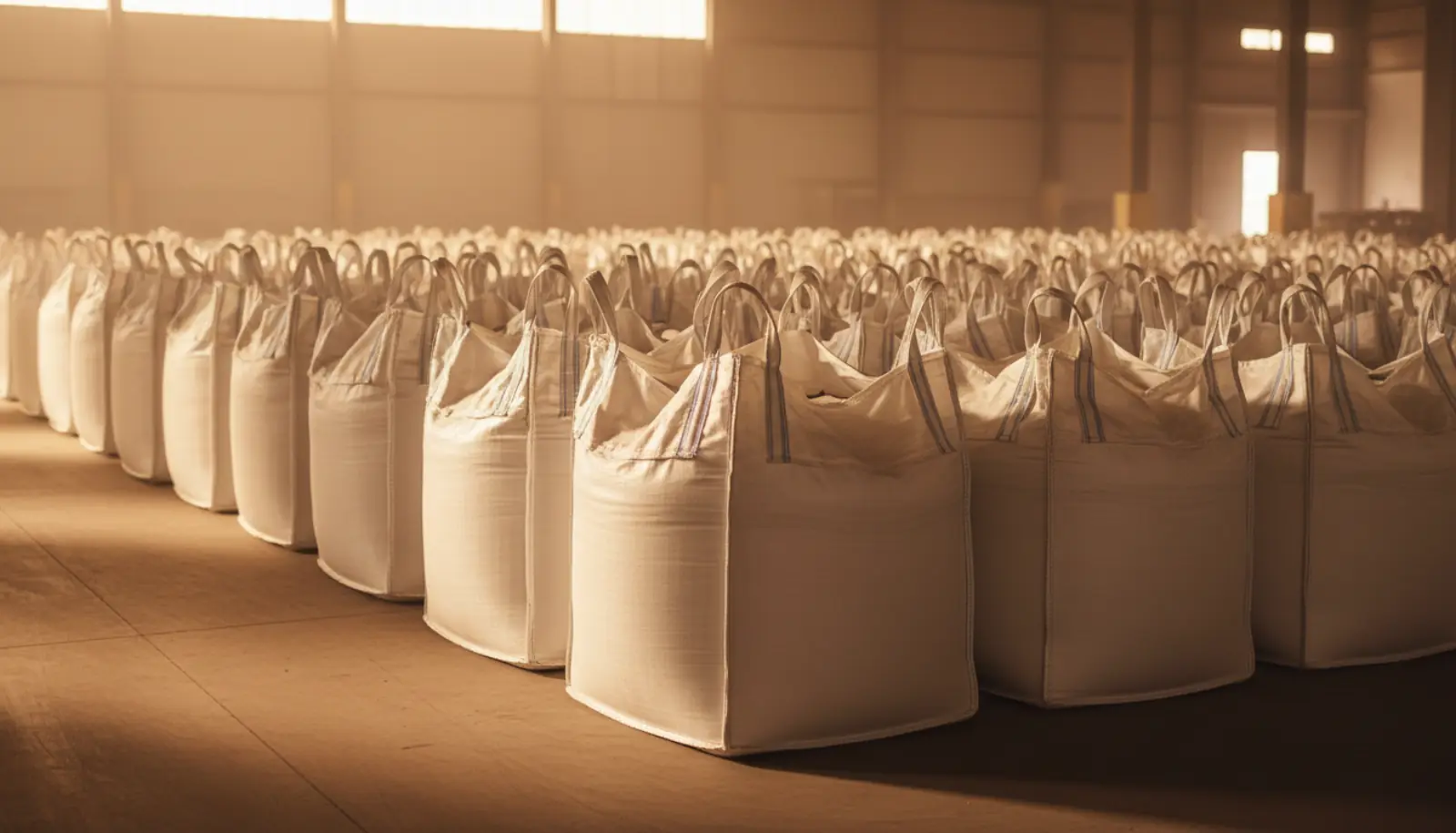
A big bag looks like the simplest piece of packaging in the supply chain: a woven sack with four loops that holds about a tonne. In practice, it is an engineered lifting device, and the choice of bag decides whether the product arrives dry, whether it empties cleanly into your hopper, whether the stack stays upright in a container and, with some powders, whether filling it creates a spark hazard. Most problems with big bags come from buying "a one-tonne bag" without specifying anything else.
This guide explains how flexible intermediate bulk containers, or FIBCs, are built and rated, what the static protection types mean, how liners and spouts are chosen, how to handle bags safely and what to put in an order. It is general guidance. Bags must be selected against the applicable standards, the product's safety data sheet and your own risk assessment, particularly where combustible dust or flammable vapours are present. For the choice between small bags, big bags and bulk, see our guide to bagged versus bulk fertiliser shipping.
What an FIBC is
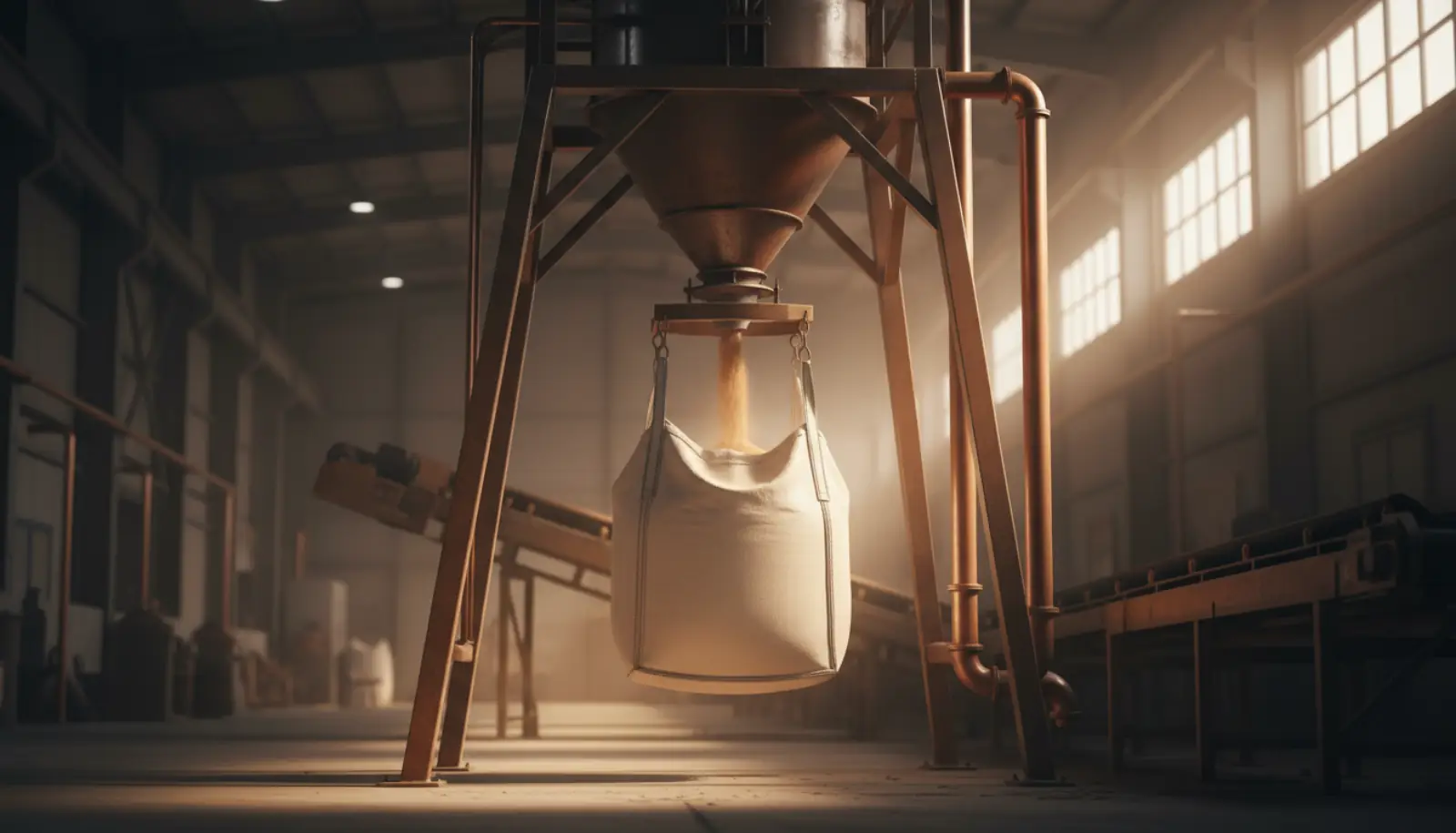
Answer first: an FIBC is a large flexible container, usually woven from polypropylene tape, designed to be lifted from above by loops and to carry bulk solids, commonly between half a tonne and two tonnes.
It goes by many names: big bag, bulk bag, jumbo bag, super sack, tonne bag. The fabric is woven polypropylene, the same material family as ordinary woven sacks, and our guide to polypropylene raffia and fibre grades explains how that tape is made. FIBCs are used for fertilisers, polymers, minerals such as calcium carbonate, sulphur, activated carbon, and many other granular and powdered products.
Why buyers choose them:
- One lift moves a tonne, so loading and discharge are faster than with small bags.
- They can be emptied into a hopper with little labour.
- They need less packaging per tonne than small bags.
- They suit customers who do not have bulk storage.
Their limits are equally clear. They need lifting equipment at both ends, they concentrate a lot of product in one unit, so one damaged bag is a large loss, and they are less forgiving of poor handling.
Construction
Body designs
- U-panel. One long piece forms the bottom and two sides, with two more side panels sewn in. A common, robust design.
- Four-panel. Four separate side panels and a base. Holds a squarer shape.
- Circular or tubular. The body is woven as a tube, so there are no vertical side seams. Useful for fine products, since there are fewer seams to leak, but the bag bulges more.
- Baffle bags. Fabric panels or strings sewn across the inside corners keep the bag square when filled. They stack more stably and use container space better, which matters for container shipping. Very fine or poorly flowing products may not fill the corners behind the baffles well.
Lifting loops
- Corner loops. Four loops sewn to the corners or side seams. The standard design.
- Cross-corner loops. Loops span each corner, so they stand open and are easier for a forklift driver to pick up alone.
- Single-loop and two-loop bags. The body fabric extends into one or two lifting points. Common for fertiliser, quick to handle by hook, and cheaper, with different handling rules.
- Sleeve or tunnel loops. Fabric sleeves along two sides for forklift tines.
- Stevedore straps. Extra straps linking loops, so a crane hook can lift from one point.
Loops must be used exactly as designed. A bag designed for four-point lifting must not be lifted by one or two loops.
Top options
- Open top. No closure. Simple to fill, no protection.
- Duffle top or skirt. A fabric skirt that ties closed. Wide access for filling, reasonable protection.
- Filling spout. A fabric tube sized to the filling machine, tied off after filling. Cleanest and least dusty.
- Flap or cover. A panel that folds over the top.
Bottom options
- Flat bottom. No outlet. The bag is cut open to empty, so it is single use.
- Discharge spout. A fabric tube in the base, tied and often protected by a cover, opened over a hopper for controlled emptying.
- Full-open or conical bottoms for sticky or poorly flowing products.
Match the spouts to your equipment. The diameter and length of the filling spout must suit the filler, and the discharge spout must suit your hopper and any dust control you use.
Fabric, coating and seams
- Fabric weight. Heavier fabric carries more load, and resists abrasion and puncture.
- Coated or laminated fabric. A thin polymer layer on the fabric reduces moisture ingress and stops fine powder sifting through the weave. Uncoated fabric breathes, which suits some products.
- Sift-proof seams. Felt or cord sewn into seams to stop fine powders leaking through needle holes.
- UV stabilisation. Polypropylene degrades in sunlight. Bags are stabilised for a limited outdoor life, but they should still be stored under cover. See our guide to polymer additives for why.
Safe working load and safety factor
Answer first: every bag has a safe working load, the maximum it is designed to carry, and a safety factor, the ratio between the load it survives in testing and that working load. Never exceed the safe working load, and never reuse a bag that was built for one trip.
Safe working load
The safe working load, or SWL, is printed on the bag's label. It is the maximum mass of product the bag may hold. Choose a bag whose SWL is at least the filled weight you plan, and remember that a dense product reaches the weight limit before the bag looks full, while a light product fills the volume before it reaches the weight. The bag's dimensions should therefore be chosen from your product's bulk density. Our guide to stowage factor and bulk density explains the calculation.
Safety factor
Standards for FIBCs define categories by safety factor. The usual ones are:
- Single-trip bags, with a safety factor commonly stated as 5:1. They are designed to be filled once.
- Standard-duty reusable bags, commonly 6:1, designed for a limited number of fills and lifts under controlled conditions.
- Heavy-duty reusable bags, commonly 8:1, for more demanding multi-trip use.
Confirm the category and the standard it was tested to on the bag's certificate and label, not from a general figure. The safety factor is a margin against dynamic forces, wear and imperfect handling. It is not spare capacity, and it does not permit overfilling.
Reuse
A single-trip bag must not be refilled, however sound it looks. Reusable bags should be inspected before each use, for cut or frayed loops, damaged seams, contamination and sun damage, and withdrawn when they show wear. Refilling a bag with a different product also risks contamination.
Stacking
Stacking depends on bag design, product and filling. Bags should be stable, filled to shape and stacked in a pyramid or supported pattern, to the height the manufacturer permits. Baffle bags and well-filled bags stack better. Leaning stacks are dangerous, so restack them immediately. Never allow anyone to stand under a suspended bag or beside an unstable stack.
Static electricity: types A, B, C and D
Answer first: filling and emptying a big bag generates static charge. If the product is a combustible dust, or flammable vapours or gases may be present, the wrong bag can ignite them. Bags are classified into four types by their electrostatic behaviour.
| Type | What it is | General use |
|---|---|---|
| A | Plain fabric, no static protection | Non-combustible products, with no flammable atmosphere present |
| B | Fabric with a low breakdown voltage, to prevent the most energetic discharges | Dry combustible powders, where no flammable vapours or gases are present |
| C | Conductive fabric or interwoven conductive threads, which must be earthed during filling and emptying | Combustible powders, and where flammable vapours or gases may be present, provided the bag is properly grounded |
| D | Static-dissipative fabric designed to dissipate charge safely without an earth connection | Similar environments to type C, where grounding cannot be assured, subject to the maker's conditions |
This table is a general summary. The correct type depends on the product's ignition sensitivity, which comes from test data, on the atmosphere where the bag is filled and emptied, and on the liner used, since a liner can defeat the bag's protection if the two are not compatible. A type C bag that is not earthed can be more dangerous than a plain bag. Selection is a job for a competent person using the relevant standards and the product's safety data sheet.
Products where this matters include sulphur, fine polymer powders, activated carbon and many organic powders. See our guides to sulphur dust and fire safety and how to read a safety data sheet.
Liners
Answer first: a liner is a plastic inner bag that protects the product from moisture and contamination, and protects the surroundings from fine dust. Choose it by what the product needs to be protected from.
- Loose polyethylene liners. A simple tube inserted into the bag. Cheap and common. They can twist or be pulled out during discharge unless they are tabbed or glued.
- Form-fit liners. Shaped to the bag, including the spouts. They fill and empty better, and are less likely to block the outlet.
- Barrier liners. Multi-layer or foil laminates for products very sensitive to moisture or oxygen.
- Conductive or dissipative liners. For use with the matching static-protective bags.
- Attached liners. Sewn or glued in, so the liner does not come out with the product.
Hygroscopic products benefit most. Urea and other fertilisers take up moisture from humid air and cake, and a sealed liner slows that. See our urea storage and caking guide. Liner thickness, sealing and closure method are worth specifying, since a liner that is simply folded over does little.
Some products should be allowed to breathe, or are filled hot and need to cool. Ask the supplier what they use and why.
Regulated and special uses
- Dangerous goods. Products classified as dangerous goods for transport need bags that are tested, approved and marked under the UN packaging system, with a code showing the bag type and performance level. An ordinary big bag is not acceptable. See dangerous goods in shipping chemicals.
- Food and pharmaceutical products. Require bags made in controlled conditions from approved materials, with documentation.
- Fine or toxic powders. May need sift-proof seams, coated fabric, liners and dust-controlled filling and discharge.
- Hot filling. Needs fabric and liners rated for the temperature.
Filling, handling and discharge
Filling
- Hang the bag by all its loops on the filling frame, so it fills evenly.
- Inflate or shape the liner, so the product fills the corners.
- Fill to the specified weight, not by eye.
- Use vibration or settling where needed, to make a stable, square bag.
- Close the liner and the top properly.
- Earth type C bags and follow the static controls for the product.
Lifting and moving
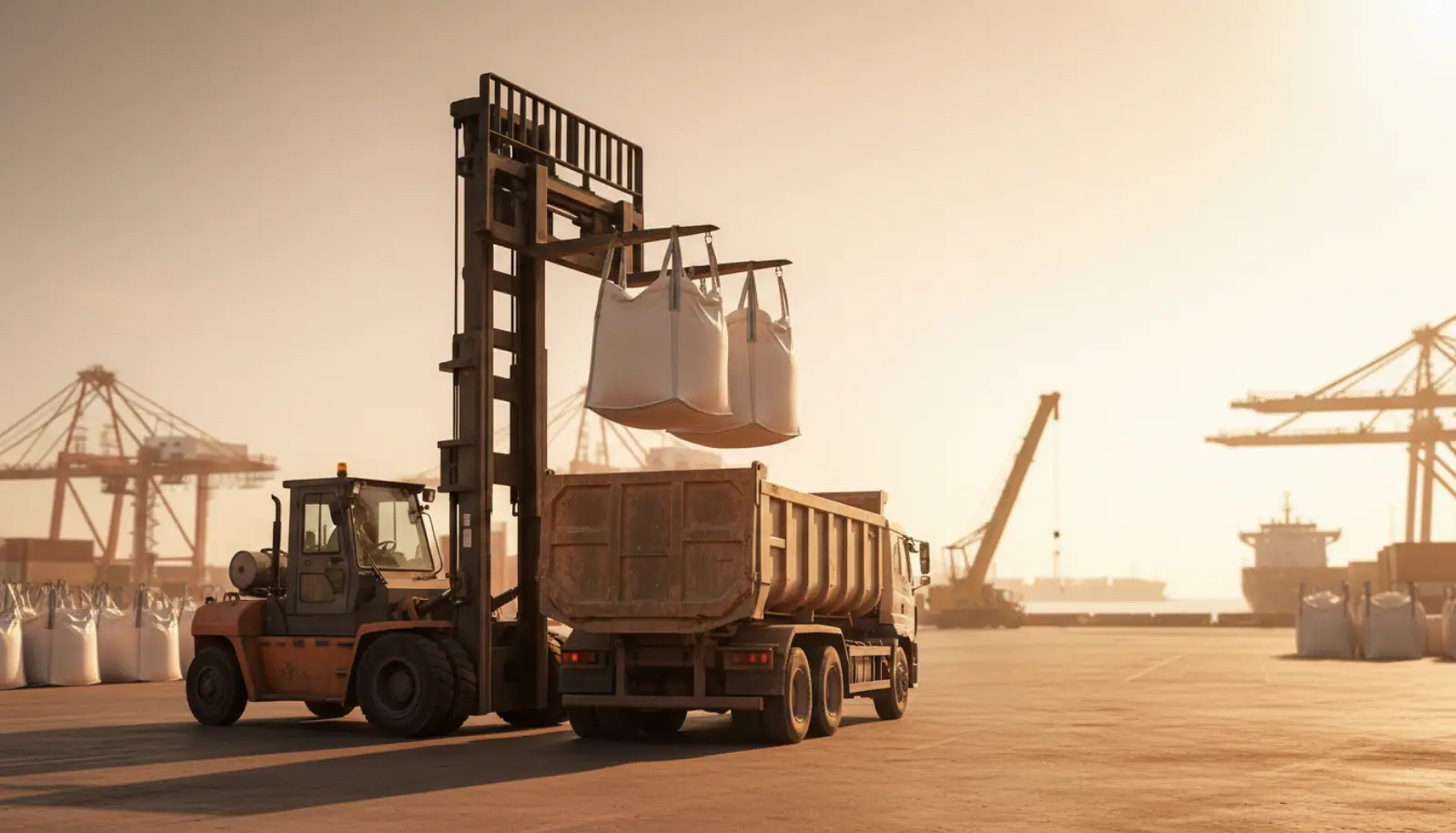
- Use all loops, each on its own tine or hook, with the loops vertical and not twisted.
- Forklift tines should be rounded or sleeved, and set to the loop spacing. Sharp edges cut loops.
- Lift smoothly. Do not jerk, swing or drag the bag.
- Keep the mast tilted back and the load low when travelling.
- Nobody under or close to a suspended bag.
- Do not push bags with the tines or let them rub against walls.
Storage
- Under cover, out of sunlight and rain.
- On clean, dry floors or pallets, away from sharp objects.
- In stable stacks within the permitted height.
- Rotated first in, first out. See our guide to shelf life and storage.
Discharge
- Suspend the bag securely above the hopper before anyone reaches under it. Use a discharge station with a support frame where possible.
- Open the spout from the side, with a tool or a long cord, not with your hand beneath the bag.
- Control the flow with the spout tie or a closure device.
- Manage dust with extraction or a sealed connection.
- Keep the liner from being drawn into the conveyor or screw.
Shipping big bags
- Containers. Bag dimensions should be chosen to fit the container floor in a regular pattern, usually two bags across. Baffle bags waste less space. Check the door opening height against the bag height on its pallet.
- Pallets. Bags can travel on pallets or palletless, depending on handling equipment at destination. Wooden pallets must meet plant-health rules. See pallets and wood packaging.
- Weight. The filled weight, pallets and container tare must stay within the container's limits and the road limits at both ends. See gross, net, tare and verified gross mass.
- Breakbulk. Bags loaded loose into a ship's hold face more handling and more risk of damage. See choosing between bulk, container and breakbulk.
- Moisture. Container condensation can wet the tops of bags. Liners, closed tops and desiccants help.
What to put in the order
- Product and its bulk density, particle size and flow behaviour.
- Filled weight per bag and the required safe working load.
- Safety factor category: single trip or reusable.
- Dimensions, chosen for the product volume and the container or pallet.
- Body design: U-panel, four-panel, circular or baffle.
- Loops: type, number and height.
- Top and bottom: spout sizes or other closures, matched to your equipment.
- Fabric: weight, coated or uncoated, UV stabilisation.
- Seams: sift-proofing if the product is fine.
- Liner: type, thickness, attachment and closure.
- Static type A, B, C or D, decided by a competent person.
- Approvals: dangerous goods certification, food-grade or others if needed.
- Printing and labels: product name, weights, handling symbols and batch.
- Test certificate and the standard the bag was tested to.
- Stacking and palletising arrangement for shipment.
Ask for a sample bag and run a filling and discharge trial before the first shipment. Our guide to qualifying a new supplier explains how to run a trial order.
Common mistakes
- Ordering by weight only, with no dimensions, spouts or liner specified.
- Wrong bag volume for the product's bulk density.
- Reusing single-trip bags.
- Lifting by fewer loops than the bag was designed for.
- Choosing static type by habit instead of from the product's data.
- Using a type C bag without earthing it.
- A liner that is not compatible with the bag's static protection.
- Storing bags in sunlight for months.
- Unstable stacks from under-filled or rounded bags.
- Cutting the base open when a discharge spout was needed.
- Ignoring dangerous goods approval for classified products.
Frequently asked questions
What does FIBC stand for?
Flexible intermediate bulk container. It is the technical name for a big bag, bulk bag or jumbo bag.
How much can a big bag hold?
Commonly between half a tonne and two tonnes, depending on its design. The limit for a particular bag is the safe working load printed on its label.
What does a 5:1 safety factor mean?
It means the bag is tested to withstand a load several times its safe working load. A 5:1 bag is generally a single-trip bag. The factor is a safety margin and does not allow overfilling or reuse.
What is the difference between type C and type D bags?
Both are for situations where static electricity is a hazard. Type C bags are conductive and must be earthed during filling and emptying. Type D bags are designed to dissipate charge without an earth connection, within the maker's conditions.
Do I need a liner in a big bag?
It depends on the product. Liners protect against moisture and contamination and stop fine powder leaking. Hygroscopic or fine products usually benefit, while some products are better left to breathe.
Next step
If you want product supplied in big bags and need to agree bag size, liner and loading pattern, send the trade desk your product, quantity, handling equipment and destination through the contact page. We quote Suez and Cape routing side by side for shipments from Sohar and Salalah, and firm offers are valid for 72 hours.
Our trade desk can turn the views in this report into firm offers on today's indicative prices — valid 72 hours, with complete documentation.
Request a quote