Polypropylene Grades Explained: Homopolymer, Random and Impact Copolymer
How to read polypropylene grades: homopolymer, random and impact copolymer, what melt flow index means for raffia, injection, fibre, film and thermoforming, and which additives matter.
Polypropylene (PP) grades are defined by two choices: the polymer type (homopolymer, random copolymer or impact copolymer) and the melt flow index (MFI). Get those two right and you have narrowed a very large catalogue to a short list; get either wrong and the resin may run badly, fail a drop test or turn up cloudy when your customer expected clear.
This guide is written for buyers who purchase PP in volume: raffia and woven-sack makers, injection moulders, fibre and nonwoven producers, film converters and thermoformers. It explains what each type is, what MFI actually tells you for each process, which additives change behaviour, and how to turn all of that into a clear enquiry.
The short version
- Homopolymer PP (PP-H): stiff, strong, high melting point, good for tapes, fibres, rigid injection parts and oriented film. Brittle in the cold.
- Random copolymer PP (PP-R): a small amount of ethylene is built randomly into the chain. More flexible and more transparent, with a lower melting point. Used in clear containers, cast film, and hot-water pipe systems.
- Impact (block) copolymer PP (PP-B or ICP): a homopolymer matrix containing a rubbery ethylene-propylene phase. Tough at low temperature, opaque. Used in automotive parts, crates, appliance housings and freezer-grade containers.
- MFI (measured on PP at 230°C under a standard load, per ISO 1133 or ASTM D1238) is the main processing dial: low for tapes and thermoforming, medium for general injection and film, high for thin-wall injection and fibre.
Densities for all three types sit close together, typically a little over 0.9 g/cm³, which is why density is rarely the deciding factor. Confirm every figure against the producer's datasheet.
Three polymer types, three behaviours
Homopolymer: stiffness and strength
Homopolymer PP is made only from propylene. Its chains arrange themselves into a highly crystalline structure, which delivers high stiffness, good tensile strength, good heat resistance and a relatively high melting point compared with polyethylene. It is also the lowest-cost route to a stiff plastic part.
The weakness is impact performance at low temperature. At around freezing and below, homopolymer becomes noticeably brittle, which can show up as cracked boxes or split sacks in cold chains and cold climates. For ambient-temperature use, it is the default for most tape, fibre and rigid-moulding work.
Random copolymer: clarity and flexibility
In a random copolymer, a few per cent of ethylene is incorporated at random positions along the polypropylene chain. The effect is to disrupt crystallinity. The polymer becomes more flexible, lower melting, and more transparent. It also seals at lower temperature, which is useful in film and in heat-sealed packaging.
Random copolymer is the standard choice where appearance and softness matter: clear food containers, cosmetic packaging, medical-style disposables and cast film. Specific random copolymer grades are also used in hot and cold water pipe systems because of their long-term pressure and temperature performance. Those pipe grades are qualified against pipe standards and are not interchangeable with general-purpose random copolymers.
The trade-off is lower stiffness and lower heat resistance than homopolymer. If a part must hold its shape in hot service, check the datasheet's heat deflection data rather than assuming.
Impact (block) copolymer: toughness in the cold
Impact copolymer is a two-phase material: a homopolymer matrix with rubbery ethylene-propylene domains dispersed through it. Under impact, the rubber phase absorbs energy and stops cracks. This gives far better low-temperature toughness than homopolymer, at the cost of some stiffness and almost always opacity.
You find impact copolymer in automotive interior and under-bonnet components, battery cases, storage crates and bins, household appliance parts, and any product expected to survive a drop in a cold store or a cold climate. Higher rubber content means higher impact strength and lower stiffness; datasheets typically show this through notched impact figures at stated temperatures and a flexural modulus. Do not assume the numbers between two producers are comparable unless the test conditions match.
Quick comparison
| Feature | Homopolymer | Random copolymer | Impact copolymer |
|---|---|---|---|
| Stiffness | Highest | Lower | Medium |
| Low-temperature impact | Weak | Moderate | Best |
| Clarity | Translucent, can be improved with additives | Best, especially with clarifiers | Opaque |
| Melting and heat resistance | Highest | Lower | Close to homopolymer matrix |
| Heat-seal temperature | Higher | Lower | Not typical for film |
| Typical uses | Raffia, fibre, BOPP film, rigid parts | Clear packaging, cast film, pipe systems | Automotive, crates, appliances |
Treat the table as a relative guide. Specific grades vary a great deal inside each type.
Melt flow index: what it measures and why it matters
MFI is the mass of molten polymer, in grams, that flows through a standard die in ten minutes under a fixed load and temperature. For polypropylene the standard conditions are 230°C with a 2.16 kg load, and the method is defined in ISO 1133 and ASTM D1238. It is sometimes quoted as MFR (melt flow rate), which is the same measurement.
Three practical points:
- MFI is inversely related to molecular weight. Low MFI means long chains, a thick melt and (usually) higher strength. High MFI means shorter chains and an easy-flowing melt.
- MFI is a single point on a flow curve. It tells you little about behaviour at the high shear rates found in injection moulding or spinning. Two resins with the same MFI can fill a mould differently. Molecular weight distribution matters, and datasheets rarely give it.
- MFI is not fixed from reactor to bag. Many high-MFI PP grades are made by controlled degradation (visbreaking) of lower-MFI base resin using peroxide. This narrows the molecular weight distribution, which helps fibre spinning and thin-wall moulding. It also means a grade's behaviour reflects its process history as well as its headline number.
When you quote or compare, state the MFI with its test conditions, and agree a tolerance. Producers publish typical values, and commercial specifications allow a band.
Matching grade to process
The ranges below are described qualitatively because exact windows depend on the machine, tool design and product. Ask your converter or machine supplier for the window that suits your line, and verify against the producer's datasheet.
Raffia, tape and woven sacks
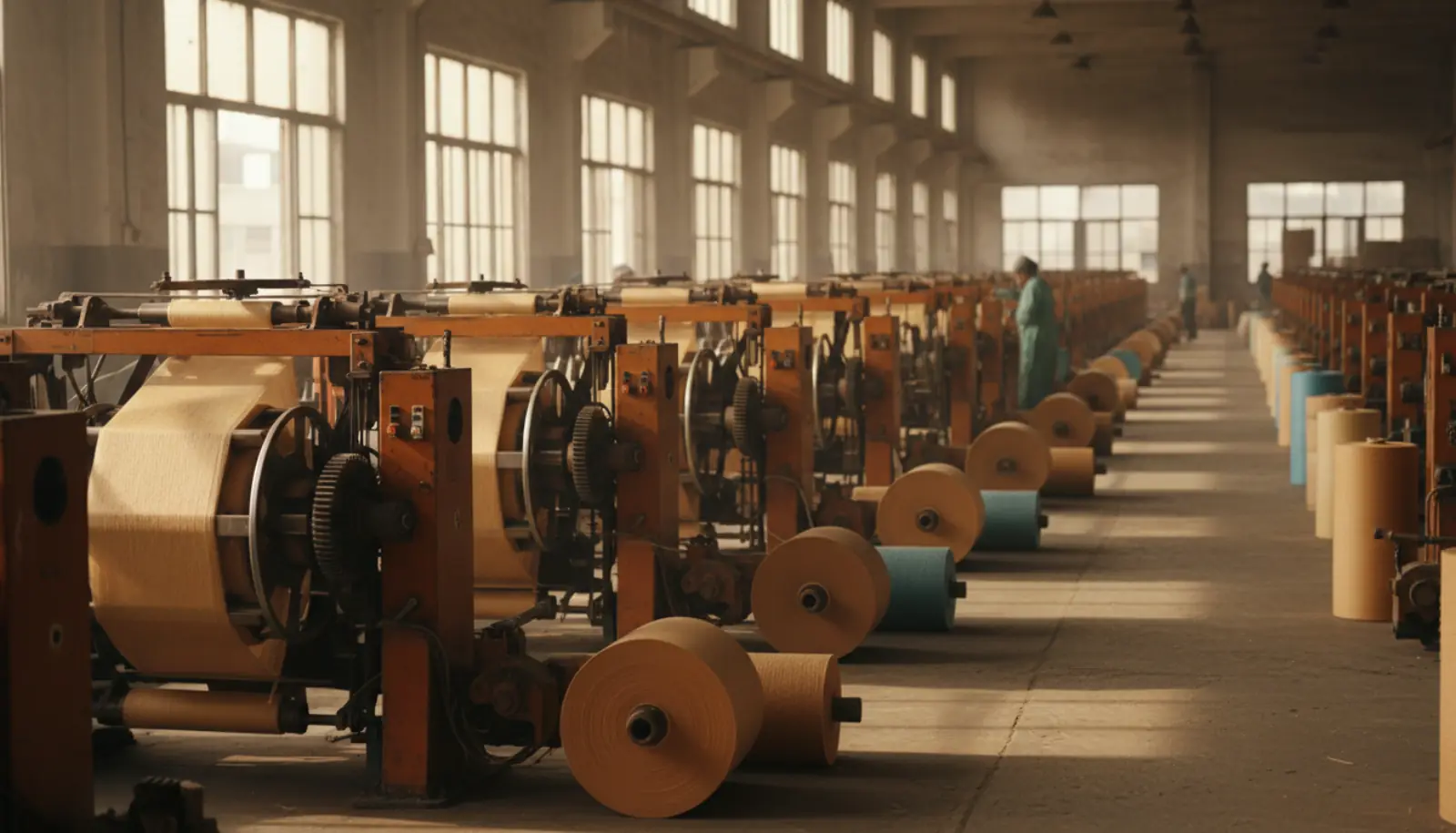
Raffia grades are homopolymer with low MFI, typically in the low single digits. The process extrudes a film, slits it, and then stretches the tapes several times their length to orient the molecules and give tensile strength. These tapes are then woven into fabric for sacks, bulk bags and tarpaulin-type products.
What matters here:
- Low MFI and narrow distribution for good draw ratio and tape strength.
- Low gel content and clean melt, because gels and foreign particles cause tape breaks on the draw line, which is the main cost driver for a raffia plant.
- Consistent lot-to-lot MFI, since line settings are tuned to a narrow window. Big swings between lots cost machine time.
- UV stabilisation if the sacks or fabric will sit outdoors. Many sack applications specify masterbatch for this, and raffia lines normally add filler masterbatch (such as calcium carbonate) to lower cost, which can be sensitive to resin quality.
Raffia is the application where cheap, off-spec resin most often shows its true cost. Tape breaks, uneven denier and weak seams all trace back to inconsistent MFI or contamination. Impact copolymer is not normally used for tape because it is harder to orient.
Injection moulding
Injection grades span the widest range. As a rule:
- Medium MFI homopolymer suits general-purpose rigid parts such as housewares, caps and closures.
- High MFI homopolymer or random copolymer suits thin-wall packaging, where the melt must travel a long way through a thin cavity before it freezes, and where cycle time is critical.
- Impact copolymer suits parts needing toughness, such as crates, bumpers and housings, and the MFI chosen depends on part size and flow length.
- Random copolymer with clarifier suits clear containers and lids.
Warpage and shrinkage depend on crystallinity and cooling. Nucleating agents shorten cycle times and improve stiffness and clarity, but they change shrinkage, so do not switch to a nucleated grade on an existing tool without a trial.
Fibre, filament and nonwovens
Fibre applications use homopolymer, normally with a narrow molecular weight distribution. Spunbond nonwovens for hygiene products, geotextiles and packaging use medium to high MFI grades. Melt-blown nonwovens use very high MFI grades so that the melt can be drawn into extremely fine fibres. Continuous filament and staple fibre for carpet, ropes and strapping have their own windows.
The key requirements are a narrow distribution, very clean melt (spinneret holes block easily), and stable MFI. Many fibre producers use visbroken grades, because the controlled rheology improves spinnability. Buyers in this segment should insist on lot certificates with the MFI measured, not only on the nominal grade name.
Film: BOPP, cast and blown
- BOPP (biaxially oriented PP) film uses homopolymer with low MFI, often in the low single digits, and for the skin layers, random copolymer or terpolymer for heat-sealing. Gel content and cleanliness are critical because the film is stretched thin and defects show up.
- Cast PP film (CPP) often uses random copolymer for clarity and sealability, or homopolymer for stiffer film. MFI is typically a little higher than for BOPP, since cast lines run at high output.
- Blown PP film is less common than polyethylene, and uses grades with sufficient melt strength.
For all film grades, ask about gel level, slip and anti-block package and food-contact status if relevant to your market.
Thermoforming and sheet extrusion
Thermoforming starts with extruded sheet, which is heated and formed over a tool. Sheet grades are homopolymer or copolymer with low to medium MFI and adequate melt strength so that the heated sheet does not sag excessively. For cups, trays and tubs, the choice between homopolymer and random copolymer depends on the stiffness-versus-clarity trade-off. For freezer-grade tubs, impact copolymer or modified random copolymer is used. Some sheet grades use special high-melt-strength resin to widen the processing window; if you have problems with sag, discuss that class of grade with the producer or your supplier.
Pipe and profile
Random copolymer pipe grades for hot and cold water systems are specified against pipe standards and require qualified resin. Do not buy these on general-purpose terms. If your product is pressure-rated, the resin must be the one qualified for that purpose, with the paperwork to show it.
Additives that change the outcome
Polypropylene is highly dependent on additive packages. The same base polymer can behave very differently depending on what is mixed in.
- Antioxidants and process stabilisers. PP is more susceptible to oxidative degradation than polyethylene. The stabiliser package protects the polymer in the extruder and during long-term service.
- Nucleating and clarifying agents. Nucleators speed crystallisation and improve stiffness and cycle time. Clarifiers reduce haze in random copolymers. Both change shrinkage.
- UV stabilisers (HALS and others). Needed for outdoor use. PP degrades quickly in sunlight without them.
- Acid scavengers. Neutralise catalyst residues; a standard part of most packages.
- Anti-static and slip agents. Used in film and fibre to control handling and static charge.
- Flame retardants, fillers and reinforcements. Talc, calcium carbonate, glass fibre and mineral fillers extend PP into engineering applications; these are usually supplied as compounds rather than virgin resin.
- Peroxide (for controlled rheology). Added during production to raise MFI in a controlled way.
- Pigments and masterbatch. Colour is usually added by the converter; resin colour and yellowness index can matter for white and natural applications.
Compounded and filled grades are a separate category and should be specified on filler content and the properties the compounder certifies. A virgin homopolymer is not a substitute for a talc-filled compound, and the reverse also applies.
Reading a PP datasheet
A usable PP datasheet gives you:
- Grade type (homopolymer, random copolymer, impact copolymer).
- MFI with conditions (230°C, 2.16 kg is standard for PP).
- Density, typically a little above 0.9 g/cm³.
- Mechanical properties such as flexural modulus, tensile strength at yield and notched impact strength, each with test method and temperature.
- Thermal properties such as heat deflection temperature and melting point.
- Additive notes on stabiliser, nucleation, antistatic and any food-contact statements.
- Recommended applications from the producer.
Be wary of datasheets with only a grade name and an MFI. Also bear in mind that the figures are typical values, not guarantees; the certificate of analysis for the shipped lot is the document that states what the batch actually measured.
How to specify polypropylene in an enquiry
State the following, in this order:
- Process and product: raffia tape for woven sacks, thin-wall injection, spunbond, BOPP, thermoforming sheet, and so on.
- Polymer type: homopolymer, random copolymer or impact copolymer.
- MFI target and tolerance, with test conditions.
- Critical properties: low-temperature impact, clarity, stiffness, fibre spinnability.
- Additive requirements: UV, antistatic, clarified, nucleated, food contact.
- Quality tier: prime only, or other grade for defined end uses. Our guide to prime and off-grade polymers explains the distinctions.
- Packing, volume and destination.
- Documents and inspection: certificate of analysis, safety data sheet, and whether you require independent pre-shipment inspection.
Chemineral exports from Sohar and Salalah, offers SGS or Intertek pre-shipment inspection, and quotes the Suez and Cape routes side by side. Details of what we supply are on the polypropylene product page.
Mistakes buyers make with polypropylene
- Buying on MFI alone. A raffia grade and a fibre grade can have the same nominal MFI and not be interchangeable. Distribution, additive package and cleanliness differ.
- Using homopolymer where cold-chain impact is needed. If the product travels or stores in freezing conditions, impact copolymer is the safer choice.
- Forgetting UV stabilisation. PP outdoors without UV protection loses properties fast. Specify it in the order, not afterwards.
- Swapping grades mid-run. Even a nominally equivalent grade from another producer changes shrinkage, cycle time or draw behaviour. Trial first.
- Accepting unverified MFI. Without a measured value on the certificate or an arrival test, you are relying on a nominal figure. Our guide to quality checks for imported polymer resin shows how to verify.
- Mixing up recycled or wide-spec material with prime. The price gap is explained by something. Ask what.
Frequently asked questions
What is the difference between PP-H, PP-B and PP-R?
PP-H is homopolymer, stiff and strong. PP-B is block or impact copolymer, with a rubbery phase for low-temperature toughness. PP-R is random copolymer, more flexible and more transparent. The letters are shorthand used in trade and in pipe standards; confirm the meaning on the datasheet, because the letters are not always applied consistently outside pipe applications.
Which PP grade is used for woven sacks?
Woven sacks and bulk bags use raffia-grade homopolymer with low MFI. The grade must draw well into tape without breaks, so consistency and cleanliness matter as much as the headline MFI. Specify UV stabilisation if the product will be stored or used outdoors.
Can I use a high-MFI polypropylene for raffia to improve output?
Generally not. Higher MFI reduces tape strength and draw performance. If you want faster output, discuss options with your machine supplier and resin supplier, rather than moving to a grade intended for injection moulding.
Does a clear PP grade need to be random copolymer?
Usually, yes, especially with a clarifying agent. Homopolymer can be made clearer with nucleators, and thin films may look clear, but for thick-walled transparent containers random copolymer with clarifier is the normal route.
Is impact copolymer suitable for food contact?
It can be, depending on the grade and its additive package, but compliance is grade-specific and market-specific. Ask for the food-contact documentation for the exact grade and check it against the regulations in your destination market.
What should I test when a PP shipment arrives?
At minimum, MFI at 230°C and the stated load, and density; for fibre and film also gel level and cleanliness. Sample from several bags across the lot and check bag markings against the certificate. The full list is in our guide to resin quality checks.
Next step
If you are buying polypropylene for raffia, injection, fibre, film or thermoforming, send your grade type, MFI window with test conditions, additive needs and destination to the Chemineral trade desk via our contact page. We will respond with a firm offer valid for 72 hours, with Suez and Cape routing quoted side by side from Sohar or Salalah.
Our trade desk can turn the views in this report into firm offers on today's indicative prices — valid 72 hours, with complete documentation.
Request a quote