Polymer-Modified Bitumen (PMB): Why It Is Used, How to Test and Specify It
What PMB is, when it beats straight-run bitumen, how SBS compares with other modifiers, and what to write in a specification: elastic recovery, storage stability, heating limits and tests.

Polymer-modified bitumen (PMB) is straight-run bitumen blended with a polymer, most often SBS, so that the binder resists rutting in heat and cracking under repeated loading or in cold weather better than any plain penetration or viscosity grade can. The grade number alone will not tell you whether you are getting that performance. A PMB has to be specified by elastic recovery, softening point and storage stability as well as penetration, and it has to be stored and heated differently from plain bitumen.
This guide explains what PMB is, why road designers specify it, how SBS differs from other modifiers, how PMB compares with the grades in our bitumen grades guide, and which tests and specification clauses protect a buyer. It is general guidance. Your project specification, road authority and mix designer take precedence over anything written here.
What PMB is
Bitumen is viscoelastic. At high pavement temperatures it flows like a thick liquid, which is how wheel ruts form. At low temperatures it turns stiff and brittle, which is how cracks form. Make plain bitumen stiff enough to resist rutting in summer and it cracks sooner in winter; make it soft enough to resist cracking and it deforms in heat.
PMB addresses this by adding a polymer to a base bitumen. The polymer is blended in at elevated temperature with high-shear mixing, and it swells by absorbing the lighter oily fractions of the bitumen. Once there is enough polymer, it forms a continuous network through the binder. That network gives the blend elasticity: when a load is removed, the binder springs back instead of staying deformed.
SBS (styrene-butadiene-styrene) shows how this works. It is a thermoplastic elastomer. The styrene end blocks cluster together and act as physical cross-links, and the butadiene middle section gives rubber-like stretch. When the blend is heated, the cross-links release and the binder can be pumped and mixed. As it cools, the cross-links re-form. The polymer dose is usually a small percentage of the blend by weight, depending on the polymer, base and target grade.
Modification takes place at a blending plant, terminal or refinery, or occasionally in a mobile unit near the job. Blend quality depends on the compatibility of the polymer and base, the shear applied, and the temperature and time of mixing. This is why two PMBs with the same name can behave differently.
Why buyers specify PMB
A road authority or contractor usually specifies PMB to prevent one of a short list of failures:
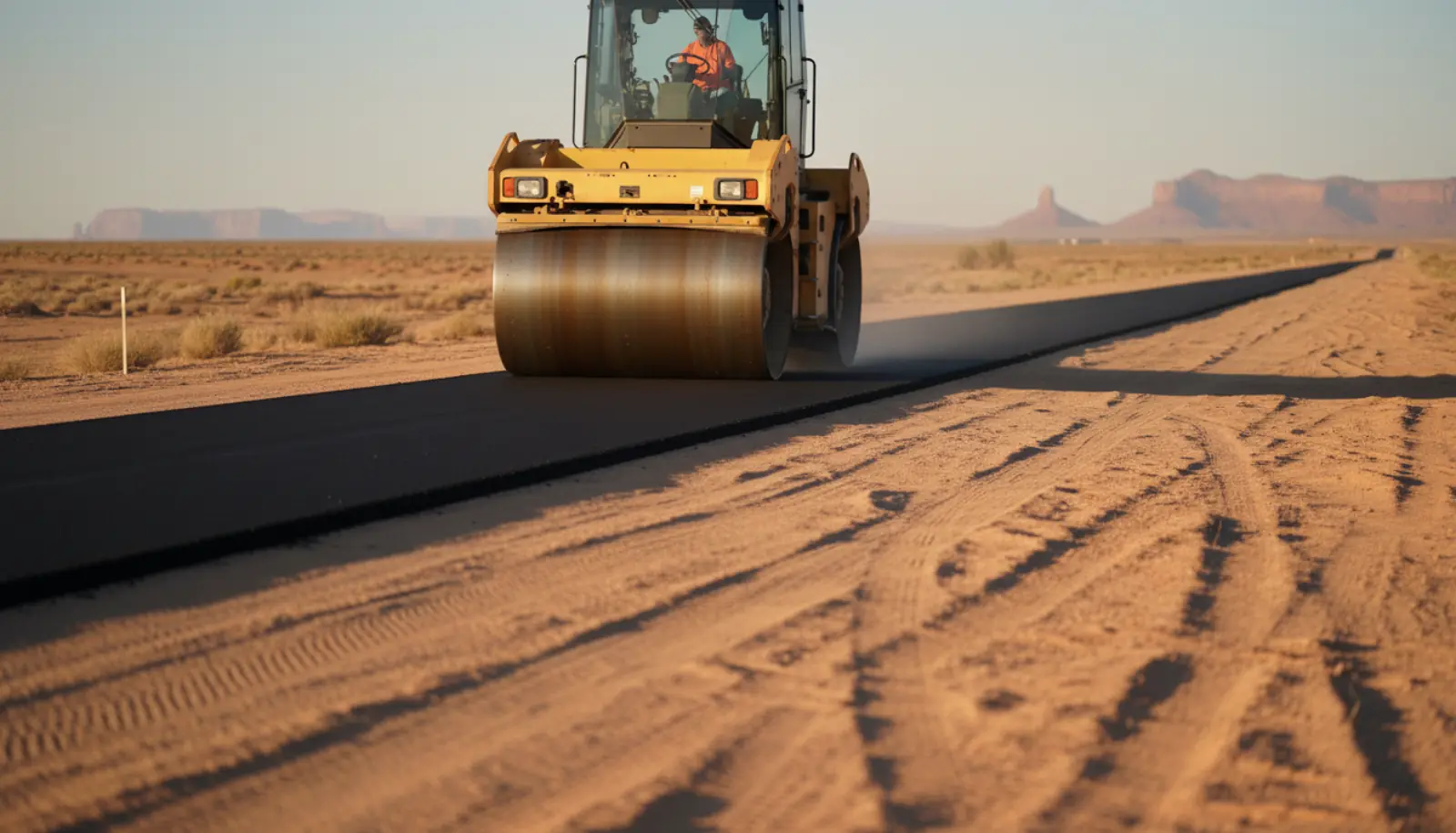
- Rutting. Channels worn into the wheel paths, worst in hot weather and where traffic is slow, heavy or channelised: junctions, bus stops, climbing lanes, toll plazas and container terminals. A binder with higher stiffness and elastic response at high temperature resists this.
- Fatigue cracking. Repeated loading flexes the asphalt layer until it cracks. An elastic binder recovers between load cycles and tolerates more flexing before it fails.
- Low-temperature and thermal cracking. Cold climates and large day-night swings contract the pavement. Modified binders can stay more flexible at low temperature than a plain binder with the same high-temperature stiffness.
- Reflective cracking. Cracks in an old pavement work up through a new overlay; a more elastic binder slows that.
- Durability and adhesion. Open-graded and stone mastic mixtures use thick binder films and need a binder that holds together.
The buyer's rule: specify PMB to prevent a named failure, not to upgrade a number. In hot regions with heavy traffic, such as many corridors across South Asia and the GCC, rutting is usually the driver. In temperate and cold regions, such as parts of Europe, low-temperature cracking and fatigue weigh more.
PMB costs more per tonne than straight-run bitumen. The case for it is whole-life cost: fewer repairs, longer intervals between resurfacing, or thinner layers for the same performance. It will not rescue a weak base, poor drainage, bad compaction or an unsuitable mix, and where traffic is light and the climate mild, straight-run is usually the right and cheaper answer.
SBS and other modifiers
SBS is the most widely used polymer for road binders because it adds elasticity and widens the working temperature range. It is not the only option.
| Modifier | What it is | Main effect | What to watch |
|---|---|---|---|
| SBS | Thermoplastic elastomer | Elastic recovery, better rutting and fatigue resistance, wider temperature range | Needs a compatible base and good mixing; may separate in hot storage if poorly formulated |
| SBR latex | Elastomer, usually supplied as a water-based latex | Flexibility, adhesion and elasticity; common in emulsions and surface treatments | Water content and handling differ from hot-blended polymers |
| EVA, polyethylene | Plastomers (thermoplastics) | Higher stiffness and softening point, help against rutting | Less elastic recovery than SBS; some blends separate in storage |
| Crumb rubber | Ground tyre rubber | Higher viscosity, used in rubberised binders | Needs agitation, reaction time and specialist handling; usually specified separately |
| Reactive polymers | Polymers that chemically react with bitumen | Can improve stability and performance | Specialist products; follow the supplier's instructions closely |
| Polyphosphoric acid (PPA) | A chemical modifier, not a polymer | Stiffens the binder at high temperature | Usually used alongside a polymer, not instead of one |
Elastomers such as SBS suit cases where elastic recovery matters; plastomers such as EVA or polyethylene suit cases where high-temperature stiffness is the main need.
Decision rule. State the performance you need and the tests that prove it. Name the polymer only if your road authority requires it. "SBS-modified" on an offer does not guarantee performance, because polymer type, polymer amount and base bitumen all differ between suppliers.
How PMB differs from penetration and viscosity grades
Penetration grades such as 60/70 measure how hard the binder is at 25 °C. Viscosity grades such as VG-30 measure how thick it is at 60 °C. Both are single-temperature, empirical measures. They tell you about stiffness at one point and say nothing about how well the binder springs back after loading. Two binders can share a penetration range and still differ sharply in elasticity and in how quickly stiffness changes with temperature.
| Aspect | Straight-run penetration or viscosity grade | PMB |
|---|---|---|
| What the grade controls | Hardness or viscosity at one temperature | Hardness, softening behaviour and elastic response |
| Elastic recovery | Low | Substantially higher when elastomer-modified |
| Sensitivity to temperature | Higher | Lower |
| Mixing and compaction temperatures | Lower | Higher, because the binder is more viscous |
| Hot storage | Tolerates normal hot storage better | Can separate or degrade if held hot for long, so limits apply |
| Cost per tonne | Lower | Higher |
PMB specifications are written in several different ways, and the naming is not universal. Some national and regional specifications grade PMB by a penetration range and a minimum softening point. Others number the grades by class. Performance-grade systems describe a high and low temperature range and, in some versions, add a traffic-level designation running from standard to extreme loading. Because of this, a grade name from one country does not map neatly to another. Ask which specification the grade belongs to and check it against what your authority accepts.
The base is also a decision. Straight-run 60/70, for which see our 60/70 bitumen product page, is a common type of base. A softer base is often chosen so that the polymer-stiffened result lands in the target penetration range. If you plan to modify locally, the base bitumen must be compatible with the polymer. Not every straight-run bitumen of a given grade is, because crude source and refinery process affect how well the polymer disperses.

Heating, handling and storage
PMB is more viscous than straight-run bitumen of a similar base, so it needs higher temperatures to pump, mix and compact. The correct range comes from the supplier's data sheet and the mix design, not from general rules. Two errors cause most of the trouble:
- Overheating or holding hot for too long. Prolonged high temperature breaks down the polymer chains and ages the bitumen, so the binder loses the elastic recovery you paid for.
- Underheating. A PMB that is too cold coats aggregate poorly and compacts badly.
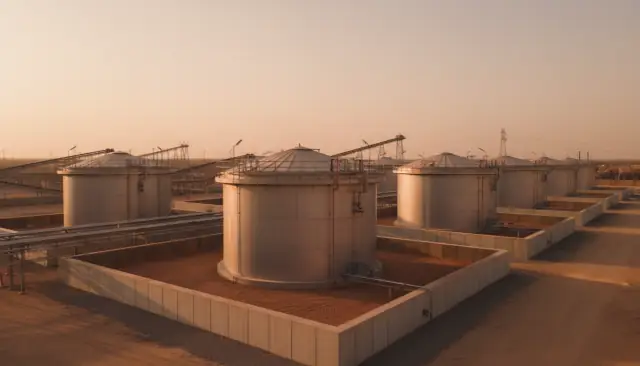
Storage stability is the property most specific to PMB. Polymer and bitumen are different materials. Left hot and still, a polymer-rich phase can rise towards the top of a tank while the bottom becomes polymer-poor. Samples from different levels then give different results, and paving from the bottom of the tank can behave quite differently from paving from the top. Formulations differ widely in how well they resist this. Some use stabilising or cross-linking agents, and a well-made blend can hold for a stated period, but none is indefinite.
Practical controls:
- Ask for the maximum storage time and temperature in writing, and the number of reheating cycles the product tolerates.
- Use circulation or agitation where the supplier recommends it.
- Keep tanks and lines clean. Residue from a different PMB, from straight-run bitumen or from a previous product can cause incompatibility.
- Do not top up an old tank with fresh PMB until you have tested what is in it, and rotate stock.
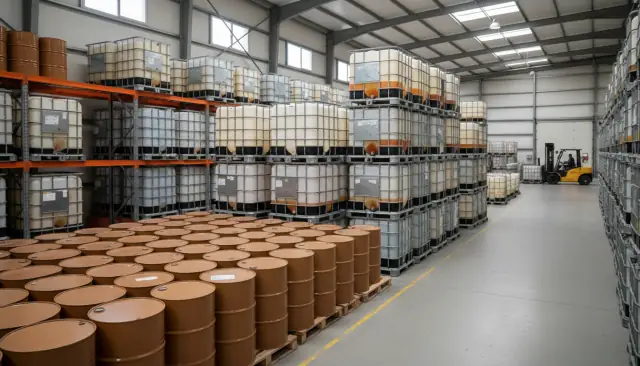
Export adds a handling dimension. Long voyages and repeated heating cycles are the stress points, and not every packaging format suits every PMB. Our bitumen packaging options guide compares drums, jumbo bags, flexitanks, ISO tanks and heated bulk vessels. Whichever you choose, get the supplier's written handling guidance for that format. Some buyers find it simpler to import a straight-run base and modify it near the project, provided the blending plant, polymer and quality control are in place.
Testing PMB
Our bitumen quality tests guide covers the routine tests on any bitumen. These are the ones that matter most for PMB, described generally. The test method, temperatures and limits come from your specification.
- Penetration. Confirms the binder is in the right hardness range at 25 °C. It remains the reference point, but it does not prove modification.
- Softening point (ring and ball). PMB normally has a higher softening point than plain bitumen of the same penetration. A high softening point alone is not proof of polymer, because a harder base or an additive that adds nothing to elasticity can also raise it.
- Elastic recovery. A sample is stretched at a set temperature to a set length, cut, and left for a set time. The test then measures how much it has returned. Elastomer-modified binders recover far more than plain bitumen. This is the simplest test that separates a genuine elastomeric PMB from a stiff straight-run bitumen.
- Storage stability (separation). A sample is held hot in a vertical tube for a set period, cooled, and cut into sections. The softening point of the top and bottom sections is compared. A small difference means the blend is stable; a large one means the polymer is separating. The specification sets the conditions and the maximum difference.
- Viscosity at a high temperature. Measured with a rotational viscometer. It shows whether the PMB can be pumped and mixed at the temperatures you plan to use.
- Flash point. A safety measure that limits handling temperatures.
- Tests on aged residue. After laboratory short-term ageing, such as the rolling thin film oven test, the specification may require retained penetration, change in softening point and elastic recovery of the aged residue. These show whether the polymer survives the heat of mixing.
- Rheology tests. Performance-grade specifications use a dynamic shear rheometer to measure stiffness and elastic response at pavement temperatures. Many also use the multiple stress creep recovery test, which measures how much the binder deforms permanently under repeated load and how much it recovers. Low-temperature flexibility is checked with tests such as the bending beam rheometer or the Fraass breaking point.
A hypothetical storage stability reading. Suppose a tube is held hot for the specified period and the top section has a softening point of 71 °C while the bottom section reads 64 °C. The difference is 7 °C. Whether that passes depends entirely on the limit in the specification, which is why the limit must be written in. The numbers here are invented to show the method and are not typical values.
Testing results for PMB are sensitive to handling. A sample reheated several times, or taken from the top of a tank that has been standing, may not represent the batch. Agree the sampling point, the container and the heating procedure in advance. Where the shipment is high-value or the specification is tight, use independent inspection at loading and retain sealed samples. Chemineral can arrange SGS or Intertek pre-shipment inspection, and our SGS certification guide explains what such certificates do and do not prove.
What to write in a specification
Vague wording produces vague product. Put these items in the RFQ and the contract:
- Grade and governing specification. The exact designation, the specification it comes from and its edition. Avoid writing only "PMB" or "polymer-modified bitumen".
- Base bitumen. Straight-run from crude oil refining, with the base grade or any restrictions on additives and blending components.
- Modifier. The polymer type if your authority requires it. Otherwise state that performance requirements govern.
- A table of properties. Each test, its method, test temperature and minimum or maximum limit, for both the original binder and the aged residue.
- Elastic recovery. The minimum value, the test temperature and the method.
- Storage stability. The maximum permitted difference, with the test conditions.
- Handling limits. Maximum storage time, recommended and maximum heating temperatures, and the maximum number of reheats.
- Packaging and delivery temperature. Format, labelling, batch numbering and the temperature at delivery where relevant.
- Sampling and acceptance. Who samples, at which point, how the sample is split and sealed, which laboratory tests it, and how results within the precision of the test method are treated.
- Certificates. A batch-specific certificate of analysis showing every specified property, plus independent inspection at loading where required.
- Shelf life. How long the product remains within specification when stored as delivered.
- Quantity, Incoterm and port. For terms, see our Incoterms 2020 guide.
A hypothetical RFQ sentence: "PMB to [named specification and designation], straight-run base, elastic recovery minimum [value] at [temperature], storage stability maximum [value] under [stated conditions], supplied in [format] with batch certificate and independent loading inspection." Fill the brackets from your own specification.
Common buyer mistakes
- Asking for "PMB" with no grade. Without a designation, the supplier chooses, and so do the margins.
- Expecting plain 60/70 to meet a PMB specification. A straight-run grade has a different structure and different tests. As our grades guide notes, modified and straight-run products are not interchangeable.
- Specifying only penetration and softening point. These two numbers can be met by products with no meaningful elasticity. Add elastic recovery and storage stability.
- Ignoring storage stability on long supply chains. A binder stable for three days may not be stable after a long voyage, a port wait and weeks in a hot tank.
- Overheating at the plant. Pushing output with higher temperatures costs polymer performance.
- Mixing products in a tank. A different PMB, or residual straight-run bitumen, can produce an incompatible blend.
- Testing the wrong sample. A sample from the top or bottom of a stationary tank misrepresents the batch.
- Comparing quotes on price alone. A lower price may reflect less polymer, a weaker base or a looser test limit. Compare against the same written specification.
- Skipping mix trials. Run a laboratory mix with your actual aggregate and the actual binder before committing to bulk volumes.
Frequently asked questions
Is PMB the same as SBS bitumen?
Not always. SBS is the most common modifier, but PMB also covers binders modified with SBR latex, EVA, polyethylene, reactive polymers and other systems. Check what your specification requires and which test limits apply.
Can I make PMB by adding polymer to 60/70 on site?
It can be done, but only with high-shear mixing equipment, controlled temperatures and a compatible base bitumen. Stirring polymer into a tank is unlikely to give a stable, uniform product. Test elastic recovery and storage stability before paving.
Is a higher softening point always better?
No. It helps resist rutting but raises mixing and compaction temperatures, and a very stiff binder may crack earlier in cold weather. Judge it together with elastic recovery and low-temperature performance.
How long can PMB be stored?
It depends on the formulation and the temperature. Some blends hold well for a stated period; others separate sooner. Get the supplier's maximum storage time and the reheating limits in writing, and test stored material before use.
How can I tell whether a batch contains a real elastomer?
Elastic recovery is the practical first test, followed by storage stability and aged-residue tests. Softening point and penetration alone are not enough.
Next step
If you need straight-run bitumen as a base, or want to discuss a modified binder specification, packaging and inspection before you commit, send your grade, quantity, packaging format and destination port through the Chemineral trade desk. We ship from Sohar and Salalah, and firm offers are valid for 72 hours.
Our trade desk can turn the views in this report into firm offers on today's indicative prices — valid 72 hours, with complete documentation.
Request a quote