
Where Industrial Sulphur Goes: Acid, Fertiliser, Rubber and What to Specify
How sulphur is used in sulphuric acid, fertilisers, rubber and chemicals, why each use cares about form, purity, ash, moisture and acidity, and how that shapes what a buyer should specify.

Most industrial sulphur is bought to be turned into something else, and the end use tells you what to specify. A sulphuric acid plant wants clean sulphur that melts and burns reliably. A fertiliser user wants a form that handles well and, for direct soil use, a particle size that suits the crop. A rubber compounder wants a specific powder grade. Naming the end use in your enquiry avoids most of the mismatches that cost buyers money.
This guide follows sulphur from the buyer's side: where it is used, what each use cares about, how form, purity, ash, moisture and acidity matter in each, and what that means for handling, storage and the specification. It makes no market-size claims. It is general guidance, not a substitute for the safety data sheet, the dangerous goods regulations or your own process engineers. For the commercial forms and a basic specification walkthrough, see the granular sulphur buyers' guide, and for the product itself see the sulphur product page.
The big picture: sulphur is an intermediate
Answer first: sulphur is rarely consumed as sulphur. It is a raw material that is converted, usually into sulphuric acid, and then used in other products.
The main routes, in general terms:
- Sulphuric acid manufacture. By far the most important route. The acid goes into phosphate fertiliser production, metals processing, chemicals and many other industries.
- Sulphur-containing fertilisers. Elemental sulphur applied or blended directly, or sulphur converted into sulphate-bearing fertilisers.
- Rubber vulcanisation. Sulphur cross-links rubber polymers to give them strength and elasticity.
- Pharmaceuticals, agrochemicals and other chemicals. Smaller volumes, usually with tighter purity needs.
A supplier asks about your end use because it determines the right form and specification.
Sulphuric acid manufacture
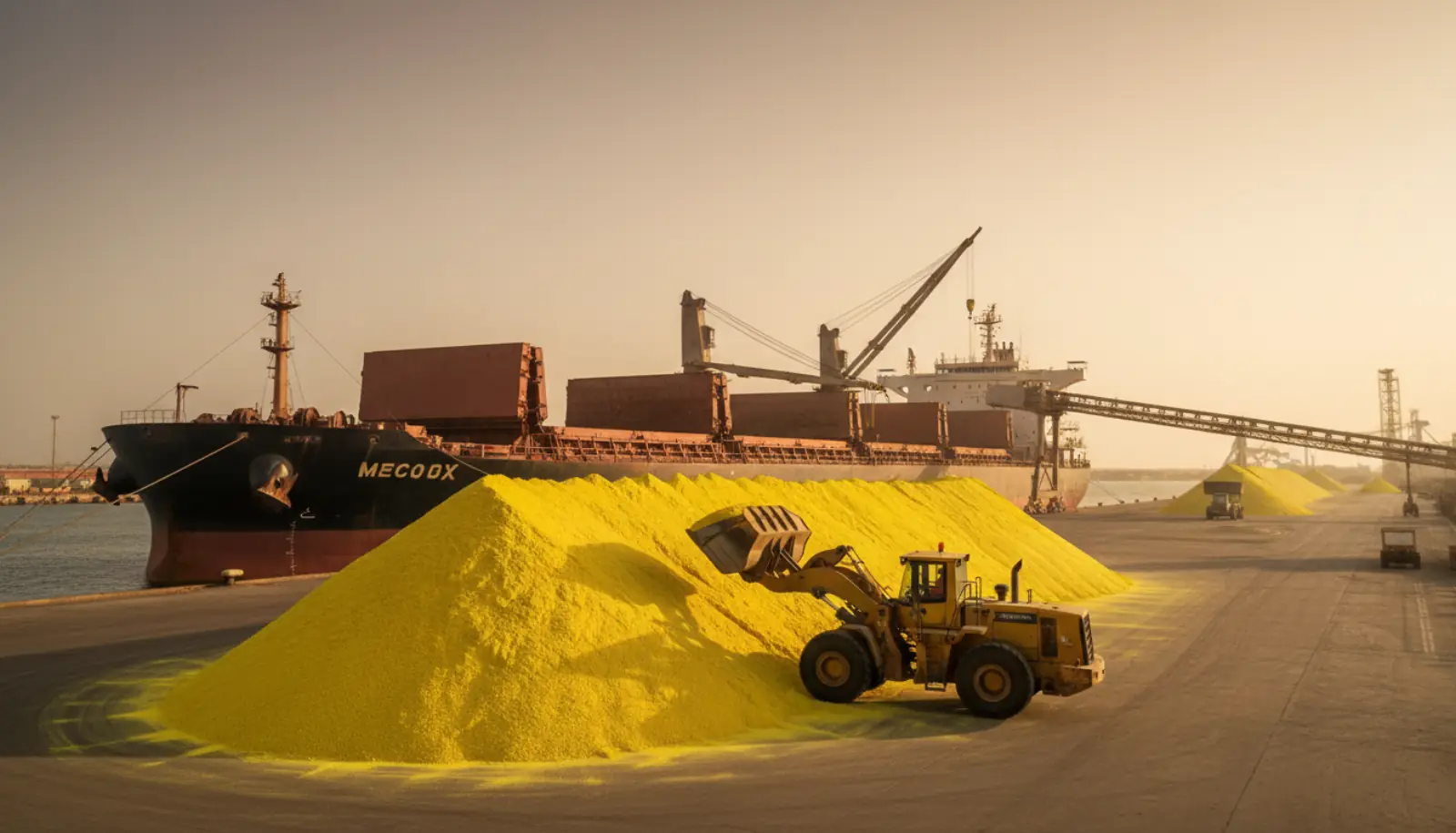
Answer first: sulphuric acid plants burn molten sulphur, so they need sulphur that can be melted, filtered and fed consistently, with low contaminants that foul the plant.
How the process uses sulphur
In the common contact process, sulphur is melted, filtered and burned in air to make sulphur dioxide. The gas is converted to sulphur trioxide over a catalyst and absorbed into acid to make sulphuric acid. Everything that arrives with the sulphur matters to the plant, because it either burns, settles or passes through to the catalyst.
What the acid plant cares about
- Ash and insolubles. Non-combustible solids do not burn. They settle in the melting pit, clog filters, build up in the furnace and eventually need cleaning out. Higher ash means more filtration, more sludge to dispose of and more downtime.
- Moisture. Water entering the melter flashes to steam and can cause foaming and splashing in the molten sulphur. It also adds to the water load in the acid plant, and it increases corrosion risk. Wet cargo is a handling and safety issue as well as a quality one.
- Organic matter. Organic contamination can discolour the melt and cause unwanted by-products.
- Acidity. Free acidity in the sulphur raises corrosion in storage and handling equipment.
- Other trace contaminants. Certain elements can poison or foul the catalyst or contaminate the acid. The plant's engineers set which ones matter and at what limit.
Form for acid plants
Large plants usually take solid sulphur by bulk vessel and melt it on site, or take molten sulphur where it is delivered hot by road, rail or specialised vessel. Granular and other formed sulphur suits long-distance bulk shipment because it handles with less dust than powder and melts readily. Lump sulphur needs crushing and handling and gives more fines. A plant that already has a melter, filters and unloading equipment designed for one form should not change form without engineering review.
Downstream uses of the acid
Because acid is the gateway to other industries, it is worth knowing why a customer might ask for sulphur:
- Phosphate fertiliser. Sulphuric acid reacts with phosphate rock to make phosphoric acid, the building block of many phosphate fertilisers, with gypsum as a by-product. Phosphate fertiliser producers are therefore among the largest consumers of acid, and so of the sulphur behind it.
- Metals leaching. Acid is used to dissolve metals from certain ores, such as in copper and some other hydrometallurgical operations, so mining regions can be sulphur buyers.
- Other chemicals and industry. Acid feeds a wide range of chemical processes.
These buyers usually care most about delivery reliability and consistent quality over time, and their contracts often cover discharge rates and demurrage. Our guide to laytime and demurrage explains how discharge delays turn into cost.
Sulphur in fertilisers
Answer first: sulphur is a plant nutrient in its own right, and soils that cannot supply enough of it limit crop yield and quality. Fertiliser users get sulphur either as elemental sulphur or as sulphate carried in other products.
Soil sulphur deficiency as a concept
Plants take up sulphur mainly as sulphate. Soils can run short of plant-available sulphate where organic matter is low, where rainfall or irrigation leaches sulphate away, or where crops remove more than is replaced. Deficiency can reduce yield and affect crop quality, and it can show up where agronomists have not looked for it, because nitrogen, phosphate and potash get the attention. Whether a field needs sulphur is an agronomic question, answered by soil and plant testing.
Ways sulphur reaches the soil
- Elemental sulphur in blends or coatings. Elemental sulphur is not directly available to plants. Soil bacteria must oxidise it to sulphate first, and how fast that happens depends on particle size, temperature, moisture and soil biology. Finer particles oxidise faster because they expose more surface.
- Sulphur-enhanced products. Fertilisers made with elemental sulphur dispersed in the granule, or sulphur combined with other nutrients, so the nutrient is delivered with the main product. The sulphur must be in a form that disperses on contact with moisture to be useful.
- Sulphate fertilisers. Products such as ammonium sulphate or single superphosphate contain sulphur as sulphate and supply it directly. They are made using sulphur-derived acid in the process.
- Bulk-blended fertilisers. Blenders add a sulphur-bearing component to the mix. Our guide to urea in NPK blending covers blending principles that apply to any component: compatible size, hardness and moisture behaviour.
What the fertiliser user cares about
- Particle size. Matters for oxidation rate in direct soil use, and for segregation in blends.
- Form. Free-flowing granular or prilled material blends and spreads more cleanly than powder or lump. Powder makes dust and is harder to apply.
- Moisture. Wet sulphur cakes, clogs equipment and, in a blend, can pass moisture to other components.
- Purity. Contaminants such as heavy metals are subject to fertiliser regulation in many countries, so check your local rules and ask for the relevant analysis.
- Acidity and dust. Free acid corrodes equipment, and fine dust is a handling and fire hazard (see the safety section below).
Our bagged versus bulk fertiliser shipping guide discusses how cargo size, packing and discharge facilities fit the decision.
Rubber vulcanisation
Answer first: rubber compounders add sulphur to cross-link the polymer chains, turning a soft, sticky material into a strong, elastic one. They buy a defined powder grade, and the details of that grade matter.
What the compounder uses
Sulphur is mixed into rubber compounds together with accelerators and other ingredients, then heated so the cross-links form. The process is called vulcanisation. Compounders typically buy finely ground sulphur, and in some cases a specially prepared grade for particular needs.
One such need is blooming. Ordinary sulphur can migrate to the surface of an unvulcanised rubber compound and form a powdery film, which interferes with building the product, especially where layers must stick together. Compounders therefore sometimes use a special form of sulphur, often called insoluble sulphur, that resists migration. It is a separate grade and costs more, so do not assume ordinary ground sulphur will substitute for it.
What the rubber user cares about
- Fineness and dispersibility. The powder must disperse evenly in the compound. Coarse particles leave local variations in cross-linking.
- Purity and acidity. Free acid and some contaminants can affect cure behaviour or damage the product. Rubber users generally set tight limits on acidity and on ash.
- Moisture. Moisture upsets dosing and mixing and can cause lumping.
- Grade and consistency. The manufacturer's compound is designed around a specific grade, so lot-to-lot consistency matters more than a nominal specification figure.
- Packing. Rubber sulphur is usually bagged for dust control and moisture protection. Fine sulphur dust has the highest ignition risk of any form. Follow the safety data sheet and our sulphur dust fire safety guide.
If you are a trader supplying a rubber compounder, get the grade name, particle size method and limit, acidity and ash limits, packing and the compounder's approval requirements in writing before you quote.
Pharmaceuticals, agrochemicals and other chemicals
Answer first: smaller-volume uses tend to have tighter purity needs and more paperwork, and they are the uses where a "typical" specification is least likely to be enough.
Sulphur is a starting material for a range of chemicals, including sulphur-containing intermediates, some agrochemical products such as fungicidal sulphur formulations, and carbon disulphide. It also goes into some pharmaceutical and cosmetic products as an ingredient or raw material.
What these buyers typically ask for:
- Higher purity and tighter impurity limits than commodity grades.
- A defined particle size or form, often powder or flakes, depending on the process.
- Documentation: certificate of analysis per lot, safety data sheet, traceability and sometimes regulatory declarations or quality system evidence.
- Packing that protects purity, and sampling and testing agreed in advance, often with a retained sample.
For any use in pharmaceuticals or other regulated products, the buyer's quality and regulatory team decides what grade and documentation are acceptable. A commodity cargo of industrial sulphur is not automatically suitable, and a supplier should not claim otherwise unless it can supply the documents.
Form, purity, ash, moisture and acidity: how to think about them
Answer first: each specification line exists because a particular process fails or a particular cost rises when the value is wrong. Specify the lines that matter to your use, not every line you can think of.
Form
| Form | General character | Typical fit |
|---|---|---|
| Granular (formed) | Hard, free-flowing, lower dust | Bulk shipment, acid plant feed, fertiliser manufacture |
| Lump | Coarse, irregular, more fines when broken | Stockpile supply to plants equipped to crush and melt |
| Prilled or pastille | Uniform, free-flowing | Fertiliser blending and uses needing uniform size |
| Flake | Melts quickly, friable, more dust | Some chemical processes |
| Powder (ground) | High surface area, dispersible, highest dust risk | Rubber, agrochemicals, chemical and pharmaceutical use |
| Molten | Delivered hot in heated tanks | Large plants set up to receive it |
Choose the form the receiving equipment is built for.
Purity
Purity is the sulphur content. For acid, purity affects residue and plant cleaning. For chemical and pharmaceutical use it matters more directly because impurities pass into the product. Ask what the purity figure means, which method produced it and what the other components are.
Ash
Ash is the residue left after the sulphur is burned off, a measure of non-combustible matter. It matters most to acid plants, where it settles and fouls equipment, and to rubber users, where it can affect cure and finish. State the limit and the test method.
Moisture
Moisture matters everywhere. It causes caking, handling problems, corrosion and, in melting, foaming. Specify the maximum and where it is measured. Moisture can rise in transit and storage, particularly with wet weather, condensation or poor hatch protection, so say whether the limit applies at loading, on arrival or both.
Acidity
Acidity is usually reported as free acid, expressed as sulphuric acid, and it comes from residual or formed acid on the sulphur. It drives corrosion in storage and handling equipment and can matter in rubber and chemical uses. Agree the unit and the method.
Bulk handling and storage considerations
Answer first: sulphur is a flammable solid, and its dust can form explosive mixtures with air, so handling is a safety question as much as a quality one. Follow the safety data sheet, dangerous goods rules and site procedures.
Points a buyer should plan for, in general terms:
- Classification and documentation. Whether and how a given form of sulphur is regulated for sea carriage depends on the form and on the applicable code, so check with your carrier and the safety data sheet. Our dangerous goods shipping guide explains the documentation approach.
- Dust control. Choose forms and handling methods that limit dust. Fines build up on surfaces and in ducts and need housekeeping. Details are in the sulphur dust fire safety guide.
- Ignition sources. Control sparks, hot work, static and hot surfaces near sulphur handling. Use equipment suitable for the area, as your safety engineers specify.
- Moisture and corrosion. Wet sulphur can form acidic conditions, and the combination attacks steel and concrete. Keep cargo covered and dry, and manage drainage.
- Storage. Use clean, dedicated areas away from incompatible materials and ignition sources. Keep stockpiles from picking up contamination from the ground.
- Molten sulphur. Delivered and stored hot in heated tanks. It brings burn hazards and gas hazards, including the possible presence of hydrogen sulphide, so follow the supplier's safety information and your site's confined space and gas rules.
- Discharge. Grabs, conveyors and hoppers should suit the form, with dust suppression planned. For bulk cargoes, plan quantity measurement in advance; see our draft survey guide.
- Fire. Burning sulphur produces toxic sulphur dioxide. Emergency response should follow the safety data sheet and your emergency plan, and be trained and rehearsed.
What to specify when buying
Start from the end use and work back to the specification:
- End use and process. Acid plant, fertiliser manufacture, direct soil use, rubber, chemicals or other.
- Form. Granular, lump, prilled, flake, powder or molten, and size range where relevant.
- Purity. Minimum sulphur content and method.
- Ash. Maximum and method.
- Moisture. Maximum, method and point of measurement.
- Acidity. Maximum, unit and method.
- Organic matter and other contaminants. As your process requires, by agreement.
- Particle size. Where it matters, such as fertiliser, rubber and chemical uses.
- Packing. Bulk, bags or jumbo bags, with liners and marking where relevant.
- Quantity and shipment size, tolerance and delivery window.
- Documents. Certificate of analysis, safety data sheet, and dangerous goods documents where applicable.
- Inspection and sampling. Whether independent inspection is required, which tests, and how retained samples are kept. Chemineral can arrange SGS or Intertek pre-shipment inspection.
- Discharge facilities. Berth, grab or conveyor capability, and storage.
- Terms and route. Chemineral exports from Sohar and Salalah and quotes Suez and Cape routing side by side.
A hypothetical example, for illustration only: a buyer enquires for "sulphur" for a site that makes both fertiliser and chemicals. If the fertiliser line takes granular material by grab and the chemical line needs fine powder, one cargo will not serve both, and splitting the requirement beats a compromise that suits neither.
Common buyer mistakes
- Not stating the end use, so the form and specification are guessed.
- Specifying only purity. Ash, moisture and acidity often cause more trouble.
- Mixing up grades. Substituting ordinary ground sulphur where a special rubber grade is needed.
- Ignoring receiving equipment. The form must suit the melter, hoppers or blenders.
- Underestimating dust and fire controls, especially for powder and flakes.
- Leaving moisture undefined. No limit, no point of measurement.
Frequently asked questions
Which form of sulphur is best for a sulphuric acid plant?
It depends on the plant's equipment. Granular and other formed sulphur is common for bulk shipment because it handles with less dust than powder and melts readily. Plants set up for molten delivery or for lump have different needs, so state your receiving arrangements in the enquiry.
Why does ash matter so much to an acid plant?
Ash is the non-combustible residue. It does not burn, so it settles in the melter, blocks filters and builds up in the furnace, which means more cleaning and more downtime. Specify a maximum ash and the test method.
Can plants use elemental sulphur directly as a fertiliser?
Elemental sulphur is not directly available to plants, because soil bacteria must first oxidise it to sulphate. Rate depends on particle size, temperature, moisture and soil biology. Ask an agronomist whether it suits your crop and conditions.
Is rubber-grade sulphur the same as ordinary powdered sulphur?
Not necessarily. Rubber compounders buy a defined fine grade, and some applications call for a special form that resists migrating to the surface of the compound. Get the compounder's grade requirements in writing before quoting.
What should I do about moisture in a sulphur cargo?
Set a maximum in the specification, say where it is measured, and keep the cargo covered and dry in transit and storage. Moisture causes caking, corrosion and foaming when melting, and can change during transport.
Next step
If you buy sulphur for acid, fertiliser, rubber or chemicals, send the trade desk your end use, form, specification limits, packing and quantity through the contact page. We quote Suez and Cape routing side by side for shipments from Sohar and Salalah, and firm offers are valid for 72 hours.
Our trade desk can turn the views in this report into firm offers on today's indicative prices — valid 72 hours, with complete documentation.
Request a quote